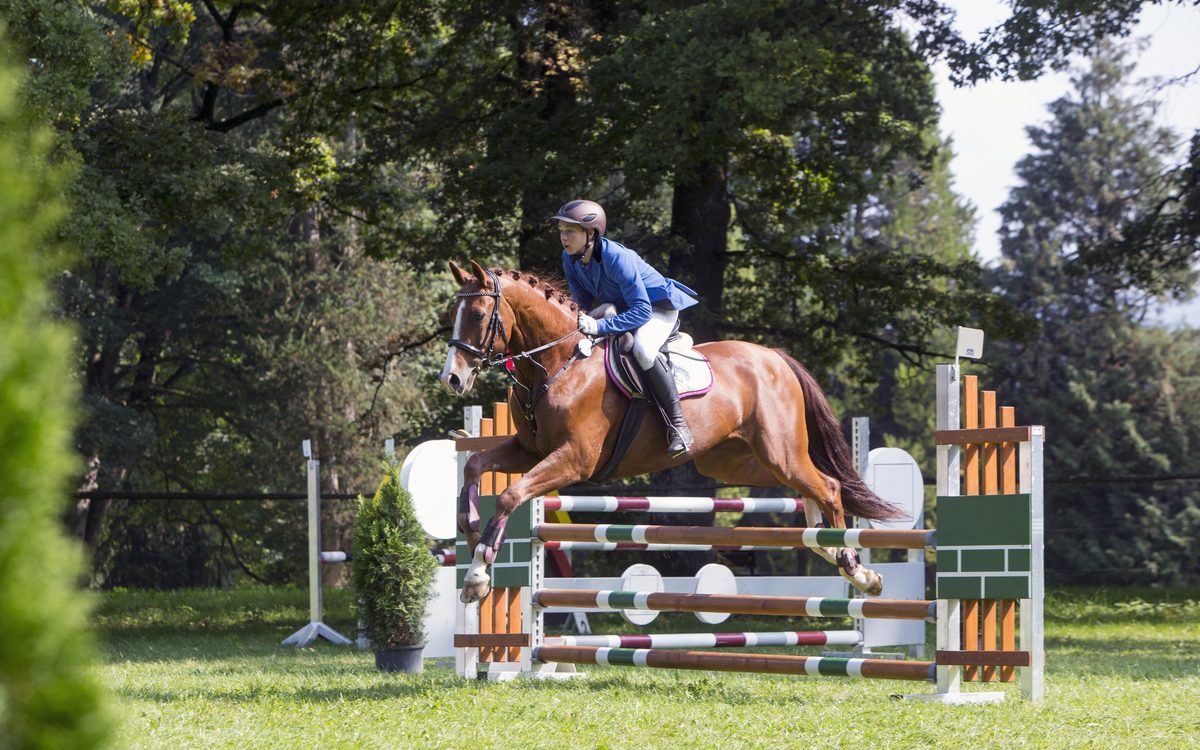
The jump-off bell goes, and a rider who has been fine all day suddenly feels her thighs burn on the turn to the last line. A show jumping round is over in about a minute, but it asks a lot in that minute. Show jumping training means the work that gets a rider and horse ready for it: riding itself, strength and fitness off the horse, and a plan that balances load and rest. This page covers the physical demands, a sensible weekly shape, and what research does and does not tell us. Rules are on our rules page.
Quick answer: Show jumping is short but physically and mentally intense. Riders need leg strength, a stable trunk, balance and enough aerobic fitness to stay effective through several classes. A common weekly shape (general coaching practice, not a prescription) is a few ride days with flatwork and jumping, two strength sessions, some easy aerobic work and a full rest day. If pain keeps coming back, see a sports medicine doctor, physical therapist or athletic trainer.
What the sport asks of the rider
A 2023 review of equestrian physiology in Nutrients (Best, Williams and Pearce) lists show jumping at about 11 METs of energy cost, for a ride that lasts under 90 seconds, and notes that riders may enter several classes in a day. It also reports that show jumpers have a high need to absorb force at take-off and landing, and that strength training “should not be deprioritised” because riding strength is sport-specific and benefits both horse and rider. In a small study of six horse and rider pairs, rider heart rate rose from about 91 beats per minute to 150 at a public performance (von Lewinski and colleagues, 2013), a reminder that nerves are part of the load.
Other research is more specific. A 2026 study of 16 intermediate show jumpers found riders stabilized the trunk more on the approach to a 110 cm fence and that stirrup forces were highest in the two-point seat (Regnault and colleagues). A 2025 study of 75 young people found sport riders had the best core stability of the groups tested, with recreational riders lower and non-riders lowest (Skwierawska and colleagues). It was a small study and cannot say what training works best.
A sensible weekly shape
There is no published, tested weekly plan for show jumpers, so what follows is general coaching practice built from the physical demands above, not a program from a study. Adjust it with an instructor, and with a strength coach if you have one.
| Part of the week | What it usually covers | Why |
|---|---|---|
| Flatwork rides (1-3) | Rhythm, straightness, transitions, position without fences | Most skills carry over from the flat; fewer jumps means less wear on the horse and the rider |
| Jumping rides (1-2) | Poles, gymnastic lines, single fences, then courses | Practise lines, turns and rhythm at heights you can ride calmly |
| Strength sessions (2) | Legs, hips, trunk, upper back, shoulders and grip | Best et al. 2023: do not deprioritise strength; riders need control more than bulk |
| Aerobic work (1-2 easy) | Walking, cycling, jogging or swimming | Aerobic fitness helps with several classes in a day; the CDC advises adults to do 150 minutes of moderate activity a week |
| Rest day (at least 1) | Full rest from riding and hard training | The AAP says young athletes should have at least one to two days off a week |
The CDC’s adult guideline also recommends muscle-strengthening activity on two or more days a week, which matches the two strength sessions above. Strength moves coaches often choose for riders include squats and lunges, hip hinges, planks and side planks, rows and single-leg balance work, plus a two-point hold in the saddle. Those are examples of general strength-and-conditioning practice, not tested show-jumping protocols. Ask a qualified coach for loads and progressions that suit you.
Skills, flatwork and the horse
Jumping well starts with riding well on the flat, and training is a partnership, so the horse’s fitness, soundness and rest matter as much as yours. Many trainers build in ground poles and small gymnastic lines for rhythm and balance, practise turns and approaches without huge fences, and school a course only occasionally. Video of your rounds, a trainer’s eye and a note of what happened on each refusal or knockdown are common tools.
Asymmetry deserves attention. A 2022 study of 147 riders on a simulated horse found nearly all were uneven in how they loaded the stirrups when sitting (99.3%) or standing (98%), and 46.3% when rising to the trot (Baragli and colleagues). A small 2025 exam of 12 elite junior riders reported hip flexion contractures in every show jumper and adductors 8 to 19% stronger than abductors (Havertz and colleagues). These are small studies, not diagnoses, but they support asking an instructor or a physical therapist to look at your symmetry and hip mobility.
Periodisation basics
Periodisation means planning the year in blocks. The usual structure in strength and conditioning is a base period, a building period, a pre-competition period and a competition period, with a lighter week now and then and a break after the main season. For show jumpers this often means more fitness and strength in the off-season, then more riding specific work and fewer gym sessions as the show calendar fills. It is general practice, not a study result. Two source-backed points: the AAP clinical report on young athletes advises one to two days off a week and about three months a year away from a single sport, and a 2024 survey of 347 Portuguese riders found lower back pain more likely with higher weekly riding workloads and daily stable chores (Duarte and colleagues). Count barn work as load.
Show days, travel and the mental side
A show day can mean walking courses on foot, several classes and a lot of waiting. Many riders pack water and food and plan their warm-up around their order of go. The mental side has its own page: show jumping mental training. For rest, soreness and sleep see recovery and mobility, for fuel see nutrition and supplements, and for how to lower injury risk see injury prevention.
Show jumping training FAQs
How fit do you need to be for show jumping?
No standard fitness test exists for amateur riders. The Nutrients 2023 review rates show jumping at about 11 METs for a short ride and says strength training should not be neglected. A rider fit enough to ride several classes in a day without losing position or focus is a reasonable practical goal.
What muscles do show jumpers use?
Legs and hips to hold the jumping position, trunk muscles to stay stable, and the shoulders, arms and grip for soft contact. A 2025 study found sport riders had better core stability than non-riders.
Should show jumpers lift weights?
Many do, and the Nutrients 2023 review says strength training benefits both horse and rider. Start with a coach who can teach safe technique, especially if you are a teenager or new to lifting.
How often should I ride each week?
It depends on your goals, horse and time. A mix of flatwork and jumping rides with at least one rest day is common, and the AAP advises young athletes to take one to two days off a week. Ask your instructor.
Can I train for show jumping without a horse?
You can build the fitness, balance and core strength that riding uses, but you still learn jumping by riding. A school horse and a qualified instructor are the starting point.
Sources
- Best, Williams and Pearce, The Physiological Requirements of and Nutritional Recommendations for Equestrian Riders, Nutrients 2023 (full text)
- von Lewinski et al., cortisol, heart rate and HRV in horse and rider, Vet J 2013
- Regnault et al., how obstacle approach shapes rider biomechanics, J Biomech 2026
- Skwierawska et al., core stability in equestrian riders, Folia Med Cracov 2025
- Baragli et al., stirrup force asymmetry in riders, Animals 2022, Havertz et al., young elite equestrian athletes, BMC Sports Sci Med Rehabil 2025
- Duarte et al., lower back pain in Portuguese riders, Sports 2024, AAP, Sports Specialization and Intensive Training in Young Athletes, Pediatrics 2016
- CDC: physical activity guidelines for adults
General information for education only, not medical advice. It does not replace a visit with a doctor, physical therapist or athletic trainer. See how we write and check our pages in our editorial policy.