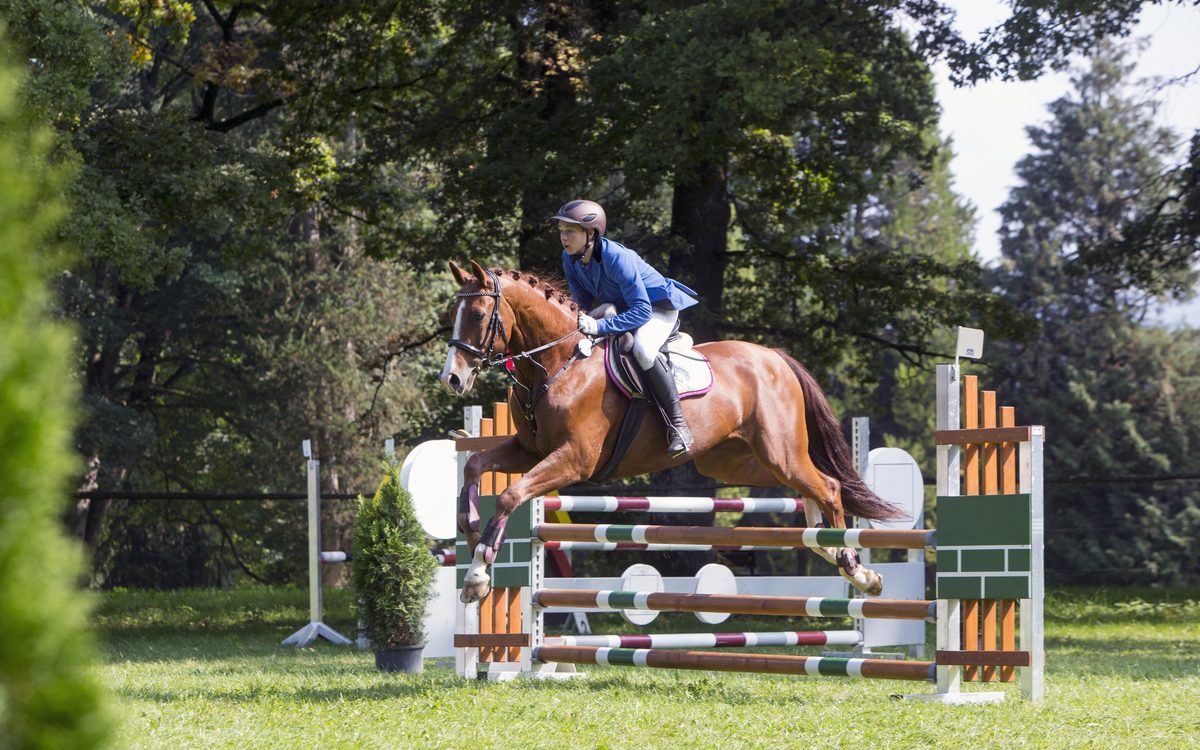
The gate steward calls your number. Two riders ahead of you each had a rail down at the water, and you can feel your hands go cold on the reins. Then the bell rings, you pick up the canter, and for the next sixty seconds nothing exists except the first fence. Show jumping mental training is the set of skills riders use to manage nerves, hold their focus, ride a plan and bounce back from mistakes. This page covers what sport psychology research offers, what is known about riders in particular, and where mental performance ends and mental health begins. Competition logistics are on our rules and getting started page and the hub.
Quick answer: Mental skills for riders are the same as for other athletes: realistic goals, a short pre-ride routine, imagery, controlled breathing and self-talk, and a plan for mistakes. The research in show jumpers is small and none of it guarantees results. Feeling nervous is normal; riders’ heart rate rises sharply at a public performance. If anxiety, low mood, disordered eating or burnout persist, see a qualified mental health professional, and in the US call or text 988 in a crisis.
Nerves are part of the sport
In a study of six horse and rider pairs at a public performance and an identical rehearsal, rider heart rate rose from about 91 to 150 beats per minute in public, versus 94 to 118 at the rehearsal (von Lewinski and colleagues, 2013). The rise was bigger in riders than in their horses. It was a small study and does not tell us what to do about it, but it supports a simple idea: feeling activated before a class is expected, not a sign that something is wrong. A study of 62 German riders in dressage, show jumping and eventing found riders who read their physical symptoms as helpful tended to place higher, though the link fell just short of statistical significance (Wolframm and Micklewright, 2010).
Confidence and self-talk
Confidence is usually built from evidence: jumps you have cleared at home, courses you rode well, a fit horse and a sound basics routine. Sport psychologists commonly teach short, practical self-talk (one cue per fence, such as “rhythm” or “look up”) in place of judging yourself mid-round. That is general sport-psychology practice, not a show-jumping trial. In a small interview study of five professional event riders, the riders described using goal-setting, time management, pre-performance routines, self-talk and imagery to manage arousal and build confidence, with support teams helping manage distractions (a Hartpury interview study). It suggests what some elite riders do and is not proof that it works.
Goals and motivation
Goals work best when you can control them. A result such as winning the class depends on other riders, the course and the horse’s day, while a process goal, such as riding a steady rhythm through the combination or keeping your eyes up after fence three, is yours to keep. Many coaches split goals into short, medium and long ranges and review them after each show; that is general coaching practice. Writing down why you ride is a simple way to reconnect when training feels flat.
Imagery and visualisation
Riders walk the course on foot and often rehearse it in their minds. A 2012 study of 21 skiers and 16 riders found that novice and expert riders underestimated how long the actual course would take when they imagined it (Louis and colleagues), a hint that imagery timing is a skill that takes practice. A 2024 study of 30 professional show jumpers, known to us only through a published summary, assigned riders to imagery, mindfulness or no program for six weeks and reported lower anxiety and better performance with both; it is a small study, and the summaries we saw disagree on one statistic, so treat it as a lead. Practical imagery, as coaches teach it: after walking the course, close your eyes and ride it at real speed, feeling the rhythm and the turns, and include a calm recovery from a mistake.
Pre-ride routine and handling pressure
A routine is a short, repeatable sequence that puts you in the right state: the same warm-up pattern, a breathing cue, a look at your first fence, a deep breath at the in-gate. It is common practice, not a rule, and it works best if you rehearse it on ordinary days. Controlled breathing, such as a slow breath out longer than the breath in, is a simple tool many athletes use to settle themselves. The goal is not to remove nerves but to channel them. Plan arrival, course walk and warm-up times with some margin.
Setbacks, decisions and the horse
Every jumper has a rail, a stop or a mistake. A routine for the minutes afterwards helps: breathe, check the horse is fine, name one thing to fix, and let the rest go until you have watched the video. Decision-making in the jump-off is a skill, too: choosing a tighter turn or a smoother track, based on what your horse can do that day, is better learned in lessons than invented in the ring. Horses react to a rider’s tension. A 2019 study found signs of horse distress are commonly missed (Bell and colleagues), so part of mental preparation is learning to read your horse and decide when not to push.
Mental health is not the same as mental performance
Mental skills help you perform. Anxiety disorders, depression, disordered eating and burnout are health matters, and they need a qualified professional, not a mindset trick. The IOC’s 2026 consensus statement on mental health in elite athletes says mental health symptoms and disorders are common among elite athletes, can have sport-related causes and can affect performance, and that with appropriate support and treatment many athletes improve. A survey of 493 female equestrians found concerns about body image linked to feeling self-conscious while riding (Forino and colleagues, 2021); see nutrition and athlete health. If you are struggling, tell a doctor, a counsellor or a sport psychologist. In the US, the 988 Suicide & Crisis Lifeline is available by call or text at 988.
Show jumping mental training FAQs
How do I stop being nervous before a show jumping class?
Some activation is normal: in one small study rider heart rate rose from about 91 to 150 beats per minute at a public performance. Many riders use a routine, breathing and imagery to channel it. If nerves are severe or constant, talk to a sport psychologist or doctor.
Does visualisation work for show jumpers?
Small studies and coaching practice support it, but it does not guarantee results. A 2024 study of 30 show jumpers reported benefits from imagery and mindfulness, and the evidence overall is thin.
How do I get my confidence back after a fall or a refusal?
Many riders step back to easier fences, ride with a trusted instructor and build up gradually. After a head injury, wait for a healthcare provider to clear you first. If fear stays high, a sport psychologist can help.
What should I think about while riding a course?
Many coaches advise one or two simple cues per fence and a plan for the whole track, rather than judging yourself in the moment. This is general practice.
When should I see a professional about anxiety?
If worry, low mood, disordered eating or exhaustion stay for weeks, affect your sleep or daily life, or you have thoughts of harming yourself. In the US call or text 988 in a crisis.
Sources
- von Lewinski et al., cortisol, heart rate and HRV in the horse and its rider, Vet J 2013
- Wolframm and Micklewright, trait anxiety and precompetitive arousal in dressage, show jumping and eventing, Comp Exerc Physiol 2010
- Hartpury: professional event riders and psychological interventions (interview study, 2018)
- Louis et al., motor imagery time in skiers and riders, Res Q Exerc Sport 2012
- Afzali and MolaNorouzi, imagery and mindfulness in show jumpers, 2024 (published summary)
- Bell et al., horse distress signs, Animals 2019, Forino et al., body image in female equestrians, 2021
- Reardon et al., Mental health in elite athletes: IOC consensus statement (2026) and 988 Suicide & Crisis Lifeline
General information for education only, not medical advice. It does not replace a visit with a doctor, physical therapist or athletic trainer. See how we write and check our pages in our editorial policy.