This article contains affiliate links: if you buy through them we may earn a commission, at no extra cost to you. Read our affiliate disclosure.
Cross-country morning, and the start box is a few strides from a ditch the rider has walked three times on foot. The countdown ends, the horse leaps forward, and for the next several minutes there is no arena, no stopping and no do-overs: a rider and horse head over solid timber, up and down banks and through water. At Paris 2024, Germany’s Michael Jung won his third Olympic individual gold, and Great Britain took the team title. Eventing (also called horse trials, three-day eventing or, in older US books, combined training) is the equestrian triathlon: dressage, cross-country and show jumping, ridden by the same rider on the same horse.
Eventing guides: what do you need?
New to eventing? Start with the first card. Everything here is general education, not medical advice.
History & Origins of Eventing
Eventing began as a cavalry test and is sometimes called the equestrian triathlon because it combines dressage, cross-country and show jumping (US Equestrian). It has been on the Olympic programme since the Stockholm Games of 1912 (FEI), and the FEI itself was founded in 1921. For many years it was known internationally as combined training. In the United States, the sport’s association was founded in September 1959 by people including Alexander Mackay-Smith, who felt combined training needed a body of its own. It was first called the US Combined Training Association, and on 1 December 2001 it became the US Eventing Association, after the FEI adopted the name “eventing” (USEA). Origin stories before this are not well documented in the sources we use, so we leave them out.
- 1912: Eventing is part of the Stockholm Olympics (FEI).
- 1921: The FEI is founded.
- 1959: The US Combined Training Association is founded in September.
- 2001: The FEI uses the name “eventing”; the US body is renamed USEA on 1 December.
- 2018: Great Britain wins team gold at the World Championships in Tryon (British Equestrian).
- 2021 and 2024: Great Britain wins Olympic team gold at Tokyo and Paris.
- 2026: Aachen World Championships; Michael Jung wins individual gold.
- 2028: Eventing at Santa Anita Park for the Los Angeles Olympics (FEI).
Legends of the Sport
Influential contemporary riders, in no order. Historic greats are not listed because we could not verify them from official pages yet. None endorse AthleteRx.
- Michael Jung (Germany): Olympic individual champion in Paris and World champion at Aachen 2026, with a record five individual golds at Olympics and World Championships.
- Ros Canter (Great Britain): Paris 2024 team gold and Aachen 2026 team gold with individual silver.
- Laura Collett (Great Britain): team gold in Tokyo and Paris, and individual bronze in Paris and at Aachen 2026.
- Tom McEwen (Great Britain): Tokyo 2020 individual silver and team gold, and Paris and Aachen team gold.
- Julia Krajewski (Germany): the first woman to win individual Olympic eventing gold, in Tokyo.
- Yasmin Ingham (Great Britain): individual World Champion at Pratoni 2022 and a member of the Paris 2024 gold team.
- Christopher Burton (Australia): individual silver at Paris 2024.
- Andrew Hoy (Australia): individual bronze at Tokyo 2020.
Official results and records
We only list champions and records here after checking them on the official source. For the latest results, go to:
How we keep this current: we re-check facts after each major championship and update this page. Spot an error? See our editorial policy.
This page is a discipline of horseback riding. It explains how the three phases are scored, the levels, the Olympic picture, and the safety rules and injury research that matter most in a sport with fixed obstacles.
Eventing at a glance
| What it is | One rider and horse; dressage, cross-country and show jumping. Also called horse trials or three-day eventing. |
|---|---|
| How it is scored | Penalty points. Dressage marks are converted to penalty points, then cross-country and jumping faults and time penalties are added. The lowest total wins. |
| Levels | US: Beginner Novice to Advanced. International: FEI CCI1* to CCI5*. |
| Where it is played | Outdoors: a dressage arena, a jumping arena and a cross-country course. |
| Governing bodies | FEI worldwide; USEF (rules) and USEA (the eventing association, founded in 1959 and renamed from the U.S. Combined Training Association in 2001) in the United States. |
| Olympic status | Olympic equestrian discipline; Team and Individual medals are on the LA28 programme (see below). |
How an event works
Phase one: dressage
The rider performs a memorized test of walk, trot and canter figures in a marked arena in front of judges. The judges’ percentage is converted to penalty points (100 minus the percentage), so a better test means fewer points. At the lowest levels it is walk, trot and canter on 20-metre figures with a halt. See our dressage page.
Phase two: cross-country
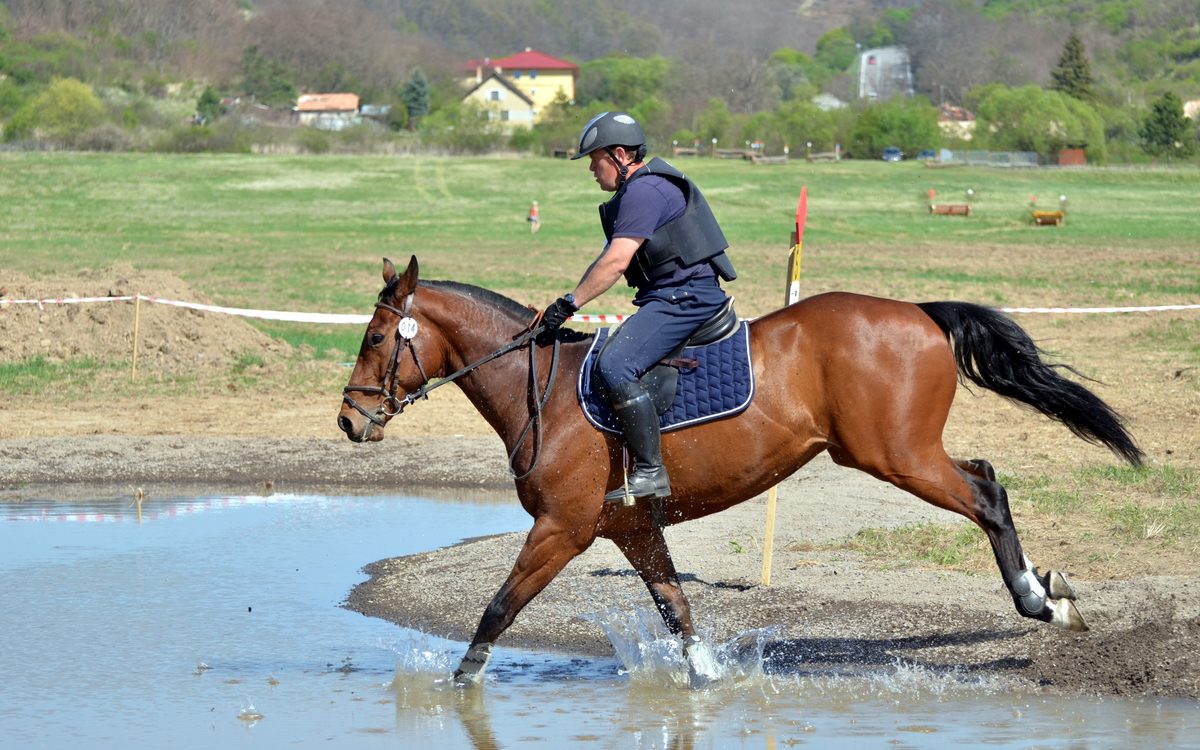
A long, timed ride over fixed, solid-looking obstacles: logs, ditches, banks, drops and water (USEF caps water depth at 35 cm). The scoring is simple: the first refusal, run-out or circle at a fence costs 20 penalties, the second at the same fence 40, and the third is elimination. Finishing slower than the “optimum time” (the course distance divided by the set speed) costs 0.4 penalty points per second, and finishing faster earns nothing extra.
From Training level up, USEF rules require frangible devices (such as frangible pins) on open oxers, open corners and similar fences where the rails fit approved parameters; they are designed to give way under a heavy hit.
Phase three: show jumping
A shorter course of knock-down rails in an enclosed arena, with penalties for knockdowns, disobediences and time. At Training level and up, 20 or more jump penalties means compulsory retirement before cross-country in USEF events. See our show jumping page for the stand-alone sport.
Under USEF rules the lowest total wins, a team is scored on its three best athletes, and elimination from any phase removes a combination from the final classification.
Levels and formats
The USEF describes Beginner Novice as the level that introduces green horses and riders to horse trials, with a walk-trot-canter dressage test, solid-looking fences with ground lines and a straightforward jumping course. Novice continues that introduction, Training is an “elementary examination,” and Modified prepares a Training-level horse for the FEI one-star level or Intermediate. Moving up requires Minimum Eligibility Requirements (qualifying results at a level). A horse trial runs all three phases over a day or two; FEI international events are labelled CCI with one to five stars, some in short (“-S”) and long (“-L”) versions.
Who plays, and the Olympic picture
Youth, school and adults. The USEA runs Intercollegiate and Interscholastic programs, and USEF rules give juniors their own divisions from Beginner Novice through Preliminary, with age cut-offs set by calendar year. Pony Club (riders 25 and under) and 4-H are other routes in; see our youth riding page. The USEA says its mission is to let riders of any age or ability experience eventing, so adult amateurs fill the lower levels, and the top riders can reach Advanced and the FEI five-star events.
Olympics, by edition. Equestrian has been Olympic since 1912, with men and women competing on equal terms; the Paralympic equestrian sport is para dressage (see para equestrian). At Paris 2024, Great Britain won team eventing gold (France silver, Japan bronze) and Germany’s Michael Jung won individual gold, his third in a row. For LA28, the IOC and the LA28 organizers list Team and Individual medal events in eventing, dressage and jumping, held at Santa Anita Park in Arcadia from 14 to 29 July 2028 (the FEI notes the timetable is provisional). Eventing opens the equestrian programme: dressage on 15 and 16 July, cross-country on 17 July, and the jumping finals and first medals on 18 July. A different cross-country order was discussed but we could not confirm it, so check the official programme for the current Games.
Physical demands
Dressage rewards a still, balanced seat and control through the hips and core; jumping needs leg strength, balance and quick reactions; cross-country adds sustained effort. A study of riders in cross-country and polo found heart rates of about 150 to 185 beats per minute, so it is a real cardiovascular workout.
Health and safety for eventing
This section is general information, not medical advice. If you are hurt, see a sports medicine doctor, physical therapist or athletic trainer. Riding any horse carries risk, and eventing carries more than most disciplines because cross-country puts a galloping horse in front of fixed obstacles.
What researchers have measured
- Rider injuries are not rare. A Swedish study of adult eventing athletes (513 invited, 70% responded) found a one-year injury prevalence of 26.6%, and more than a quarter of traumatic injuries kept riders out for over three weeks (2011 study).
- Head and face are common targets. In a study of 16,940 cross-country rides in the 1990s, the injury rate was 1.1% and head and facial injuries were the largest group at 31%, all in riders wearing helmets and body protectors (1999 study). That is why helmet and vest standards matter.
- Risk rises with the level. A study of 749,534 cross-country starts at British Eventing competitions found higher odds of a horse fall as the level rose; for example, Intermediate had about 8 times the odds of the lowest level (BE90) and Advanced about 12 times (2024 study).
Rules and equipment that matter
- Helmets. USEF rules require properly fitting protective headgear for anyone riding at licensed events; breaking the rule can bring a warning or technical elimination. Jumping an obstacle without headgear, or with an unfastened harness, is also a listed fault. The rider or parent is responsible for certification, fit and condition.
- Body protectors. A body-protecting vest must be worn during the warm-up and cross-country phase. Inflatable vests are allowed only in addition to a body protector on cross-country. The Federation recommends a vest that meets ASTM F1937 or is SEI certified.
- A medical data carrier. Riders must declare relevant conditions, including a recent head injury, and wear a medical ID tag or armband.
- Helmets after a fall. Makers such as Troxel say a helmet is built for one impact event and should be replaced after an accident or every five years. In a 2025 survey of 357 collegiate riders, more than half had fallen in the past year and 78% said they would not replace their helmet after every fall.
Evidence on inflatable vests is still developing: one analysis of FEI fall reports found air-jacket wearers over-represented among serious injuries, which does not show the vests cause harm and needs further study.
Concussion and falls
Follow the CDC’s HEADS UP rule: recognize and remove. A rider who may have hit their head stops for the day and sees a healthcare provider, who decides when to return. Call 911 for danger signs such as repeated vomiting or a seizure, and never move someone with a possible neck or back injury.
Heat
Eventing is outdoors, often in a vest and boots on a hot day. The CDC lists heavy sweating, dizziness, nausea and confusion among heat-illness signs; stop, cool down and get medical help if they appear.
Training, recovery and nutrition pointers
Riders combine flatwork, jumping lessons and their own fitness; the CDC recommends 150 minutes of moderate activity a week for adults plus two days of strength work. See our horseback riding training page, recovery page and nutrition and supplements page. Our electrolyte guide helps on hot event days; talk to a doctor or dietitian before supplements.
Gear
Start with what the rulebook requires: a certified helmet that fits, a body protector for cross-country and warm-up, and boots with a distinct heel. Choose by the standards printed on the gear (ASTM F1163/SEI for helmets; ASTM F1937 or SEI for vests) and have the helmet fitted by someone qualified. No helmet protects against every injury.
Three picks: the Troxel Spirit helmet (Troxel says ASTM/SEI certified), the Tipperary Eventer Pro vest (maker lists ASTM F1937-04 and SEI) and SSG Digital riding gloves. More on the horseback riding gear page.

Troxel Spirit Riding Helmet
- ASTM/SEI certified (maker)
- DialFit adjustment, full coverage
- Removable washable liner
$78.99 at Amazon, as of Nov 17, 2026 01:07 UTC
Check price on Amazon
Tipperary Eventer Pro Body Protector Vest
- ASTM F1937-04 and SEI certified (maker)
- Extended back panel
- Made for eventing

SSG Digital Riding Gloves
- Digital grip palm
- Grips when wet (listing)
- Machine washable
Related sports and disciplines
Parent: horseback riding. Siblings: dressage and show jumping. Also: para equestrian, polo and, for another three-part sport, triathlon.
Eventing FAQs
What is the difference between eventing and show jumping?
Show jumping is one phase: a course of knock-down rails in an arena. Eventing is three phases (dressage, cross-country, jumping) with the same horse and rider, and its cross-country phase uses fixed obstacles over open country.
How is eventing scored?
With penalty points, so low is good. Dressage marks become penalty points, then cross-country faults (20 for a first refusal, 40 for a second at the same fence), jumping faults and time penalties are added. The lowest total wins.
Is eventing an Olympic sport?
Yes. Team and Individual medals are on the LA28 programme at Santa Anita Park, with cross-country scheduled for 17 July 2028 (provisional). Check the official programme for the current Games.
How can a beginner start eventing?
Learn to ride well on the flat and over small jumps with a qualified instructor, then try schooling events and Beginner Novice horse trials. The USEA has an Eventing Coaches Program. Wear a fitted, certified helmet every time you ride.
Sources
- USEF Rules for Eventing (EV)
- USEA, About Us
- LA28 Equestrian and FEI: LA28 equestrian timetable confirmed
- Olympics.com: Paris 2024 equestrian results
- USEF GR8: Conduct of Licensed Competitions
- Swedish eventing injury study (PubMed), cross-country injury study (PubMed), British Eventing horse-fall risk (PubMed), FEI fence-level risk (PubMed), Equine fatalities in eventing (PubMed), Air jacket analysis (PubMed), Collegiate equestrian helmet study (PubMed), Rider heart rates (PubMed)
- CDC HEADS UP: respond, CDC heat signs and symptoms, CDC adult activity guidelines
- Troxel helmet certifications
Keep exploring: riding injuries, our recovery tools guide and the sports hub.