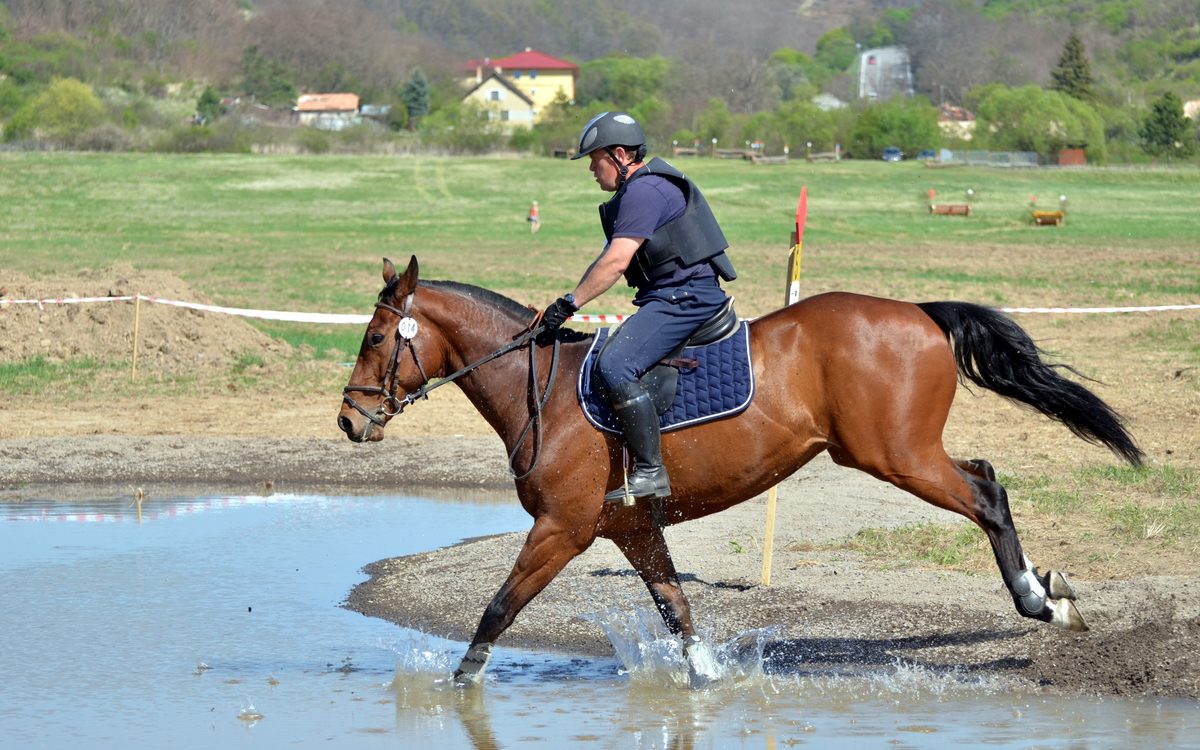
The rider walked the cross-country course three times on foot that morning, counting strides between fences and checking the ground at the water. Now, back at the trailer, she braids, tacks up and rehearses a dressage test in her head. Eventing asks one horse and one rider to do three different jobs on one weekend, and a first-timer’s biggest question is usually the same: what do I actually have to know before I enter? This page covers how the sport works, the basic skills, how a beginner starts and where the official rulebooks are. For the sport at a glance, see the eventing hub, part of horseback riding.
Quick answer: Eventing is dressage, cross-country and show jumping on the same horse. Every phase adds penalty points and the lowest total wins. To start, learn to ride confidently on the flat and over small fences with a qualified instructor, try an unrecognized schooling show, then move to Beginner Novice (the lowest recognized level in the US, where USEA membership is required). Rules change, so read the current USEF Rules for Eventing before you enter.
How the three phases are scored
Under the USEF Rules for Eventing, a combination is classified by penalty points and the lowest total wins. A team is scored on its three best athletes, and being eliminated in one phase removes a combination from the final classification. Here is what each phase adds to the score.
| Phase | What the rider does | How points are added |
|---|---|---|
| Dressage | Rides a memorized test of walk, trot and canter figures in a marked arena in front of judges | The judges’ percentage is converted to penalty points (100 minus the percentage), so a better test means fewer points |
| Cross-country | Gallops and jumps a course of fixed, solid obstacles in a set time | First refusal, run-out or circle at a fence adds 20, second at the same fence 40, third is elimination; time over the optimum time adds 0.4 per second |
| Show jumping | Jumps a short course of knock-down rails in an arena | The USEA says a knocked rail, refusal or run-out costs 4 points; time penalties also apply |
The optimum time on cross-country is the course distance divided by the set speed, and finishing faster than it earns no bonus. At Training level and above, 20 or more jump penalties in show jumping means compulsory retirement before cross-country in USEF events. USEF rules also require frangible devices at Training level and above on certain open fences; they are built to give way under a heavy hit. Check the current rulebook for the exact fences and conditions.
The basic skills a beginner needs
Most coaches would call the following general coaching practice rather than a rule, but the levels are designed around them:
- A secure, balanced seat on the flat. Dressage rewards rhythm and control, and the same balance carries you over a jump.
- Control of speed and line. Cross-country is timed, so you need to hold a steady canter and steer straight to a fence.
- Jumping position and rhythm. Show jumping shows whether you can count strides and keep the horse balanced between rails.
- Reading a horse. A rider who notices a tense or tired horse can make safer choices. A qualified instructor teaches this best.
The USEA describes its Beginner Novice level as an introduction for green horses and riders. Its own rule refresher says Beginner Novice is for horses and riders who already have schooling-competition experience in all three phases. In other words, the lowest recognized level is a step up from the first lesson, not the first lesson itself.
What the levels look like
In the US, levels run from Beginner Novice up through Novice, Training, Modified, Preliminary, Intermediate and Advanced, and internationally the FEI uses CCI one to five stars. USEF rules set Minimum Eligibility Requirements (qualifying results) for moving up. The USEA’s guidance on the lowest two levels gives a feel for the early courses:
- Beginner Novice dressage is a walk, trot and canter test with 20-metre figures and a halt.
- Beginner Novice cross-country allows no jump within 25 metres before a water crossing or 16 metres after it, and no turns tighter than a 20-metre radius, with at most one two-element combination.
- Beginner Novice and Novice show jumping courses are described as inviting and straightforward.
Fence heights and speeds are set in the USEF Rules for Eventing and the USEA handbook; we do not list them here, so check the current edition. Moving up is a rider decision made with a coach, not a race: a Swedish study of adult eventing riders concluded that care should be taken when riders move into higher qualification groups.
How a beginner starts, step by step
- Find a qualified instructor who teaches jumping and has eventing experience. The USEA runs an Eventing Coaches Program; ask a local instructor or the USEA to learn more.
- Build the basics on the flat and over small fences, wearing a certified, properly fitted helmet every ride.
- Try a schooling show. These unrecognized events let you run a dressage test, a jumping round and a cross-country course in a lower-pressure setting. Local USEA area groups and organizers are the place to ask.
- Read the entry requirements. The USEA says membership is required at Beginner Novice and above, and horses and riders at that level must be registered. Check the current requirements and deadlines on the USEA site before you enter.
- Learn your dressage test and walk the course on foot. The USEA’s Discover Eventing “My First Event” pages cover entering, learning a test, what to wear, what the horse wears and the big day.
Younger riders can also look to Pony Club and school or college programs; the USEA lists Intercollegiate and Interscholastic programs. See our youth riding page.
Official rulebooks and where to find a program
- USEF Rules for Eventing (EV), the rulebook for US competitions.
- USEA and Discover Eventing for events, membership and first-event guides.
- FEI Eventing for international rules and calendar.
Equestrian sport is on the Olympic programme, with eventing Team and Individual medal events planned for LA28; check the official programme for the current Games. Dressage and show jumping are their own sports too: see dressage and show jumping. For fitness, see eventing training, and for the right kit, eventing gear.
Eventing rules and getting started FAQs
Do I need my own horse to start eventing?
Not to begin learning. Many riders start with lessons on school horses and borrow or lease a horse later. To compete at recognized levels you need a registered horse, so ask your instructor what route fits your situation.
What is a schooling show?
An unrecognized event, often run by a local organizer, where you can try dressage, show jumping and cross-country at lower heights. It is a common first step before a recognized Beginner Novice event.
How old does a horse have to be?
USEF rules set minimum ages for horses, which we last read as four years old at Beginner Novice through Training. Rules change, so confirm the age and other eligibility in the current rulebook.
What happens if my horse refuses a fence?
On cross-country the first refusal, run-out or circle at a fence adds 20 penalties, the second at the same fence adds 40 and the third eliminates the pair. Show jumping penalties are different.
Is eventing the same as horse trials?
Yes, in the US a horse trial is the usual name for a one- or two-day event with all three phases. FEI international events use the CCI label.
Where do I find official rules?
The USEF Rules for Eventing and the USEA and FEI websites. This page is a plain-language summary, not the rulebook.
Sources
- USEF Rules for Eventing (EV)
- USEA, About Us
- USEA Discover Eventing
- USEA FAQ (membership and registration)
- USEA first-timers checklist for a recognized event
- USEA rule refresher: Beginner Novice and Novice
- FEI Eventing
- Swedish eventing injury study (PubMed)
General information for education only, not medical advice. It does not replace a sports medicine doctor, physical therapist, athletic trainer or qualified coach. See our editorial policy for how we research and write.