This article contains affiliate links: if you buy through them we may earn a commission, at no extra cost to you. Read our affiliate disclosure.
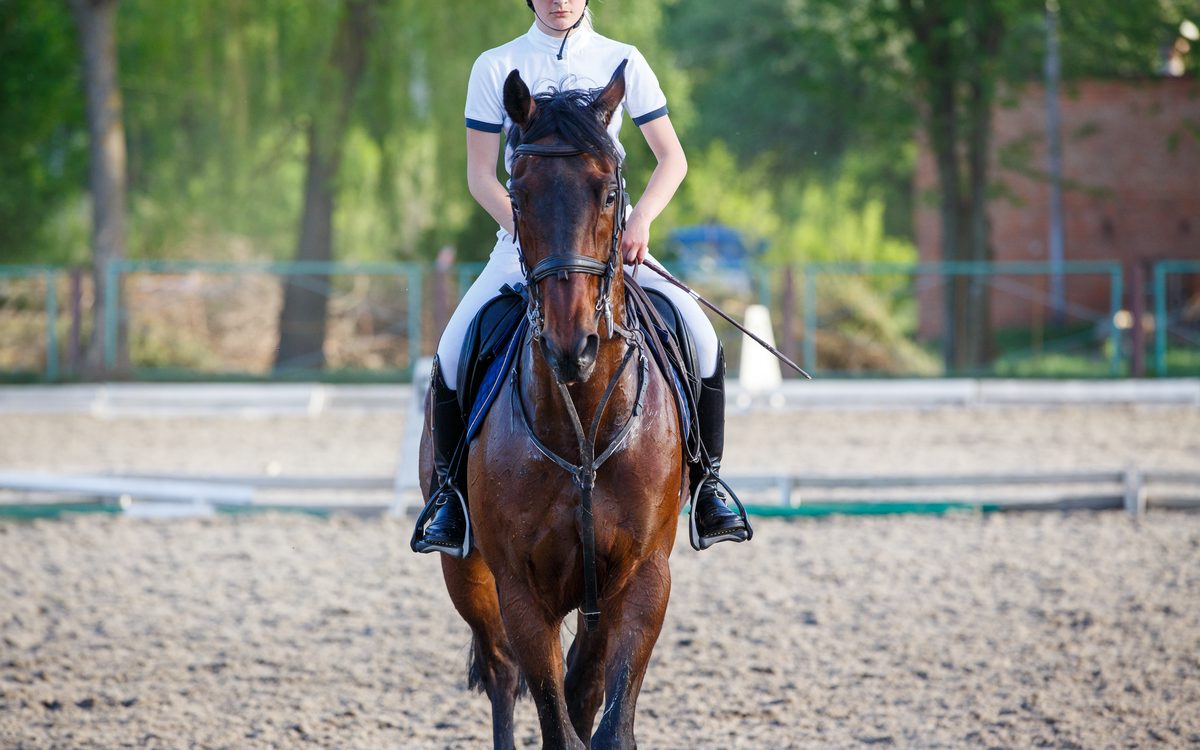
August 4, 2024, the grounds of the Palace of Versailles. Jessica von Bredow-Werndl rides the Grand Prix Freestyle to music on TSF Dalera BB and wins her second straight Olympic individual gold, the day after Germany took the team title. Her teammate Isabell Werth took silver and Great Britain’s Charlotte Fry bronze. Dressage is the riding discipline in which horse and rider perform a set pattern of movements in an arena, judged on accuracy, harmony and the quality of the horse’s gaits. It is also called a “dressage test,” and its musical form is the “freestyle.”
Dressage guides: what do you need?
New to dressage? Start with the first card. Everything here is general education, not medical advice.
History & Origins of Dressage
Dressage grew out of Greek horsemanship. Xenophon, a Greek military commander born around 400 BC, wrote some of the earliest works on training horses. The military kept developing the craft, and during the Renaissance European aristocrats showed off highly trained horses in pageants. The Imperial Spanish Riding School of Vienna was established in 1572, and much of modern dressage training builds on principles from that era (USDF).
Dressage became an Olympic sport in Stockholm in 1912. Until 1953 only military officers could compete; that year the rules changed so civilian men and women could enter. In the United States, the United States Dressage Federation (now USDF) was founded in 1973 after Lowell Boomer, founder of the Nebraska Dressage Association, invited enthusiasts to Lincoln, Nebraska, that February; the first official business meeting followed in November 1973 (USDF). Para dressage joined the Paralympics at Atlanta in 1996 (IPC). Where older riding traditions are only loosely documented, we do not rank them as origin stories.
- About 400 BC: Xenophon writes early works on horse training.
- 1572: The Imperial Spanish Riding School of Vienna is established.
- 1912: Dressage is on the Olympic programme in Stockholm.
- 1953: Civilian men and women may compete in Olympic dressage.
- 1973: The United States Dressage Federation is founded.
- 1996: Para dressage becomes Paralympic.
- 2028: Dressage at the Los Angeles Olympics, Santa Anita Park (FEI).
Legends of the Sport
Influential contemporary riders, in no order. Historic greats are not listed because we could not verify them from official pages yet. None endorse AthleteRx.
- Jessica von Bredow-Werndl (Germany): Olympic individual champion in Tokyo and Paris, and a Paris team gold medallist.
- Isabell Werth (Germany): Olympic individual silver in Tokyo and Paris, team gold both times, and freestyle bronze and team gold at Aachen 2026.
- Charlotte Fry (Great Britain): double World Champion in 2022 and 2026 and Olympic individual bronze in Paris.
- Cathrine Laudrup-Dufour (Denmark): Olympic team silver in Paris and two individual silvers at Aachen 2026.
- Carl Hester (Great Britain): team bronze in Tokyo and Paris and team silver at Aachen 2026.
- Katharina Hemmer (Germany): Aachen 2026 team gold and Grand Prix Special bronze on Denoix PCH.
- Frederic Wandres (Germany): member of the winning German teams in Paris 2024 and Aachen 2026.
Official results and records
We only list champions and records here after checking them on the official source. For the latest results, go to:
- Dressage News team report
- Grand Prix Special report
- Eurodressage Freestyle report
- Sortir a Paris
- Horse Journals
- NBC Olympics
- Practical Horseman
How we keep this current: we re-check facts after each major championship and update this page. Spot an error? See our editorial policy.
Dressage at a glance
| What it is | A ridden test of set movements at walk, trot and canter in a lettered arena. Part of horseback riding; also the first phase of eventing. |
|---|---|
| How it is scored | Judges mark each movement from 0 (“not executed”) to 10 (“excellent”), half marks allowed, plus collective marks. The total becomes a percentage; the higher the percentage, the better. Errors of course cost percentage points. |
| Participants and levels | Riders of all ages and both sexes, from Introductory and Training Level in the U.S., through First to Fourth Level, up to the FEI levels (starting with Prix St. Georges). Para dressage riders compete in five grades. |
| Where | A standard arena of 20 by 60 meters or a small arena of 20 by 40 meters, indoors or outdoors, at shows licensed by US Equestrian (USEF) and recognized by the US Dressage Federation (USDF). |
| Governing bodies | FEI (international), US Equestrian (national rules), USDF (the national membership organization for dressage). |
| Season | Varies by region and level; check the USDF and USEF competition calendars. |
How dressage works
Each level has an official test: a list of movements, such as circles, lengthening the trot, changes of direction, and at higher levels pirouettes and flying changes, that the rider performs in a set order at lettered spots around the arena. A beginner will see one horse and rider at a time in the arena while the judges mark every movement; the combined percentage ranks the rides. Because everyone at a level rides the same pattern, the contest is about how well it is ridden.
Formats
- Standard tests: rides at your level, scored as a percentage. Many riders spend years working through the levels and competing against their own earlier scores.
- Freestyle: the rider designs a pattern set to music, within the rules of the level.
- Team and individual at the Olympics: teams of three; at Paris 2024, Olympedia lists team totals from the Grand Prix and the Grand Prix Special, and the individual title was decided in the Grand Prix Freestyle.
- Para dressage: a championship test, a freestyle and a team test. See our page on para equestrian sport.
Who rides dressage, and at what level
Youth. The Interscholastic Equestrian Association (IEA) lists dressage among its divisions for students in grades 4 through 12, and Pony Club and 4-H offer riding programs for younger riders. See our youth horseback riding page.
Adult and club. USDF is the national organization for dressage and has over 100 affiliate clubs, and US Equestrian licenses the competitions. US Equestrian has separate Amateur divisions.
Olympics. Dressage, jumping and eventing joined the Olympic programme in 1912, and men and women compete against each other on equal terms. Status by edition, as far as official sources confirm:
- Paris 2024 (held): team dressage was held at Versailles from July 30 to August 3. Germany won gold, Denmark silver and Great Britain bronze, according to Olympedia; Olympics.com reports von Bredow-Werndl won the individual title.
- Los Angeles 2028: the IOC approved all three Olympic equestrian sports for LA28 in April 2025, according to the FEI. The FEI said dressage has 60 athlete places and two medal events (team and individual), with three-rider teams. Dates and venue reports point to Santa Anita Park in July 2028, but the FEI planned to submit the final equestrian rules in 2026, so check the official programme for the current Games.
- Paralympics: para dressage has been on the programme since Atlanta 1996, open to athletes with physical or vision impairments. Men and women compete together, grouped by functional profile.
Physical demands
Dressage looks calm, but it asks for a balanced, upright seat held over many minutes. A 2023 review of equestrian physiology (Best and colleagues) calls the sport under-researched and estimates energy and hydration needs across disciplines rather than dressage alone. Studies give hints. A 2025 survey of 100 competing dressage riders in South Africa found 71% reported low back pain at the time of the survey, and 56% reported it over their lifetime. The authors linked pain to riding-specific gaits. A small 2025 study of 12 elite junior riders in Germany found their hip adductors were 8% to 19% stronger than their abductors. These are small, self-reported or single-team studies, not rates for all riders.
Health and safety for dressage
If you are hurt, see a sports medicine doctor, physical therapist or athletic trainer. The numbers below are for horse riding overall, since we did not find dressage-only injury rates.
- Falls and head injuries: CDC authors estimated about 102,900 emergency department visits a year for horse-related injuries in the U.S. in 2001 to 2003; two-thirds of patients were mounted and fell or were thrown, and about 11,500 a year had traumatic brain injuries. Riders on the ground were most often kicked.
- Helmet rule: under the USEF dressage rule (DR120), anyone mounted, whether competing or not, must wear protective headgear from the moment horses are admitted to the grounds, including para dressage riders. A rider without a helmet is stopped until it is on.
- What helmets do: a 2025 systematic review found helmets protect against skull fracture and traumatic brain injury. A 2025 survey of 357 collegiate riders found more than half had fallen in a year and that 78% would not replace a helmet after every fall.
- Concussion: the CDC’s HEADS UP program says to recognize and remove: a rider with a possible concussion stops for the day and sees a healthcare provider before returning. Signs include headache, dizziness, confusion and balance problems; call 911 for danger signs like repeated vomiting or a seizure.
Back pain in riders is a reason to talk to a clinician, not to push through. A physical therapist who understands riding can look at hips, pelvis and trunk. Sun and heat matter at outdoor shows: the CDC recommends shade, a hat or sun protection and water.
Training, recovery and nutrition
Time in the saddle with a good instructor is the core of dressage training. For work off the horse, see the parent pages on horseback riding training, recovery and nutrition. The CDC recommends at least seven hours of sleep for adults and 8 to 10 for teens. Supplements are a decision for a doctor or dietitian first.
Gear
The essential piece is the helmet. US Equestrian’s list of accepted standards includes ASTM F1163 certified through the Safety Equipment Institute (SEI), among others, and it says a helmet must be fitted by someone qualified. Some makers say helmets should be replaced after an impact; Troxel, for example, says every five years or after an accident. Competition clothing is set by the rulebook, so check the dress code for your level; at licensed competitions boots with a distinguishable heel are required, with some exceptions. Gloves help with grip on the reins.

Troxel Spirit Riding Helmet
- ASTM/SEI certified (maker)
- DialFit adjustment
- Removable washable liner
$78.99 at Amazon, as of Nov 17, 2026 01:07 UTC
Check price on Amazon
Ovation Deluxe Schooler Helmet
- ASTM F1163-15 + SEI (listing)
- Removable washable liner
- YKK adjuster

SSG Digital Riding Gloves
- Digital grip palm
- Grips when wet
- Machine washable
Related sports and disciplines
- Parent: Horseback riding, with its rules and gear pages.
- Siblings: eventing, show jumping and para equestrian.
- Other horse sports: horse racing, polo and rodeo.
Dressage FAQs
How is dressage scored?
Each movement gets a mark from 0 to 10, half marks allowed, plus collective marks, and the total is turned into a percentage. Errors of course reduce the score.
Is dressage in the Olympics?
Yes. Dressage has been on the programme since 1912, was held at Paris 2024, and the IOC approved it for LA28. Check the official programme for the current Games.
Do dressage riders need a helmet?
At US Equestrian licensed competitions, yes. The dressage rule requires protective headgear for anyone mounted on the grounds, including when warming up and not competing.
What are the dressage levels?
In the U.S., Introductory and Training Level, then First to Fourth Level, then the FEI levels, starting with Prix St. Georges. Each level has its own test.
Can people with disabilities compete in dressage?
Yes. Para dressage has been in the Paralympics since 1996 for riders with physical or vision impairments, with five grades. Riders may use aids such as dressage crops, connecting rein bars and rubber bands.
Sources
- US Equestrian, Dressage division rules (DR) and accepted helmet standards
- FEI, history; Olympedia, Paris 2024 team dressage; Olympics.com, Paris 2024 equestrian results
- Horse Illustrated, equestrian confirmed for LA28 (reporting the FEI announcement)
- Paralympic.org, equestrian
- Landman DM et al. Low back pain in competitive dressage riders, 2025; Havertz A et al. young elite equestrian athletes, 2025; Best R et al. equestrian physiology, 2023
- Thomas KE et al. Non-fatal horse related injuries treated in emergency departments in the United States, 2001-2003, 2006; Crawford AE et al. systematic review, Sports Health 2025; Gould S et al. collegiate equestrians, 2025
- Troxel, helmet certifications; CDC HEADS UP, response; CDC sleep
Keep exploring: horseback riding injuries, leagues and associations, the sports hub, our recovery tools guide and the foam roller guide.