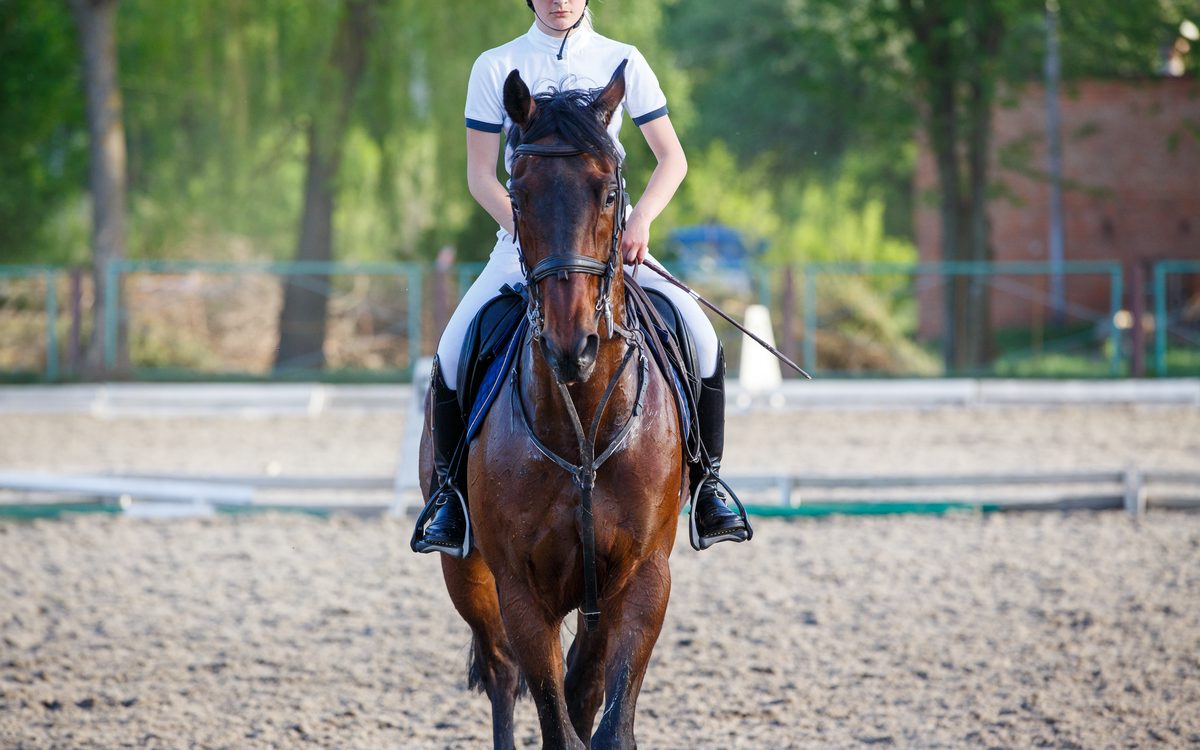
The horse spooks at a flapping banner at the far end of the arena, and the rider who has been schooling for forty minutes is suddenly on the ground. Dressage looks like the safest corner of horse sport, and it often is, but falls, kicks and slow-building back pain all happen here too. Injury prevention for dressage riders means the habits and equipment that lower the chance and seriousness of those injuries. It cannot remove the risk. Here is what the research and the rulebooks support, and where the evidence runs out.
Quick answer: The best-supported steps are a correctly fitted, certified helmet worn every ride, careful ground handling, a rider who matches the horse and has instruction, and off-horse core and hip work for the back. Evidence specific to dressage is thin, so some points below are general coaching practice and say so. See a sports medicine doctor, physical therapist or athletic trainer for pain that persists or changes how you ride, and call emergency services after a head injury with danger signs.
General information, not medical advice. What each injury looks like and how it is treated is on our dressage injuries page, so we do not repeat it here. For the whole sport, see the dressage overview.
Know where the risk is
We did not find dressage-only injury rates. For horse riding overall, CDC authors (Thomas and colleagues, 2006) estimated about 102,900 emergency department visits a year in the U.S. in 2001 to 2003, with 66.1% of patients mounted when hurt (usually falling or thrown) and the rest most often kicked while on the ground. So prevention covers two places: on the horse and around it.
Warm up the rider, too
No published rider warm-up program for dressage exists that we could find, so what follows is general coaching practice. A few minutes of walking, arm circles, hip circles and gentle trunk rotation before mounting, then a walk-only start, lets stiff hips and back loosen before they must follow the horse’s gaits. The horse needs a warm-up too: a 2024 scoping review (Frippiat and Votion) found that warm-up increased blood and muscle temperature in horses, and that dressage riders spent longer warming horses up than show jumping riders did.
Technique and the rider’s position
A 2025 narrative review (Balog and colleagues) found that correct pelvic orientation, trunk control and even weight distribution went with better saddle pressure distribution, and that many riders did not know they were unbalanced. A 2025 survey of 100 competitive dressage riders in South Africa (Landman and colleagues) found 71% reported low back pain at the time and 56% over their lifetime, and linked it to riding-specific gaits. These are small and cross-sectional, so they show an association, not a cause. Practical points, labelled general coaching practice:
- Take regular lessons and video to spot crookedness early.
- Ask your instructor about sitting trot and how long you practice it in one go.
- Do not ride through pain that makes you tighten or brace.
Ground handling
Because riders on the ground are most often kicked, handling habits matter. Extension guidance (Penn State, University of Arkansas) says to approach a horse from the front toward the shoulder while speaking to it, avoid standing directly behind, never wrap a lead rope around your hand or body, use a quick-release knot tied at about withers height, and wear hard-toed boots instead of sandals or sneakers.
Load: how much, how fast
Rules of thumb for riders are scarce. The AAP’s 2016 clinical report on young athletes recommends 1 to 2 days off a week from a sport and about 3 months off a year from a single sport. Riders who handle several horses should also remember stable work counts: a 2024 Portuguese survey of 347 riders (Duarte and colleagues) found low back pain more likely with higher weekly riding workload and daily stable duties. Build up the number of horses or the hours of sitting trot gradually, as general practice.
Conditioning and strength
A 2025 narrative review (Balog) found targeted core programs and cross-training improved balance and reduced back pain. See dressage training for exercises and the weekly shape. A physical therapist should set up work for any current pain.
Environment and footing
Outdoors, heat is the main hazard. The CDC advises shade, a hat or sun protection and water, and the NATA position statement on exertional heat illness covers recognizing and treating it. The Best 2023 review notes that riding clothing and cooling matter. Indoor arenas bring dust and low light. We found no research on arena footing and rider injury, so ask your barn manager about footing, lighting, mirrors and gates, and avoid schooling alone.
Protective equipment and fit
Verified standards and maker claims differ, so keep them apart:
- Helmet rule (verified): under the US Equestrian dressage rule (DR120), anyone mounted on the grounds, competing or not, must wear protective headgear from the time horses are admitted, including para dressage riders.
- Standards (verified): US Equestrian’s list of accepted standards includes ASTM F1163 certified through the Safety Equipment Institute (SEI), and the helmet must be fitted by someone qualified.
- What helmets do: a 2025 systematic review (Crawford and colleagues) found helmets protect against skull fracture and traumatic brain injury. A 2018 matched-pairs study (Bier and colleagues) of 20 pairs found a lower risk of intracranial hemorrhage with a helmet. A 2018 study (Short and colleagues) found only 19.7% of 142 children at equestrian events were helmeted.
- Limits: a 2019 study (Connor and colleagues) found 46% of head-injury cases had no helmet damage, so a helmet may not show a hit. A 2025 survey (Gould and colleagues) of 357 collegiate riders found more than half fell in a year, and that 78% would not replace a helmet after every fall.
- Replacement (maker claim): Troxel says its helmets are designed for one impact and should be replaced after an accident or every five years.
- Fit: a 2020 survey of 2,598 adult riders (Stanfill and colleagues) found poor fit was a reason given by 48.6% of those who did not always wear a helmet.
- Saddle fit: a 2025 survey of 384 male riders (Tan and colleagues) found 57% reported groin or pelvic pain, and deep-seat saddles were linked to more pain, notably in dressage. Ask a qualified saddle fitter, and see a doctor for pain that continues.
Body protectors and air vests are common in eventing and jumping, but we found no source ranking them for dressage, so we do not rank them. See our dressage gear guide.
What prevention can’t do
Even a well-fitted helmet, a calm horse and fit rider cannot guarantee safety. A horse is a prey animal and can spook. Studies in this field are mostly observational, so “was linked with” is the honest wording. We found no source for a falling technique or emergency dismount lowering injury; ask an instructor.
When to see a professional
Get care for head impact with confusion, vomiting, worsening headache, drowsiness, loss of consciousness or seizure. The CDC’s HEADS UP program says to remove anyone with a possible concussion from play and let a health care provider decide when to return. Also see a clinician for neck or back pain after a fall, numbness, groin or pelvic pain that continues, and back pain that does not settle or wakes you at night. Time frames are general guidance.
Dressage injury prevention FAQs
Do dressage riders need helmets?
At US Equestrian licensed dressage competitions, yes, for anyone mounted on the grounds. Outside competition, the evidence supports wearing a certified, fitted helmet every ride.
How often should I replace my riding helmet?
Makers such as Troxel say after any accident, or every five years. Some studies show a helmet may be damaged without visible signs.
Can core exercises prevent back pain from riding?
Reviews and small studies suggest core and cross-training can improve balance and reduce back pain, but they cannot guarantee prevention. See a physical therapist for pain.
Is dressage safer than jumping?
We found no dressage-only injury rates to compare, so we cannot say. Falls, kicks and back pain happen in all riding.
What is the safest way to handle a horse?
Approach from the front toward the shoulder, never stand directly behind, never wrap a lead around your hand, and wear hard-toed boots.
Sources
- Thomas KE et al. Non-fatal horse related injuries treated in emergency departments in the United States, 2001-2003, Br J Sports Med 2006
- US Equestrian, Dressage division (DR120) and accepted helmet standards; ASTM F1163; Troxel certifications
- Crawford AE et al. CNS and thorax injury in equestrian sports, Sports Health 2025; Bier G et al. Helmet use in equestrian TBI, 2018; Short SS et al. Helmet under-utilization by children, 2018
- Connor TA et al. Do equestrian helmets prevent concussion? Sports Med Open 2019; Gould S et al. Equestrian helmet type and head injury, 2025; Stanfill AG et al. Helmet use in equestrian athletes, 2020
- Landman DM et al. Low back pain in competitive dressage riders, 2025; Balog O et al. Rider performance and horse welfare, 2025; Duarte C et al. Low back pain in Portuguese riders, 2024
- Tan J, Cameron L, Lewis V. Groin and pelvis area pain in male equestrian riders, J Equine Vet Sci 2025 (Europe PMC record)
- Frippiat T, Votion DM. Warm-up strategies in sport horses, Animals 2024; Best R et al. Nutrients 2023
- Brenner JS, AAP. Sports specialization and intensive training in young athletes, Pediatrics 2016
- Casa DJ et al. NATA position statement: exertional heat illnesses, 2015; CDC sun safety; CDC HEADS UP
- Penn State Extension, Safe horse handling; Extension Horses, Safe ground handling and Basic horsemanship principles
General information for education only, not medical advice. It does not replace a visit with a doctor, physical therapist or athletic trainer. See how we write and check our pages in our editorial policy.