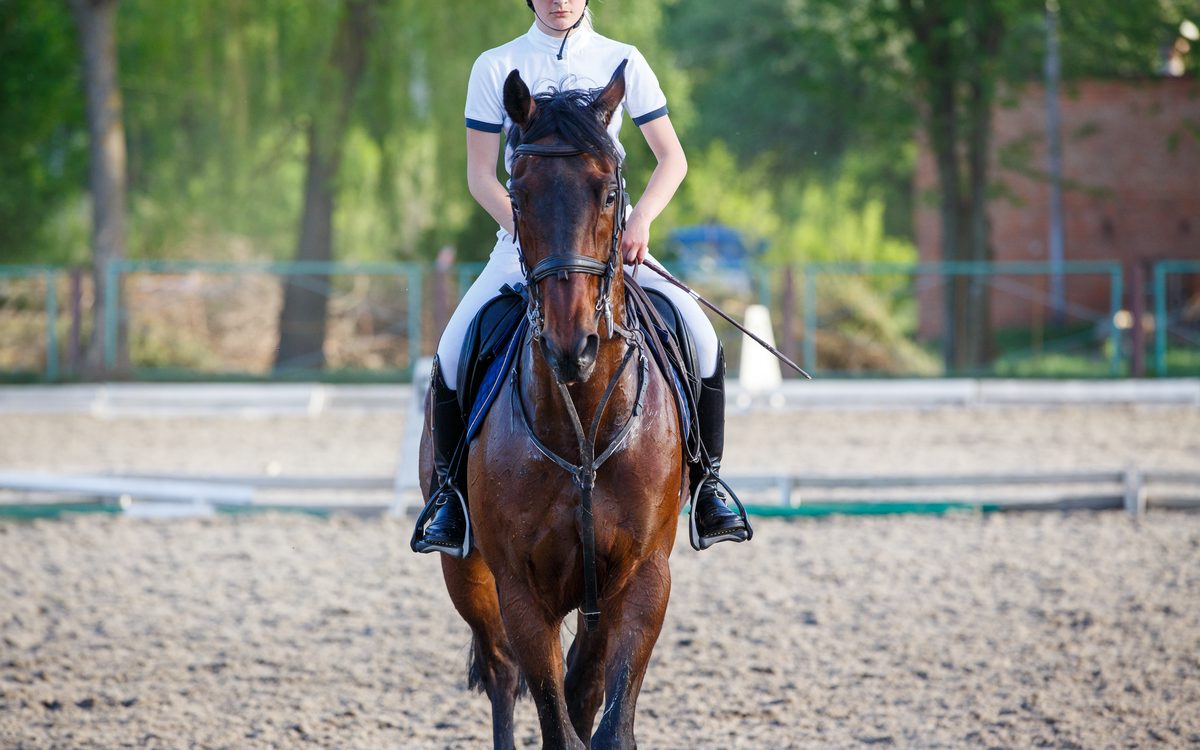
Watch a good dressage rider from the side and not much seems to be happening. The hands are still, the back is tall, and the horse looks like it is doing everything on its own. That stillness is trained, in the saddle and out of it. Dressage training means building a rider’s balance, strength and feel on the horse, while the horse is trained in step with them. This page covers what the sport asks of the body, a sensible weekly shape, off-horse conditioning, and how riders plan a season. Most of the numbers here come from small studies, and we say so.
Quick answer: Dressage rewards a balanced, symmetrical seat and a strong, mobile trunk. A sensible week mixes several rides with lessons, two or three short off-horse sessions for core, hips and legs, and rest. The research on rider fitness is small, so treat the plan below as general coaching practice, not a prescription. A coach and a physical therapist can tailor it.
What dressage asks of the rider
A 2023 review of the physiology of equestrian riders (Best and colleagues) says the evidence base is thin and mostly covers other disciplines. It reports high heart rates (about 150 to 185 beats per minute) in the cross-country phase of eventing and in polo, which is not a dressage figure, and it says this is no reason to skip strength training. In dressage the demand is different: holding an upright, balanced position and following the horse’s movement for many minutes, with the arms, legs and trunk each doing a different job.
What research there is points to a few themes:
- Symmetry. A 2022 study of 147 riders (Baragli and colleagues) measured the force through the stirrups during simulated trot and found asymmetry in 99.3% of riders when sitting and 98% when standing, and in 46.3% in rising trot. Most riders, in other words, load one side more than the other.
- Trunk control. A 2025 narrative review (Balog and colleagues) found that correct pelvic orientation, dynamic trunk control and symmetrical weight distribution went with better saddle pressure distribution and better horse gait. It also found that many riders were unaware of their imbalances.
- Skill and consistency. A 2023 simulator study of dressage riders (Heidbuchel and colleagues) found that experts had less variability in rein force in medium canter.
- Core stability. A 2025 study of 75 people aged 15 to 30 found core stability was best in sport riders, lower in recreational riders and lowest in non-riders.
Riding alone may not give enough conditioning. A 2023 survey of 2,039 American equestrians (Keener and colleagues) found that equestrian activity, barn work and other exercise together met aerobic and muscle-strengthening recommendations for many, but fewer recreational riders saw riding as physical activity at all.
A sensible weekly shape
There is no published dressage-specific weekly plan, so this is general coaching practice, built on the CDC adult guideline of 150 minutes of moderate (or 75 minutes of vigorous) activity a week plus muscle-strengthening on at least two days:
- Two to four lessons or schooling rides, with at least one lesson with a coach who can see your position, ideally with video.
- One to two lunge or no-stirrup sessions if your instructor sets them up safely, to work on seat and balance without managing the reins.
- Two or three short off-horse sessions (20 to 40 minutes) for core, hips, legs and mobility.
- Easy cardio such as walking, cycling or swimming, which helps riders who spend long days in the barn.
- At least one full rest day and a lighter day after a show.
Riders who ride several horses a day or spend hours on barn chores carry more load than the hours in the saddle suggest. A 2024 Portuguese survey of 347 riders (Duarte and colleagues) found 61.7% reported low back pain in the past year, and it was more likely with higher weekly riding workload and daily stable duties.
Off-horse strength and conditioning
A 2026 pilot study (Zeliszewska-Duk and colleagues) had four riders train three times a week for about 60 minutes on flexibility, mobility and fitness for 60 days. Saddle pressure sensors showed less irregularity in the riders’ balance afterward, compared with a control group. It is a very small study, but it fits the review evidence that targeted core training and cross-training improved balance and reduced back pain. A small 2024 study of nine equestrians (Weeks and colleagues) found an eight-week exercise program improved pain, interference and riding function in all nine. A physical therapist should set up any program for current back pain.
Common building blocks in rider programs (general coaching practice, not tied to one study):
- Trunk: dead bug, bird dog, side plank, Pallof press, sitting on an exercise ball.
- Legs and hips: squats, split squats, step-ups, single-leg balance, hip abduction and adduction work, so the legs can stay long and still.
- Posture and shoulders: rows and band pulls to counter slumping and help steady the hands.
- Mobility: hips, upper back and ankles, so the seat can follow the horse without bracing.
Start light, keep the movement slow and controlled, and stop for sharp pain. Our injury prevention page says more on load and when to see a professional.
Periodisation basics
Periodisation just means planning harder and easier weeks around the calendar. For riders, a common (general coaching) pattern is:
- Off-season or early season: more strength and fitness work, more schooling, fewer shows.
- Competition season: keep two short strength sessions, protect rest, and lighten the week before a show.
- Recovery weeks: every few weeks, drop volume for a few days. See dressage recovery.
The horse is part of the training load too. Dressage riders warm up their horses longer than show jumping riders, according to a 2024 scoping review of horse warm-up (Frippiat and Votion), and a longer or harder warm-up did not change the final score. Ask your coach to plan the horse’s work as carefully as your own.
Rider and horse fit
A 2026 survey of 134 Finnish riders (Karikoski and colleagues) found the average rider-to-horse body-weight ratio was 12.9%, lower than the commonly cited maximum of 20%. The study was self-selected and cannot tell any one rider what is right. A vet or experienced coach should help match horse and rider, because the horse’s size, build and training matter.
Monitoring progress
Simple things work: video from the side and behind every few weeks, a short list of seat goals from your coach, and a training log that includes how you feel. Wearables can track sleep and heart rate, but they cannot judge your seat.
Next steps
Start with the dressage rules and getting started page if you are new, and read about fueling for long show days. See the horseback riding hub for other disciplines.
Dressage training FAQs
How many times a week should I ride?
There is no research-based number for dressage riders. Many riders ride several days a week with at least one rest day; ask your coach to set a plan that fits your horse and level.
Do dressage riders need to lift weights?
The evidence is small but supportive. Reviews and pilot studies suggest core and conditioning work can improve balance and reduce back pain, and the Best review says there is no reason to skip strength training. Start light and get guidance.
Why do my coach and the mirror say I sit crooked?
Asymmetry is common: one study found most riders load the stirrups unevenly. Video, off-horse mobility work and a coach’s feedback can help.
Is riding enough exercise?
For some people it counts toward activity goals, especially with barn work, but recreational riders often do less. The CDC’s adult guideline is a useful baseline.
Can I train through back pain?
Persistent or worsening pain deserves a check with a sports medicine doctor or physical therapist before you keep riding through it.
Sources
- Best R, Williams JM, Pearce J. Physiological requirements and nutritional recommendations for equestrian riders, Nutrients 2023
- Balog O et al. Factors influencing rider performance and horse welfare, Front Sports Act Living 2025
- Baragli P et al. Stirrup directional force asymmetry, Animals 2022; Heidbuchel A et al. dressage rider skill on a simulator, J Equine Vet Sci 2023
- Skwierawska Z et al. Core stability in equestrian riders, Folia Med Cracov 2025; Keener MM et al. Physical activity in American equestrian athletes, J Phys Act Health 2023
- Zeliszewska-Duk P et al. Riders’ physical activity and seat balance, PLoS One 2026; Weeks RA et al. Exercise program for chronic low back pain in equestrians, 2024
- Duarte C et al. Low back pain in Portuguese riders, Sports 2024
- Frippiat T, Votion DM. Warm-up strategies in sport horses, Animals 2024; Karikoski NP et al. Rider and horse size proportions, J Equine Vet Sci 2026
- CDC, adult physical activity guidelines
General information for education only, not medical advice. It does not replace a visit with a doctor, physical therapist or athletic trainer. See how we write and check our pages in our editorial policy.