This article contains affiliate links: if you buy through them we may earn a commission, at no extra cost to you. Read our affiliate disclosure.
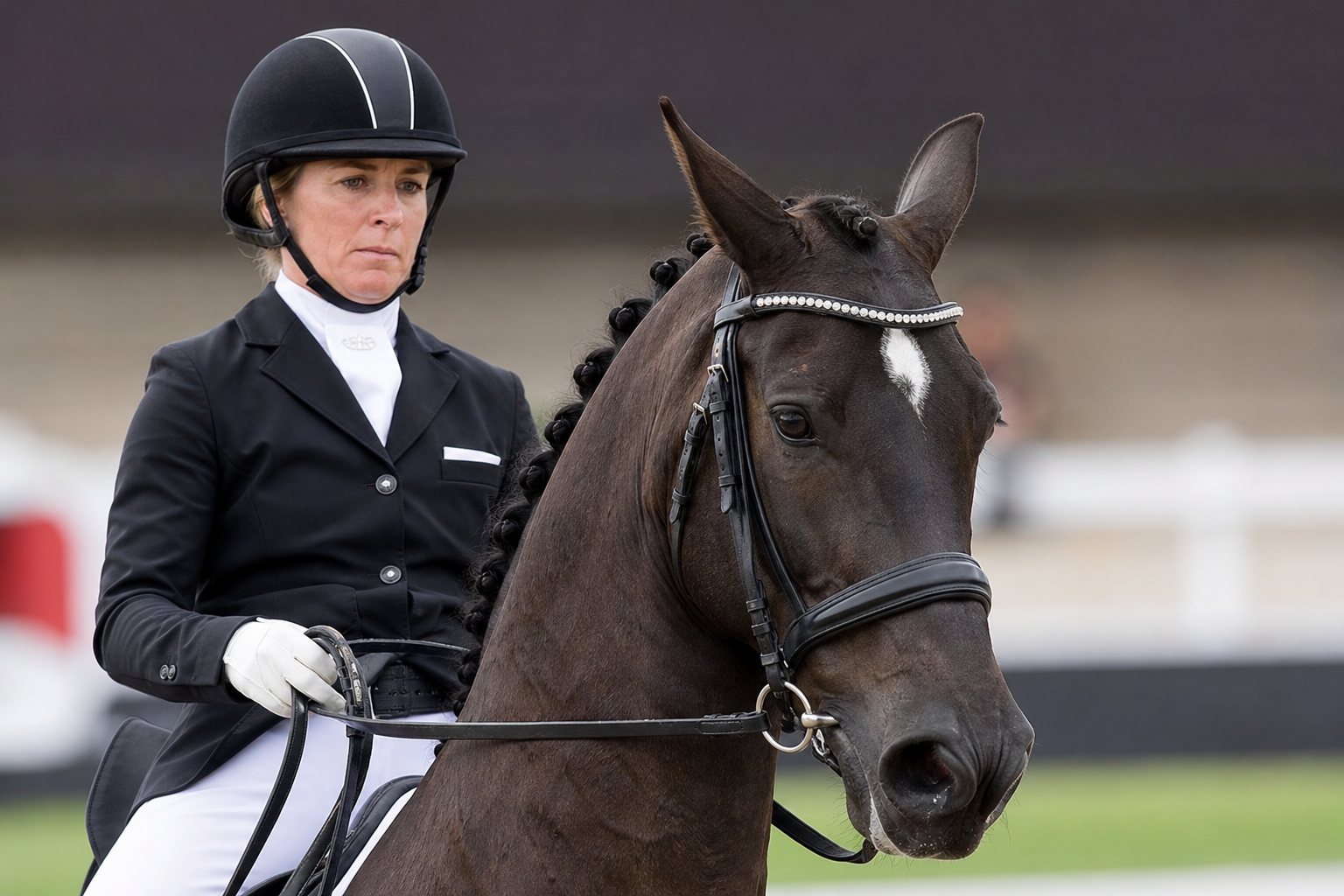
At Versailles in September 2024, Heidemarie Dresing of Germany rode into the Paralympic arena at 69 years and 65 days old, the oldest Para athlete at the Games, and left with bronze in the Grade II freestyle. In para equestrian, riders and horses compete together, men and women on equal terms, judged on the horse’s performance and the rider’s skill and not on the rider’s impairment. Para equestrian, also called para dressage or Paralympic equestrian, is the version of dressage for riders with a physical or vision impairment, and it is the only equestrian sport on the Paralympic programme.
Para Equestrian guides: what do you need?
New to para equestrian? Start with the first card. Everything here is general education, not medical advice.
History & Origins of Para Equestrian
According to the Paralympic Movement’s own sport page, the first Para equestrian competitions were held in the 1970s, and the activity began as a form of therapy and leisure. It made its Paralympic debut in 1984, with 12 medal events and 15 competitors from six nations. The sport was not on the programme in 1988 or 1992, then joined the regular Paralympic programme at Atlanta 1996. Today every event is mixed, with men and women competing together across five classes (Paralympic.org). We cite only dates found on the official page.
- 1970s: First competitions, growing out of therapy and leisure riding.
- 1984: Paralympic debut (12 medal events, 15 competitors, six nations).
- 1988 and 1992: Not on the Paralympic programme.
- 1996: Joins the regular Paralympic programme at Atlanta.
- Paris 2024: Heidemarie Dresing (Germany), aged 69, is the oldest Para athlete at the Games and wins bronze in the grade II freestyle; Michele George (Belgium) wins her sixth and seventh medals, both gold.
Legends of the Sport
Listed in no ranking order. Information is from Paralympic.org.
- Lee Pearson (Great Britain): Paralympic.org names him the sport’s most successful athlete; its results table shows 14 golds across six Games from Sydney 2000 to Tokyo 2020 (the page’s text figure of 14 medals total is inconsistent with that table).
- Sophie Christiansen (Great Britain): Won 10 Paralympic medals across four Games and has announced her retirement.
- Michele George (Belgium): Won her sixth and seventh Paralympic medals, both golds, at Paris 2024.
- Heidemarie Dresing (Germany): At 69 years and 65 days, the oldest Para athlete at Paris 2024, and a grade II freestyle bronze medallist there.
Official results and records
We list official sources instead of repeating results tables we have not checked line by line.
How we keep this current: we re-check facts after each major championship and update this page. Spot an error? See our editorial policy.
This page covers how a para dressage test works, what the five grades are for, who competes at what level, and how riders stay safe on horseback. For the wider world of riding, from trail rides to Pony Club, see our horseback riding hub.
Para equestrian at a glance
| What it is | Dressage for riders with a physical or vision impairment: a memorised test of set movements, ridden in an arena and scored by judges. |
|---|---|
| How it is judged | Judges score each movement in a test. Within each grade, riders are judged on their riding, without regard to impairment. |
| Levels | Five grades, I to V. Grade I is for athletes with the greatest degree of physical impairment and Grade V for the least. |
| Events at the Games | Individual championship test, freestyle to music and a team test (three to four riders per team). All events are mixed: men and women compete together. |
| Governing body | FEI (Fédération Equestre Internationale) worldwide; the US Equestrian Federation (USEF) in the United States, with the US Para-Equestrian Association (USPEA) supporting riders. |
| Season | Competitions run year-round indoors and outdoors depending on region; international CPEDI shows lead up to the Paralympics every four years. |
How para dressage works
A dressage test is a pattern of movements, ridden from memory, around a lettered arena. The rider and horse show walk, trot and (in some grades) canter, with transitions, circles and turns, and judges score each movement. In the freestyle the rider designs the pattern and rides it to music. What differs by grade is the gaits in the test: Grade I rides at walk, Grade II at walk and trot, and Grade III and above at walk, trot and canter, though Grade III canters only in the freestyle. FEI rules also put Grades I to III in a 20 by 40 metre arena and Grades IV and V, where possible, in a 20 by 60 metre arena.
Riders can use approved compensating aids to communicate with the horse: dressage crops, connecting rein bars, rubber bands and voice commands, according to paralympic.org. Which aids a rider may use is decided in classification, so ask your classifier and the FEI’s guidelines before you buy or modify anything. What a beginner sees is a quiet, precise picture: a horse working in rhythm, and a rider whose hands, seat and voice keep a conversation going.
What the grades are for
Grades group riders by the effect of their impairment on riding, so competition tests the partnership and not the disability. USPEA states that grades reflect physical impairment, not riding skill. A licensed physical therapist or medical doctor trained in the classification system assigns the grade. Riders need a permanent, measurable physical or vision impairment from the IPC’s recognised types, such as impaired muscle power, limb deficiency, hypertonia, ataxia, athetosis or vision impairment. Non-permanent conditions and non-physical conditions, such as ADHD or PTSD, do not qualify. In the US a rider can be classified nationally by USEF for USEF para classes or internationally by the FEI for CPEDI competitions, and medical documentation is due at least six weeks before the classification date.
Who rides and at what level
Starting out. Many riders begin in therapeutic riding programs or with a riding instructor experienced with adaptive riders, using a quiet school horse and an assistant. USPEA offers a Learning Center with Para Dressage 101 and video resources, grants for first-time classification and a virtual judging program. Equipment such as mounting ramps, extra-secure saddles or reins should be tried with an instructor.
Clubs, shows and national level. Para riders compete in USEF para classes at local and national shows, and at international CPEDI shows once classified by the FEI. Youth and college routes depend on the program, so ask about adaptive access; we found no school or college league specific to para dressage.
Paralympic status, by edition. Paralympic.org says the sport first appeared at Stoke Mandeville and New York in 1984 (12 medal events, 15 competitors, six nations), was absent afterwards and joined the regular programme at Atlanta 1996. At Paris 2024 it was held at Versailles. For LA28 (15 to 27 August 2028) the IPC confirmed 11 medal events, all mixed, with 78 athlete places. Great Britain leads the medal table with 34 medals, Lee Pearson has won 14 individually and 19 nations have won Paralympic medals. There are currently no Para showjumping events. As of 2026, check the official programme for the current Games.
Physical demands
Riding is a whole-body skill that looks easy when done well. A rider must stay balanced on a moving horse, follow its motion with the pelvis and trunk, and keep hands steady. In one study, riders’ heart rates climbed from about 91 to about 150 beats per minute during a public performance, a larger rise than their horses’; nerves matter as well as effort. A study of 147 riders found that 99.3% sat asymmetrically at sitting trot, so symmetry is a lifelong project even for riders without an impairment. Para riders often put extra effort into core strength, hip mobility and balance, shaped by their own impairment. Researchers are also working on a more evidence-based classification system for para dressage, which shows how much of this sport is still being learned.
Health and safety in para equestrian
This is general information, not medical advice. If you are hurt, see a sports medicine doctor, physical therapist or athletic trainer. Para-specific injury surveillance for riding is limited, so the figures below come from riders in general, and para riders should discuss their own risks with a clinician who knows their impairment.
Falls, head injuries and helmets
CDC researchers estimated about 103,000 emergency department visits a year for horse-related injuries in the US (2001 to 2003), most of them riders who fell or were thrown, and about 23% of injuries involved the head or neck. Wear a properly fitted helmet certified to ASTM F1163 and SEI standards whenever you are on a horse. USEF strongly encourages helmets for all riders, and a 2025 review found that helmets protect against skull fracture and traumatic brain injury. Replace a helmet after an impact. Anyone who hits their head should be removed from riding; the CDC’s HEADS UP guidance is to recognize the signs, remove the person from activity, and have a healthcare provider decide when a return is safe. Call 911 for danger signs such as repeated vomiting, a seizure or worsening confusion. Never move someone with a possible neck or back injury.
Back pain and long hours
A 2024 systematic review of 14 studies with 4,527 riders found low back pain more common than in the general and athlete populations, with point prevalence between 27.9% and 87.9%. The reviewers named workload and stable duties as significant risk factors. Para riders with an upper limb or trunk impairment should plan rest, stretching and seat changes with their physical therapist.
Mounting, tack and ground handling
Mounting and dismounting can be where an adaptive rider needs the most help. Use a ramp or mounting block set up by a trained person, tack that has been checked and an assistant who knows the horse. Injuries also happen on the ground, for example when a person is kicked while handling a horse, so learn safe handling. Follow your facility’s rules on safety stirrups or other adaptive tack, and ask your instructor before changing equipment.
Training, recovery and nutrition pointers
Time in the saddle with a good coach is the main training; many riders add lunge lessons, core and balance work, and mounted exercises tailored to their grade. Sleep is the base of recovery: the CDC recommends at least 7 hours for adults and 8 to 10 for teens. On show days drink water, eat familiar foods and bring snacks. The standard sport’s pages are a good starting point: training, recovery and nutrition.
Gear
The essentials are a properly fitted, certified riding helmet, boots with a heel, and a saddle and bridle that fit both rider and horse. Many riders add a body protector, which USEF lists under ASTM F1937 or SEI standards for some competitions; check what your event requires. Certification labels are the standard to look for; claims like “extra safe” are the maker’s own. Adaptive tack, rein bars and saddles should be fitted with the help of a classifier and a trained saddle fitter, which is why we do not list them.

Ovation Deluxe Schooler Helmet
- ASTM F1163-15 and SEI certified
- Dial fit, washable liner

Tipperary Eventer Pro Body Protector
- ASTM F1937-04 and SEI certified (maker)
- Extended back covers tailbone
OOFOS OOahh Slide
- OOfoam slide
- APMA Seal of Acceptance
- Machine washable
$59.95 at Amazon, as of Nov 17, 2026 01:07 UTC
Check price on AmazonRelated sports and disciplines
Parent: Horseback riding. Other adaptive sports: para archery, para cycling and blind football.
Para equestrian FAQs
Is para equestrian in the Paralympics?
Yes. It has been on the regular programme since Atlanta 1996 and the IPC confirmed 11 mixed medal events for LA28. Check the official programme for the current Games.
Do men and women compete together?
Yes. All Paralympic equestrian events are mixed, with men and women together in the same classes.
What do the grades mean?
There are five grades, I to V. Grade I has the greatest degree of physical impairment and Grade V the least. Grades describe the impairment, not riding skill.
Which aids can riders use?
Paralympic.org lists dressage crops, connecting rein bars, rubber bands and voice commands. Which are allowed for each rider is decided in classification.
How do I get classified?
Contact USEF for national classification, or attend an FEI classification at a CPEDI show for international classification. Send medical documentation at least six weeks ahead. USPEA can help first-time applicants.
Sources
- Paralympic.org: equestrian
- IPC: LA28 Paralympic medal event programme and athlete quotas
- USPEA: para dressage classification
- FEI: Para Dressage Rules 2025
- CDC authors: horse-related injuries in US emergency departments (Br J Sports Med, 2006)
- Helmets and vests in equestrian sport (Sports Health, 2025)
- Low back pain in equestrians, a systematic review (Sports, 2024)
- Rider and horse heart rate in public performance (Vet J, 2013); Rider asymmetry at sitting trot (Animals, 2022)
- Towards an evidence-based classification system for Para Dressage (Animals, 2023)
- USEF: GR8 conduct of licensed competitions (helmets and vests)
- CDC HEADS UP: responding to a concussion; CDC: sleep
Keep exploring: the horseback riding hub, horseback riding injuries, riding gear, the sports hub and our recovery tools guide.