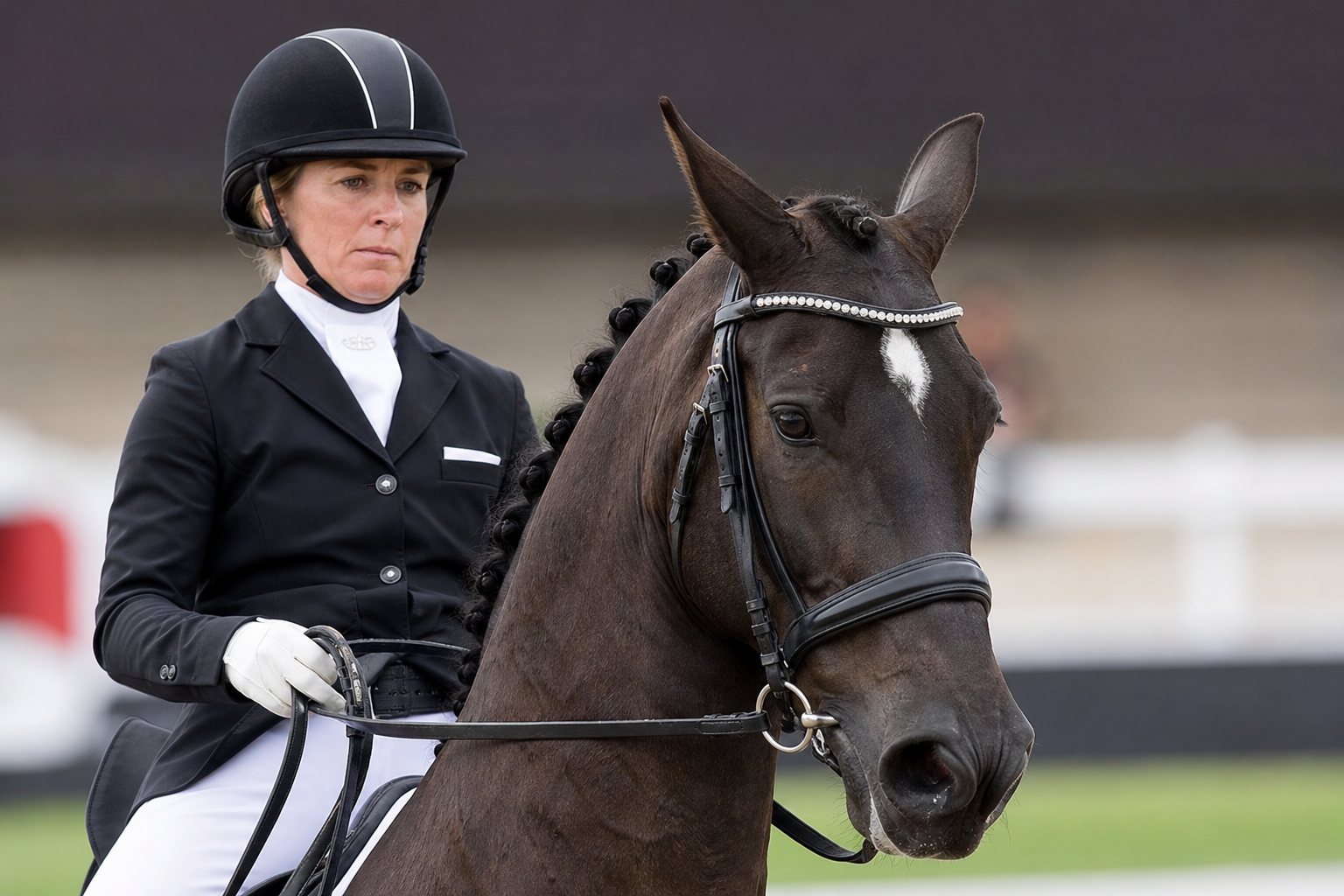
The rider waits outside the arena for the bell, and the horse can feel everything: a held breath, tight hands, a racing heartbeat. In a sport where a partner with a mind of its own is part of the team, mental training means building skills for focus, confidence and calm that you and your horse can use under pressure. It is different from mental health care, which is covered below. This page is general information, not therapy. Rules are on our rules page, and the sport overview is on the para equestrian hub.
Quick answer: Simple, practised routines (breathing, a short checklist, a reset cue) are the most common tools riders use for focus and nerves, and they work best when rehearsed at home. In one study, riders’ heart rates rose from about 91 to about 150 beats per minute in a public performance, more than their horses’, so nerves are real and physical. Mental skills do not guarantee results. Anxiety, depression, disordered eating or burnout are health matters: talk to a qualified professional, or call or text 988 in the US.
Why a rider’s mind matters in dressage
The horse is part of the system. Von Lewinski and colleagues (The Veterinary Journal, 2013) measured six horse-rider pairs and found riders’ heart rates rose from about 91 to about 150 beats per minute in public performance, compared with about 94 to 118 in rehearsal, and that spectators changed riders’ cardiac activity more than the horses’. It was a small study of riders in general, not para riders. This is a link, not proof that calm causes high scores. Still, a rider who can stay steady has a better chance to help a horse stay steady.
Confidence and motivation
Confidence in dressage comes from preparation: knowing the test, having ridden it enough that you can trust it, and having feedback you believe. Keep goals specific and in your control, such as “keep my breathing slow through the first halt” instead of “win.” Mix process goals (rhythm, straightness) with outcome goals (a percentage), as common sport-psychology practice suggests. Classification and grade are set by the system and cannot be changed by effort, so compare yourself with your own past scores and other riders in your grade, not with riders in other grades. This advice is general coaching practice rather than para-specific research.
Focus, routines and the test itself
A test is a sequence of movements, each scored. A simple pre-ride routine can make that sequence easier: arrive early, walk the arena if allowed, warm up with the same pattern, then take three slow breaths before the entry. The 2026 position statement of the Exercise and Sport Science Australia (Schweickle and colleagues) on psychological strategies describes pre-performance routines among the strategies with support in athletes; we use that as general support and not as a para-specific finding.
If you ride with a commander, who is allowed to read each movement once or twice from the official text, practise with that person so the voice becomes part of your rhythm. Under FEI rules riders in Grades IV and V may not use their voice during a test, and a caller for riders with vision impairment may only name the letters, so know the rules for your grade before you plan your self-talk. A reset cue, such as a deep breath and one word like “soft”, helps after a mistake. Reset routines and cue words are common coaching practice, not studied in para riders.
Imagery and visualization
Imagery means rehearsing the test in your mind: the centre line, the halts, the feel of the horse. A study by Louis and colleagues (Research Quarterly for Exercise and Sport, 2012) found that 21 skiers and 16 riders, novice and expert, underestimated their course time when imagining it, which suggests that imagery timing needs practice. Try it in short, regular sessions, and let it include what you will feel and hear, not only what you will see. Use it in addition to riding, not instead of it.
Handling pressure and setbacks
- Name the nerves. Pre-show nerves are common. Slow breathing and a steady walk-in routine may help; this is general practice.
- Accept that the horse has days too. A spook or a missed transition is not a verdict on you.
- Reset between movements. Let the last movement go and ride the next one.
- After a bad test, write down what went well first, then one thing to work on. This is common coaching practice, not a study result.
- After a fall, return in small steps with your instructor and, after a head injury, a provider’s approval. We found no trials on rebuilding confidence after a fall, so the step list is general guidance.
Teamwork and your support group
Para riders often depend on grooms, helpers, commanders, coaches and classifiers. Clear plans for who stands where and who does what (the FEI limits helpers around the arena for Grades I to III) can lower stress. At team events, agree in advance on communication and what to do if something goes wrong.
Competition preparation
Make a simple plan: what to pack, when to arrive, when to warm up, and what to do if your time changes. Check the schedule, the arena size for your grade and any approved aids on your classification list. Logistics on the day are in our rules page and gear page.
Mental health is not the same as mental performance
Mental skills help you focus and handle pressure. They do not treat anxiety, depression, disordered eating, substance misuse or burnout, and they should not replace care from a qualified professional. Research suggests para athletes are not immune. In a 44-week study of 59 Swedish elite para athletes, the weekly prevalence of anxiety symptoms was 15% and depressive symptoms 21%, and over the 44 weeks 58% reported anxiety symptoms and 42% depressive symptoms at some point (BMJ Open Sport and Exercise Medicine). A German study of 122 elite para athletes screened over 124 weeks found 48.4% screened positive at some point, and nearly two-thirds of those followed up were already in care or were recommended to seek it (British Journal of Sports Medicine). In a Polish cohort of 137 Paralympic athletes, 61% scored above a screening threshold for psychological distress, 75.2% needed no mental health action, 18.3% were advised psychoeducation or a sport psychologist and 7.3% were referred to a specialist (Journal of Human Kinetics). The IOC’s consensus statement on mental health in elite athletes treats mental health as part of athlete health and supports early identification and care.
If you are struggling, talk to your doctor, a sport psychologist or a counsellor. In the US you can call or text the 988 Suicide and Crisis Lifeline at 988, any time. Coaches and teammates should take concerns seriously and not treat them as a lack of toughness.
Para equestrian mental training FAQs
How do I stay calm before a test?
Practise a routine at home: slow breathing, a short checklist and the same warm-up. Nerves are normal and physical, so aim to manage them, not remove them.
Does visualization work for riders?
Imagery is a common tool, and one study found that riders and skiers misjudge imagined course time, so practise it often. It supports riding practice and cannot replace it.
Can I use my voice in the test?
Riders in Grades I to III may use their voice in moderation; Grades IV and V may not, under the 2026 FEI rules.
What if I feel anxious or low most days?
That is a health matter, not a mental-skills problem. See a doctor or mental health professional, or call or text 988 in the US.
Will mental training raise my score?
It may help you ride closer to your best, but no technique guarantees performance.
Sources
- von Lewinski M et al., Vet J 2013 (PubMed 23380228)
- Louis M et al., Res Q Exerc Sport 2012 (PubMed 22428415)
- Schweickle et al., ESSA position statement 2026 (PubMed 42271117)
- Reardon et al., IOC consensus statement on mental health in elite athletes, 2026 (PubMed 42580854)
- Mental distress and injury in elite Para athletes, BMJ Open Sport Exerc Med (PubMed 39949565)
- Mental health surveillance in elite Para athletes, Br J Sports Med (PubMed 38950918)
- SMHAT-1 in Paralympic versus Olympic athletes, J Hum Kinet (PubMed 42211805)
- 988 Suicide and Crisis Lifeline
- FEI Para Dressage Rules 2026
General information for education only, not medical or psychological advice. If you are in crisis, call or text 988 (US) or your local emergency number. How we write our pages is in our editorial policy. Next: recovery, gear and the para equestrian hub.