This article contains affiliate links: if you buy through them we may earn a commission, at no extra cost to you. Read our affiliate disclosure.
Before a rider ever sits in the saddle, someone checks a girth, a stirrup leather and a helmet buckle. In para dressage the tack room holds one more layer: the adaptive equipment that lets rider and horse communicate fairly. Para dressage gear starts with protective equipment that fits and is certified, then adds saddlery and aids that suit the rider’s classification. This page explains what matters, how to fit and inspect it, and which claims are standards and which are a maker’s words. Rules are on our rules page; how gear lowers risk is on injury prevention.
Quick answer: Buy a helmet certified to the standard your events require (ASTM F1163 with SEI certification in the US), make sure it fits snugly, replace it after an impact, and never choose adaptive aids by yourself: your classifier and the FEI rulebook decide what is permitted for you. Certification labels are standards; terms like “extra safe” are a maker’s claim. See a physical therapist or a trained saddle fitter for help matching equipment to your body.
Helmet: the one thing to get right
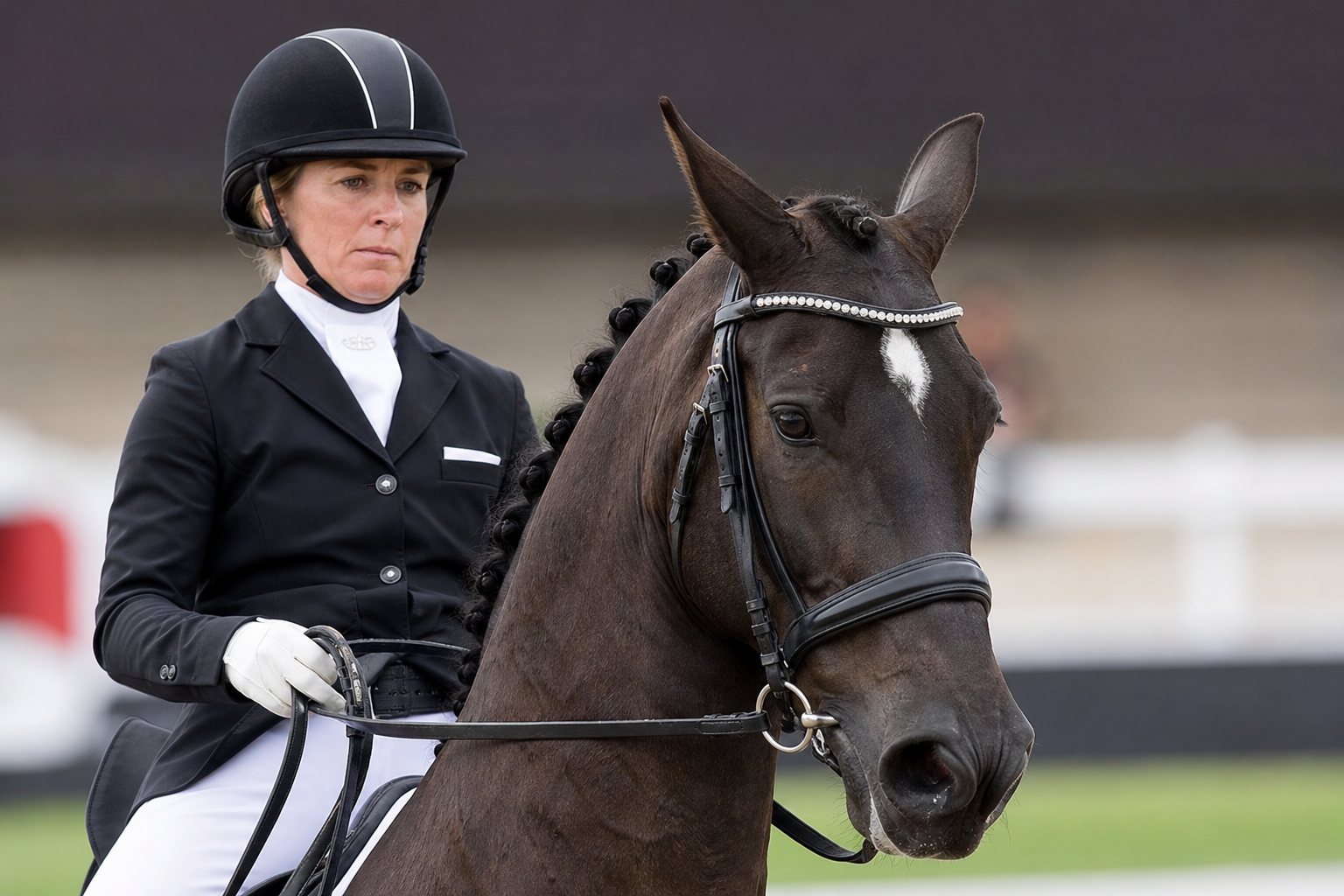
The FEI Para Dressage Rules say protective headgear must be worn by athletes, and by anyone else, at all times while mounted, and that a rider who breaks the rule must stop riding until it is properly fastened. In the US, US Equestrian lists helmets certified to ASTM F1163 with SEI certification, and a 2025 review by Crawford and colleagues in Sports Health found that helmets protect against skull fracture and traumatic brain injury. Helmets are designed for a single serious impact. Troxel’s certification page says to replace a helmet after one impact event and every five years, and many other makers say similar things, so follow your maker’s instructions.
Fit decides whether a helmet is worn and whether it works. In a 2020 survey of 2,598 adult riders, 48.6% who did not always wear a helmet gave poor fit as a reason (Stanfill and colleagues, Concussion). Check that the helmet sits level, a finger-width above the eyebrows, does not rock when you shake your head, and that the harness is snug under the chin. If you have limited hand function, test the buckle or dial before you buy. Hat covers for competition must be black or another dark colour under the FEI rules. A 2025 study of 357 collegiate riders found no difference in reported head injury between MIPS and non-MIPS helmets (Gould and colleagues), so a certification label matters more than an add-on.
Safety vests and body protectors
The FEI rules permit safety vests, including inflatable ones, in a dark colour. A vest is not a substitute for a helmet. Crawford and colleagues found that vests may protect the thorax but were not associated with fewer spinal cord injuries, and US Equestrian recommends body protectors that meet ASTM F1937 or SEI standards for some competitions. If you have a spinal condition, a stoma, a pump or a catheter, ask your clinician and a qualified fitter before choosing a vest.
Boots, breeches and the rest of the kit
Under FEI rules, boots must be black or dark and have a heel; a heel stops the foot from sliding through the stirrup. Competition breeches are cream, beige, white or off-white with a plain-coloured jacket, and gloves if worn are white, off-white or the colour of the coat. A rider with a vision impairment wears a white arm band while mounted outside the arena, and a rider with a hearing impairment wears a light blue one, according to the rulebook. Check your event’s own rules for dress, and check the fit of everything that touches your seat or legs: seams and buttons can rub if skin sensation is reduced.
Adaptive equipment (compensating aids)
The FEI sorts aids into three groups, and it is your responsibility to make sure they are allowed. Standard aids can be used by anyone and are not listed on the FEI Classification Master List; they include a soft hand hold, neck strap, elastic bands on stirrups, enclosed or magnetic stirrups, a deep saddle, one whip, joined reins, elastic rein inserts and a safety vest. Profile-specific aids are allowed for certain functional profiles and must be recorded after classification; examples are foot reins, looped or ladder reins, a connecting rein bar, a hard hand hold, two whips and a commander or callers. Non-standard aids are custom items that the FEI’s panel must approve in writing at least two weeks before the horse inspection. A soft hand hold may not be more than 10 cm above the top of the pommel under the rules. Because every aid changes how the rider sits and how the horse feels it, they should be fitted with a classifier’s guidance and a trained saddle fitter, and we do not recommend specific adaptive tack here.
Standards versus maker claims
- Standards are tested by a third party against a published specification, such as ASTM F1163 with SEI for helmets or ASTM F1937 for body protectors. Look for the label inside the helmet.
- Maker claims such as “ventilated,” “ultra-light” or “extra protection” are descriptions, not guarantees.
- Fit and wear change protection: a certified helmet that is loose or damaged does less.
- We did not compare helmets or vests for protection, and nobody should rank them by price.
Inspect before every ride
Look over the helmet shell and liner for cracks, dents or loose parts. Check girth, stirrup leathers and irons, reins, bridle stitching and any hand holds, straps or rein bars for wear. Make sure the saddle and any attachments are secure and that the horse’s tack fits the horse. Ask your instructor to look over any new adaptive equipment before the first ride. After a fall or knock, retire the helmet and get tack checked.
Product picks
Two helmets and one body protector with certifications recorded by the makers. We do not list prices, and these picks are examples, not rankings. Confirm fit, colour rules and current certification before you buy.

Troxel Spirit Horse Riding Helmet
- DialFit adjustment
- Removable, washable headliner
- Certification per maker, check label

Ovation Deluxe Schooler Helmet
- ASTM F1163-15 and SEI certified
- Dial fit, washable liner

Tipperary Eventer Pro Body Protector
- ASTM F1937-04 and SEI certified (maker)
- Extended back covers tailbone
- Check dark-colour rule
Para equestrian gear FAQs
Do I have to wear a helmet in para dressage?
Yes. The FEI rules require protective headgear for athletes at all times while mounted.
Who decides which adaptive equipment I can use?
Classifiers record profile-specific aids on the FEI Classification Master List; non-standard aids need written FEI approval. Standard aids need no listing.
How do I know if a helmet fits?
It should sit level, feel snug without pressure points and not move when you shake your head. A trained fitter can help.
When should I replace a helmet?
After a serious impact, and by the maker’s age limit. Troxel says one impact event and every five years.
Is a safety vest required?
Not under the FEI rules we read: vests are permitted, in a dark colour. Check your event’s rules.
Sources
- FEI Para Dressage Rules 2026, Articles 8427 and 8432 and annex
- US Equestrian, GR8 Conduct of licensed competitions
- Troxel, helmet certifications
- Crawford AE et al., Sports Health 2025 (PubMed 39206526)
- Stanfill AG et al., Concussion 2020 (PubMed 33976900)
- Gould S et al., Clin J Sport Med 2025 (PubMed 39495084)
- Tipperary Eventer Pro, maker page
General information for education only, not medical advice or a classification decision. Product links may earn us a commission. See a sports medicine doctor, physical therapist or trained saddle fitter for help with your own equipment. How we write our pages is in our editorial policy. Next: the para equestrian hub, injury prevention and horseback riding.