The horse spooks at a flapping banner, the rider’s weight shifts, and for half a second everything depends on a seat, a hand hold and a helper standing nearby. Injury prevention in para dressage means the habits, checks and equipment that lower the chance of getting hurt, and lower how badly, without promising anything is risk-free. This page is about reducing risk. What injuries look like is on our injuries page, so we do not repeat it here.
Quick answer: Wear a properly fitted, certified helmet every time you are mounted, mount and dismount with trained help, learn safe ground handling, plan rest and cooling if your impairment affects heat control, and check tack before each ride. No study we found measures injury prevention in para riders, so these steps come from general riding research, FEI rules and clinical reviews. See a sports medicine doctor, physical therapist or athletic trainer if pain persists, and call emergency services after a fall with head or neck symptoms.
What the evidence covers (and does not)
We did not find a published injury surveillance study specific to para dressage. The FEI Code of Conduct says competition injuries should be monitored and risk factors such as ground conditions and the frequency of competitions examined, but no results turned up. The nearest numbers come from riders in general. The CDC authors Thomas and colleagues (British Journal of Sports Medicine, 2006) estimated about 102,904 emergency department visits a year for horse-related injuries in the United States in 2001 to 2003, with 66.1% involving mounted riders and 23.2% affecting the head or neck. Para riders should discuss personal risks with a clinician who knows their impairment.
Warm-up
We found no published warm-up program for riders, so what follows is common coaching practice. Spend the first minutes walking on a long rein, then add gentle trunk movements and transitions before asking for more. Some riders add a few minutes of arm and trunk mobility before mounting, adapted to what is comfortable. The FEI rules provide warm-up and ten-minute arenas at larger events and require a steward to supervise warm-up.
Technique and handling
Learn how to mount and dismount safely, how to halt calmly, and how to fall or stay with the horse as your instructor advises. We found no source showing that a particular falling technique reduces injury, so follow your instructor’s training for your impairment. On the ground, the Penn State Extension says to approach a horse from the front toward the shoulder, speak so the horse knows you are there, never stand directly behind it and never wrap a lead rope around your hand or body. Thomas and colleagues found people who were not mounted were most often injured by a kick.
Training load and rest
Sudden jumps in workload are a common worry across sports. Brenner and colleagues for the American Academy of Pediatrics (Pediatrics, 2016) recommend one to two days off a week and about three months off a year from a single sport for young athletes. For adult riders there is no riding-specific rule of thumb we could source. A 2024 systematic review of 14 studies with 4,527 riders found low back pain more frequent with higher workload and stable duties (Sports (Basel), 2024). Plan lighter days after long shows, and count barn work as work.
Strength and conditioning
Core stability and balance work build the trunk. A 2025 study of 75 people aged 15 to 30 found sport riders had better core stability than recreational riders (Skwierawska and colleagues). A small group of nine equestrians with chronic low back pain improved after eight weeks of exercise (Weeks and colleagues, 2024), but the study had no control group. A physical therapist can match exercises to your impairment and spasticity. See our training page for more.
Environment, surfaces and heat
Warm, humid arenas and long days in the sun stress the body. For riders with spinal cord injury, a review in Sports Medicine explains that they lose vasomotor and sudomotor control below the lesion, and that tetraplegic athletes show much faster rises in core and skin temperature than paraplegic athletes. A 2021 systematic review of 32 studies in Frontiers in Physiology found high-level lesions need special attention in temperate and hot conditions and that cooling techniques can reduce this risk. A 2022 meta-analysis of 17 studies (145 participants) found pre-cooling lowered core temperature more than cooling during exercise, with greater effects in tetraplegic athletes (Journal of Science and Medicine in Sport). Shade, cool drinks and fans are general practice; ask your doctor for a plan.
Footing matters as well. FEI rules require the arena to be flat and level, predominantly sand, with limits on slope. Check your own arena for holes, wet patches and loose items before you ride.
Two health risks need a personal plan from your doctor, because we found no riding-specific source. Autonomic dysreflexia is described as a life-threatening condition unique to spinal cord injury in a 2018 report in Medicine and Science in Sports and Exercise, and clinicians commonly teach that triggers can include a full bladder or tight clothing. Skin breakdown from pressure and friction is a second concern for riders who sit for long periods or have reduced sensation; check skin after riding and ask your clinician about padding. Both are general guidance, not evidence from para riders.
Protective equipment and fit
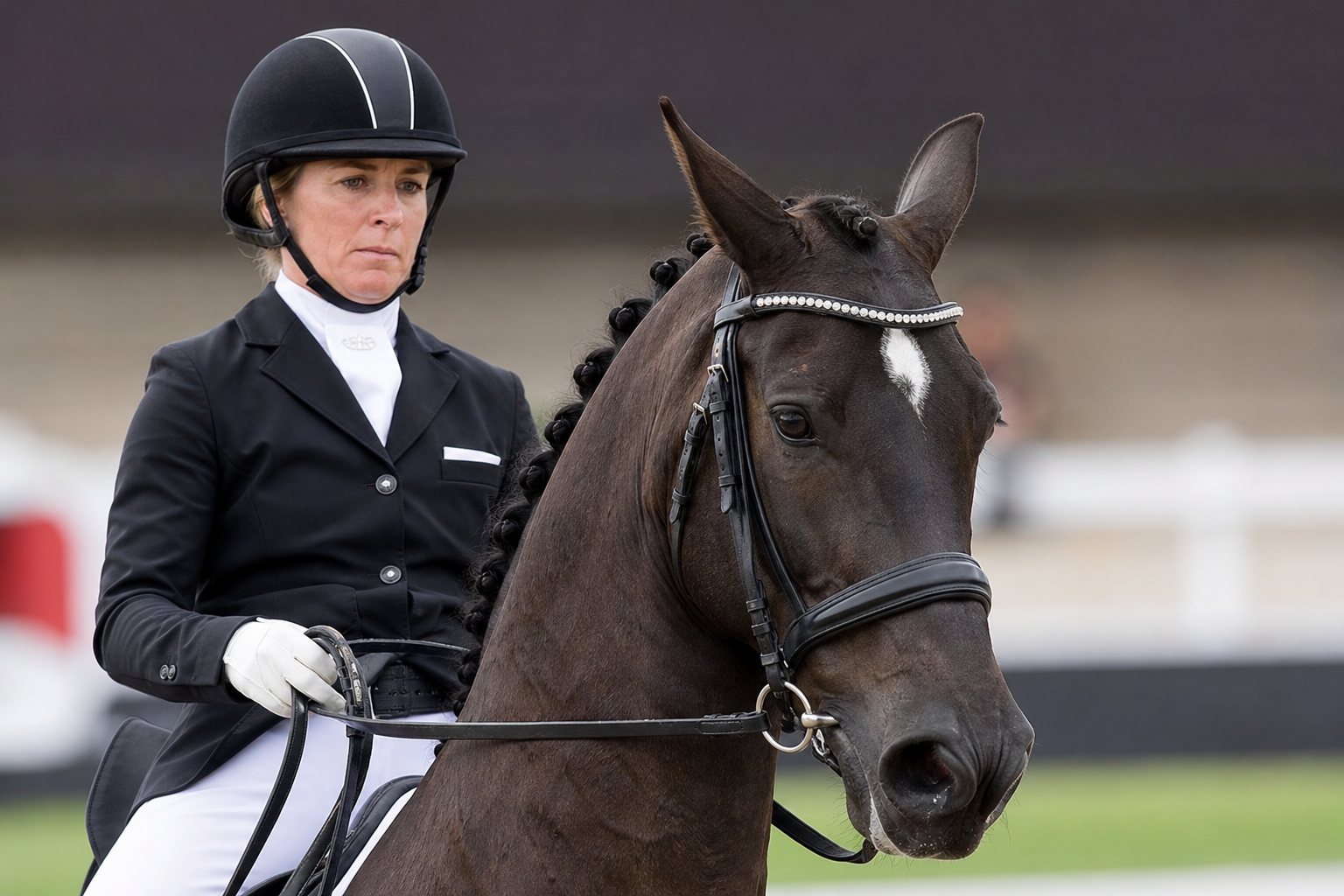
FEI rules say protective headgear must be worn by athletes and anyone else at all times while mounted, and that safety vests, including inflatable ones, are permitted. In the US, USEF accepts helmets certified to ASTM F1163 with SEI certification, and Troxel says to replace a helmet after one impact. A 2025 review by Crawford and colleagues in Sports Health found that helmets protect against skull fracture and traumatic brain injury, and that vests may protect the chest but were not associated with fewer spinal cord injuries. Poor fit is a common reason riders do not wear helmets (48.6% in a 2020 survey of 2,598 adult riders). Boots with a heel are required under FEI rules. Standard and profile-specific adaptive equipment, such as magnetic stirrups, soft hand holds and rein bars, can also reduce risk when fitted by a trained person; the FEI says what is allowed. See our gear page.
What prevention cannot do
No helmet, vest or habit can stop all falls. Horses are large and may react to something you cannot see. Prevention lowers risk but cannot remove it. Under FEI rules, a fall in the arena eliminates the combination and the rider must be checked by medical staff before remounting.
When to see a professional
See a clinician for pain that stays in one spot, shows up at rest or changes how you ride, and for numbness, new weakness or spasms. After any head impact, the CDC’s HEADS UP advice is to remove the person from activity and have a health care provider decide when to return; symptoms can show up hours later. Call emergency services for loss of consciousness, repeated vomiting, worsening headache, confusion or neck pain.
Para equestrian injury prevention FAQs
Do para riders have to wear helmets?
Yes at FEI events: protective headgear must be worn at all times while mounted. Wear one whenever you are on a horse.
Is a safety vest worth it?
Vests are permitted under FEI rules. A 2025 review found vests may protect the thorax but were not linked to fewer spinal cord injuries, so they are one layer among several.
How can I stay cooler while riding?
If your impairment affects sweating or heat control, ask your doctor. Reviews show cooling before and during exercise can help athletes with spinal cord injury.
How do I mount safely?
Use a ramp or block set up by a trained person, tack that has been checked and an assistant who knows the horse. Ask your instructor.
Sources
- Thomas KE et al., Br J Sports Med 2006 (PubMed 16611723)
- Crawford AE et al., Sports Health 2025 (PubMed 39206526)
- Stanfill AG et al., Concussion 2020 (PubMed 33976900)
- Low back pain in equestrian riders, systematic review, Sports (Basel) 2024 (PubMed 39728895)
- Thermoregulation during exercise in people with spinal cord injuries, Sports Med (PubMed 17004849)
- Thermoregulatory responses in spinal cord injury, systematic review, Front Physiol (PubMed 33868002)
- Pre-cooling and per-cooling in athletes with spinal cord injury, J Sci Med Sport (PubMed 35272937)
- Unintentional boosting in a tetraplegic athlete, Med Sci Sports Exerc (PubMed 30102676)
- Brenner JS, AAP, Pediatrics 2016 (PubMed 27573090)
- Penn State Extension, Safe horse handling
- CDC HEADS UP, response
- FEI Para Dressage Rules 2026
General information for education only, not medical advice. Please see a sports medicine doctor, physical therapist or athletic trainer about your own impairment and risks. How we write our pages is in our editorial policy. Next: para equestrian injuries, gear and the para equestrian hub.