This article contains affiliate links: if you buy through them we may earn a commission, at no extra cost to you. Read our affiliate disclosure.
Thursday, 29 August 2024, the first day of competition at the Paris Paralympics, and the first gold medal of the Games was decided in a velodrome. Caroline Groot of the Netherlands rode the women’s C4-5 500 m time trial in 35.566 seconds, an average of about 50.6 km/h, after defending champion Kadeena Cox of Great Britain crashed in the opening 50 metres. Para cycling (also written paracycling or para-cycling) is cycling for athletes with a physical or vision impairment, raced on road and track on bicycles, tricycles, handcycles and tandems, and it has been on the Paralympic programme for about 40 years.
Para Cycling guides: what do you need?
New to para cycling? Start with the first card. Everything here is general education, not medical advice.
History & Origins of Para Cycling
Para cycling reached the Paralympic Games in 1984, when road cycling was on the programme in New York and Stoke Mandeville with 22 athletes in seven events. Participation nearly doubled by Seoul 1988, and track cycling joined at Atlanta 1996 and has been on every programme since (Paralympic.org). Over the following Games the sport grew into one of the larger Paralympic programmes, and the International Paralympic Committee lists 51 medal events and 220 athlete places for Los Angeles 2028 (Paralympic.org). This page covers only dates we could tie to those official pages; the earliest informal days of adapted cycling are not documented here.
- 1984: Road Para cycling debuts at the Paralympics (New York and Stoke Mandeville), 22 athletes in seven events.
- 1988: Seoul keeps seven events, with about 40 athletes.
- 1996: Track Para cycling debuts at Atlanta.
- 2008: Sarah Storey (Great Britain) wins her first Para cycling gold at Beijing, after four Games in Para swimming.
- 2012: The mixed team relay is added to the road programme at London.
- 2020: At Tokyo, Paige Greco (Australia) wins the C1-3 individual pursuit in a world-record 3:50.815.
- 2024: Paris stages 51 medal events, 17 on the track and 34 on the road.
Legends of the Sport
Athletes from different eras, listed in no ranking order. Information is from Paralympic.org.
- Sarah Storey (Great Britain): 28 Paralympic medals in total, including 12 golds in Para cycling, after starting in Para swimming.
- Alex Zanardi (Italy): At Rio 2016 he won gold in the H5 road time trial and in the mixed road team relay, plus silver in the road race.
- Keiko Sugiura (Japan): At Tokyo 2020, aged 50, she won both the time trial and the road race in C1-3.
- Paige Greco (Australia): Tokyo 2020 C1-3 individual pursuit champion in a world-record 3:50.815.
- Amanda Reid (Australia): Won the C1-3 time trial at Tokyo 2020.
- Lauro César Chaman (Brazil): At Rio 2016, the first Brazilian to win a cycling medal at either the Olympic or Paralympic Games.
- Caroline Groot (Netherlands): Won the first gold medal of Paris 2024, the women’s C4-5 500 m time trial, in 35.566 seconds (Paralympic.org).
Official results and records
We list official sources instead of repeating results tables we have not checked line by line.
- Paralympic.org: Para cycling road and Para cycling track
How we keep this current: we re-check facts after each major championship and update this page. Spot an error? See our editorial policy.
This page explains how Para cycling works in plain words: the four equipment groups, how classification keeps racing fair, how to get started, and how to stay healthy on a bike you may sit in, lie in or ride with a partner. For regular road and track riding, see our cycling guide.
Para cycling at a glance
| What it is | Bicycle racing for athletes with eligible physical impairments or vision impairment, on road and track. |
|---|---|
| How it is won | Fastest time or first across the line, depending on the event: time trials, road races, and on the track sprints, time trials and pursuits. Athletes race in sport classes grouped by how their impairment affects cycling. |
| Equipment groups | C (conventional bicycle, adapted if needed), T (three-wheeled tricycle), H (handcycle) and B (tandem with a sighted pilot). Road events use all four; track events use bicycles and tandems. |
| Classes | C1-5, T1-2, H1-5 and B1-3. In every group a lower number means a greater impact of the impairment on riding. |
| Governing body | The UCI (Union Cycliste Internationale) runs Para cycling worldwide; in the US, USA Cycling handles national classification. |
| Paralympic status | Paralympic sport since 1984 (road) and 1996 (track). Paris 2024 had up to 220 athletes and 51 medal events. The IPC’s LA28 programme (announced 3 June 2025) lists 51 Para cycling medal events and 220 athlete places. |
How Para cycling works
The races will look familiar: a start line, a course, a finish. What is different is the machine under the rider, and that determines the group they race in.
- C: bicycle. A standard two-wheeled bike, with adaptations if needed. USA Cycling places in the C classes athletes with impaired range of movement or a coordination impairment who still ride a regular bicycle; USA Cycling also lists limb deficiency, leg length difference and impaired muscle power among the eligible impairments.
- T: tricycle. For athletes who cannot ride a two-wheeler because of poor balance or severe restriction in pedalling from a coordination impairment, according to USA Cycling.
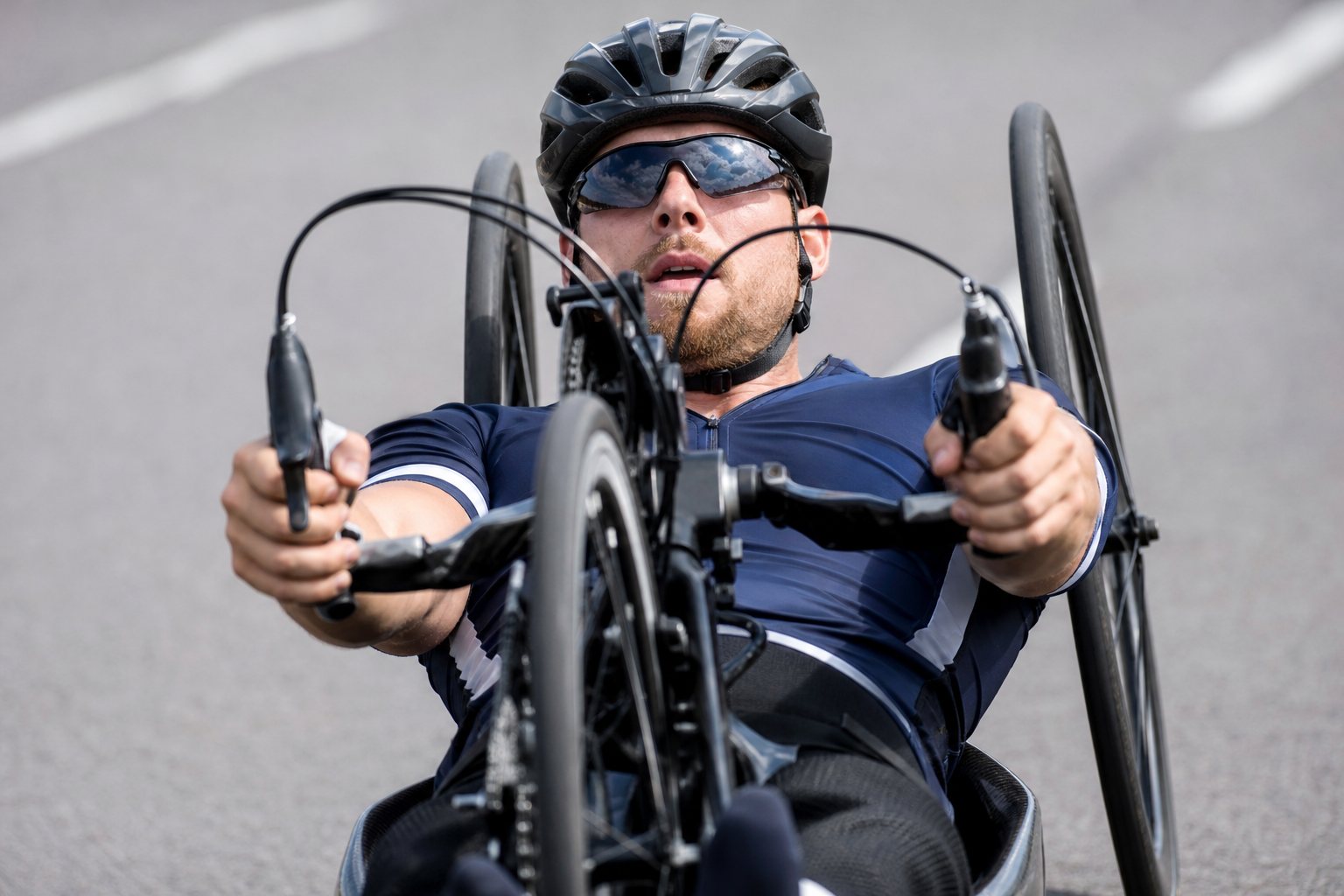
- H: handcycle. A low, recumbent machine driven by the arms (or arms and trunk). Handcyclists race on the road only.
- B: tandem. Athletes with a vision impairment ride a tandem behind a sighted pilot who steers and sets the pace. The athlete on the back is called the stoker.
Road events are held on an outdoor circuit and use all four machine types; track events are held in a velodrome and use bicycles and tandems. At Paris 2024 the 51 medal events split into 17 on the track and 34 on the road, and the road programme was 15 road races and 19 time trials. London 2012 added the mixed team relay, which is still part of the road programme.
Classification in plain words
Classification is not a medical label. It exists to group athletes whose impairments limit cycling to a similar degree, so the race is decided by training, tactics and talent. The UCI explains that each athlete is assessed by a panel of a medical classifier and a technical classifier, who may watch the athlete get on the bike, ride in a parking lot or simulate a standing start, and then observe them in competition before a final decision. The athlete submits medical information beforehand. Athletes who want to compete internationally need a UCI licence and must send the UCI medical diagnostic form six weeks before the classification date, according to USA Cycling.
Who rides Para cycling, and at what level
Beginners and clubs. Many riders start on a rented or borrowed handcycle, tricycle or tandem at an adaptive sports program, rehabilitation centre or local club, long before any racing. You do not need a classification to ride for fun or enter a mass-participation event.
National racing. To race in Paralympic divisions in the US, an athlete submits the National Medical Diagnosis Form to USA Cycling, registers for an event that has a national classification panel, and attends an evaluation (a physical assessment, a technical assessment and a provisional class) one or two days before competition. Athletes with a vision impairment do not need an event: an ophthalmologist completes the National VI Classification Form, which must reach USA Cycling at least four weeks before the athlete’s first race.
Elite and Paralympic. Road Para cycling debuted at the 1984 Games with 22 athletes in seven events, and track Para cycling arrived at Atlanta 1996. By Sydney 2000 more than 200 athletes were competing. Great Britain’s Sarah Storey has 12 cycling golds and 28 medals overall, and Great Britain has won more than 30 track golds. For the current Games, the IPC’s LA28 programme (15-27 August 2028) includes Para cycling with 51 medal events, but qualification rules, and the exact event list, can change: check the official programme for the current Games.
We did not find a single national youth or college Para cycling structure to report; ask your national federation or a local adaptive program.
Physical demands
Every Para cycling event is an endurance or power event, and what differs is which muscles do the work. Bicycle and tricycle riders pedal with their legs as in any cycling; handcyclists produce power through the shoulders, chest, back and arms while the trunk stabilises; tandem stokers add power without steering. Road time trials and races ask for steady aerobic work.
Health and safety for Para cycling
This is general information, not medical advice. For anything specific to your body or your impairment, see a sports medicine doctor, physical therapist or athletic trainer who works with Para athletes.
What injury surveillance shows
The best recent data come from the Paris 2024 Paralympic Games. A British Journal of Sports Medicine surveillance study followed 4,450 athletes over 14 days and recorded 535 injuries, an incidence of 8.6 per 1,000 athlete days. The highest injury rates were in taekwondo, 5-a-side football and sitting volleyball, and the study reported illness, not just injury, with the highest illness rate in triathlon. We did not find a published Para-cycling-specific injury rate from that study to quote, and we did not find reliable handcycling-specific injury numbers, so we will not guess at them. What is clear from the sport itself is that crashes happen: Kadeena Cox’s fall in Paris came in the first 50 metres of a time trial.
Crashes, helmets and head injuries
Wear a helmet that fits, every ride. The US Consumer Product Safety Commission says all bike helmets sold in the US since 1999 meet its federal standard (16 CFR 1203), that no helmet has been proven to prevent concussion, and that a helmet should be replaced after a crash. Tricycles and handcycles sit low, so being seen matters: bright clothing, lights and a visible flag or marker are sensible, and group rides should be agreed on in advance with the whole group.
Concussion needs particular care. A 2024 narrative review in Healthcare called urgently for concussion incidence measures in Para sport for athletes with vision impairment, which means numbers are scarce for tandem riders. The CDC’s HEADS UP guidance applies to everyone: recognize the signs (headache, dizziness, confusion, balance problems, feeling slowed down), remove the rider from riding, and let a healthcare provider decide when to return. Call 911 for danger signs such as repeated vomiting, a seizure, or a worsening headache.
Heat, sweating and spinal cord injury
Sweating and temperature control can work differently after a spinal cord injury. An exploratory study of elite athletes with spinal cord injury found that sweat and thermal responses are impaired depending on the lesion, which can make heat harder to manage and may reduce performance. Practical steps include racing and training in cooler parts of the day, using shade, cool water and clothing that suits your own sweat response, and learning your personal warning signs with your doctor or athletic trainer.
Athletes with an injury at or above the sixth thoracic level (T6) can have autonomic dysreflexia, a potentially life-threatening sudden rise in blood pressure triggered by a stimulus below the injury. The International Paralympic Committee bans deliberately inducing it (“boosting”). If you or someone you ride with has a spinal cord injury, learn the warning signs and your emergency plan with your own medical team before hard training; this is not something to work out on the road.
Training, recovery and nutrition pointers
Build up gradually, as in any cycling: increasing volume too fast is a common cause of overuse problems, and handcyclists in particular load the shoulders and wrists in every pedal stroke. Short, easy sessions to start, a warm-up before efforts, and a day off after hard ones are sensible habits for every class. A heart rate strap can guide training, though heart rate responses can differ after a spinal cord injury, so ask your coach how to interpret it. The standard cycling pages give a base to work from, adjusted to your impairment: cycling training, cycling recovery and cycling nutrition and supplements. For recovery gear see our recovery tools guide. Paralympic athletes are subject to anti-doping rules, so check any supplement with your federation before using it, and read our supplement guidance first.
Gear for Para cycling
The machine is the biggest gear decision, and it is not a shopping-cart item: handcycles, tricycles and racing bicycles are fitted to the rider, and UCI classification includes a technical check of bike adaptations, with the UCI equipment unit working alongside classifiers. Start with an adaptive sports program or a specialist dealer before buying. For everything else the basics are the same as in standard cycling.
- Helmet: a snug, level fit, with a CPSC-compliant helmet as the minimum. Some riders choose a MIPS rotational liner; the maker’s claims about MIPS are not the same as proof of concussion prevention, as the CPSC notes.
- Lights: a rear radar light such as the Garmin Varia warns of cars approaching from behind. Check that its mount fits your seatpost or frame; a handcycle or recumbent may need a different mount.
- Hydration: a drink mix and bottle placement you can reach without taking a hand off the controls.

Giro Register MIPS Helmet
- MIPS rotational liner
- Universal adult fit (54-61 cm)
- Meets CPSC standard
$39.99 at Amazon, as of Nov 17, 2026 01:07 UTC
Check price on Amazon
Garmin Varia RTL515 Radar Tail Light
- Radar alerts up to 153 yd
- Up to 16 h in day flash
- Check mount fit on your bike
$149.98 at Amazon, as of Nov 17, 2026 01:07 UTC
Check price on Amazon
Skratch Labs Hydration Sport Drink Mix
- 400 mg sodium per serving
- NSF Certified for Sport (maker)
- 20 or 60 servings
$23.95 at Amazon, as of Nov 17, 2026 01:07 UTC
Check price on AmazonRelated sports and disciplines
Standard cycling is the parent sport: cycling, with its gear and injuries pages. Other Paralympic sports on this site: Para triathlon (which includes a handcycle leg), Para rowing, Para athletics, Para swimming and Para powerlifting.
Para cycling FAQs
Is Para cycling in the Paralympics?
Yes. Road Para cycling debuted in 1984 and track in 1996, and the IPC’s LA28 medal event programme (announced June 2025) lists 51 Para cycling medal events. Check the official programme for the current Games before you plan.
What do C, T, H and B mean in Para cycling?
They are equipment groups: C for a conventional bicycle, T for a tricycle, H for a handcycle and B for a tandem with a sighted pilot. A number after the letter is the sport class, and a lower number means the impairment affects riding more.
Do I need to be classified to ride?
Not to ride for fun. You need a classification to race in Para cycling divisions: nationally through USA Cycling in the US, and internationally with a UCI licence and UCI classification.
How do blind or visually impaired athletes race?
On a tandem. A sighted pilot sits at the front and steers, and the visually impaired athlete rides behind as the stoker. Tandems race on the road and the track.
How do I find a handcycle or tricycle to try?
Ask a local adaptive sports organisation, rehabilitation centre or cycling club about demo days and loaner machines, and contact your national federation for Para cycling clubs. A professional fitting matters more than the brand.
Sources
- Paralympic.org: Paris 2024 introduction to Para cycling
- Paralympic.org: Caroline Groot wins first gold of the Paris 2024 Games
- IPC: LA28 Paralympic medal event programme and athlete quotas
- UCI: Para-cycling classification
- USA Cycling: Paracycling classifications
- British Journal of Sports Medicine: Incidence of injury and illness at the Paris 2024 Paralympic Games
- How elite athletes with a spinal cord injury sweat during exercise (PubMed)
- Autonomic dysreflexia following spinal cord injury (PubMed)
- Concussion incidence measures in Para sport for athletes with vision impairment (PubMed)
- US CPSC: Which Helmet for Which Activity?
- CDC HEADS UP: signs and symptoms
Keep exploring: the cycling rules, best wearables for cycling, the heart rate monitor guide, the recovery tools guide and every other sport on our sports hub.