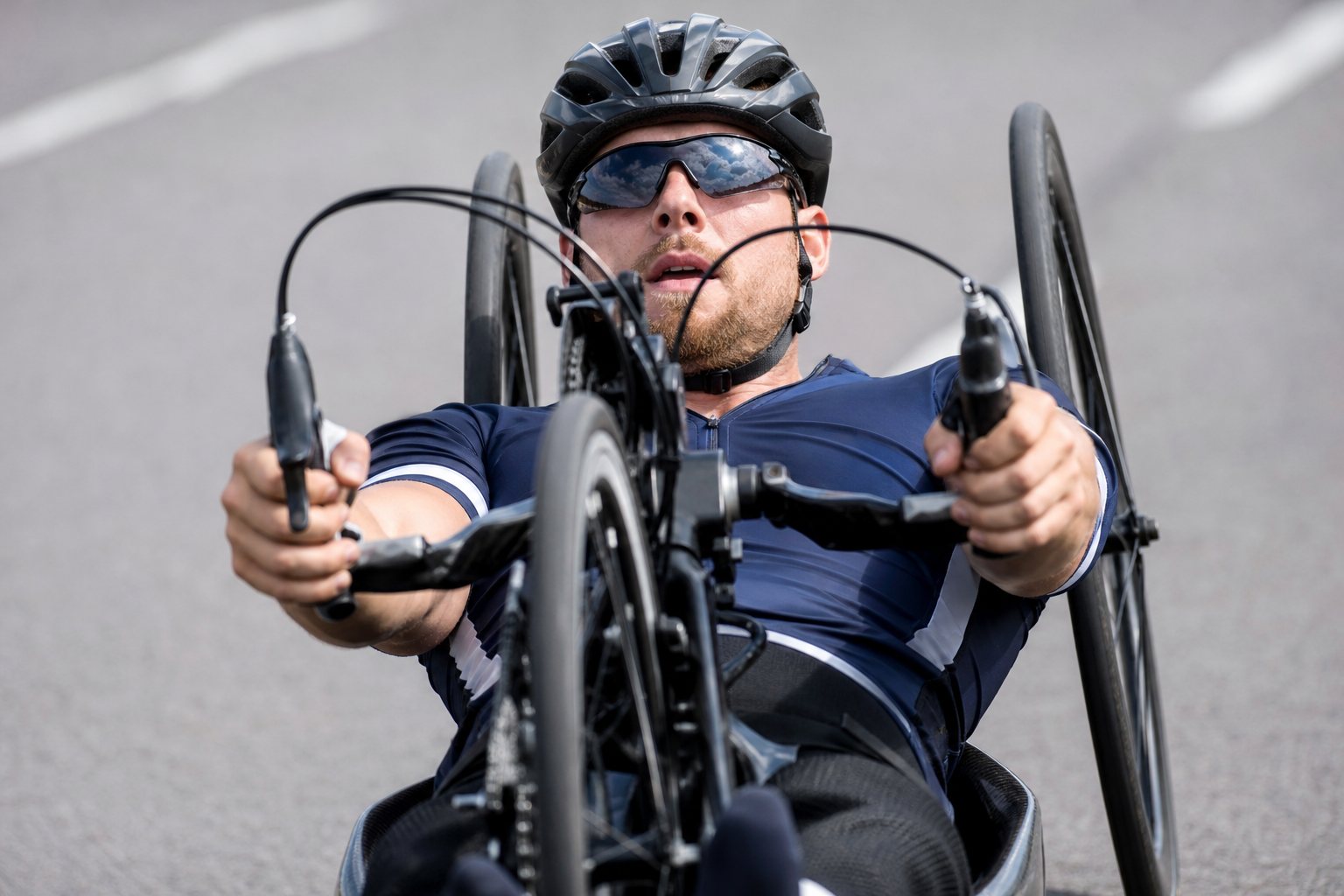
A handcyclist finishes a hard block of training and notices that the front of one shoulder aches when she reaches for the cranks, then again when she transfers into the car. It is not a crash, nothing is swollen, and it is easy to ignore. Para cycling injuries are physical problems that happen in training or racing, from crashes and falls to the slow overuse problems that build up in the muscles and joints doing the work. This page explains what is known, not how to diagnose yourself.
Quick answer: Para cycling injury data are limited. A 2025 study of ten Para cyclists found 1.94 injuries per 365 athlete days, and earlier studies point to the shoulder as the most common site. Crashes, overuse, skin problems, heat illness and concussion are the main concerns. A health professional should diagnose and manage any injury. Do not return to riding after a head injury until a provider says it is safe.
General information, not medical advice and not a diagnosis. To lower risk, see injury prevention. Sport overview: Para cycling. Standard cycling injuries: cycling injuries.
What injury surveillance shows
- Single-team study, 2025. Ten professional Para cyclists followed for 35 weeks of the 2024 Paralympic season, using the OSTRC-H2 questionnaire, reported 7.36 health problems per 365 days, an injury rate of 1.94 and an illness rate of 3.60. Injury was higher in the men (2.44) and illness higher in the women (5.40). The authors called it the first prospective study of its kind and stressed health monitoring.
- Paris 2024 Paralympics. A surveillance study of 4,450 athletes recorded 535 injuries, 8.6 per 1,000 athlete days overall, with the highest rates in taekwondo, 5-a-side football and sitting volleyball. We did not find a Para-cycling figure from it to quote.
- Tokyo 2020. Derman and colleagues reported 386 injuries in 4,403 athletes, 5.8 per 1,000 athlete days (British Journal of Sports Medicine, 2023), with more severe injuries than at earlier Games. The accompanying illness study (Eken and colleagues) gave 4.2 illnesses per 1,000 athlete days. Para cycling was not among the highest-rate sports in the parts we read.
- Caution. Rates are reported per athlete day, per 365 days or per 1,000 hours, so they cannot be compared directly. We found no reliable handcycling-specific injury rate.
Common patterns
Shoulder and upper-limb overuse. A 2025 paper reports that studies of Para cycling point to the shoulder as the most common injury site. For handcyclists, a laboratory study of an all-out sprint found the biggest changes in shoulder movement and deltoid muscle activity and judged the shoulder probably prone to overuse. The Consortium for Spinal Cord Medicine says around 75% of people with spinal cord injury have shoulder pain at some time.
Crashes. Low machines, tandems and fast group riding mean falls and collisions. At the Paris 2024 Games the first gold medal of the competition was decided after a crash by the defending champion in the opening metres of a track time trial. Typical crash injuries include abrasions, bruises and fractures; a clinician should assess anything more.
Skin. People who sit or lie for long periods can get pressure injuries, and the Australian Institute of Sport has a clinical guideline on skin health in Para sport.
Heat and illness. The 2025 Para-cycling study found illness more often than injury, and athletes with spinal cord injury can have impaired sweating, according to a 2024 study of elite athletes. Heat illness can be serious.
Concussion
The CDC’s HEADS UP guidance applies to every rider: recognise the signs (headache, dizziness, confusion, balance problems), stop riding, and let a health care provider decide when to return. A 2024 review called for concussion incidence measures in Para sport for athletes with a vision impairment, which includes tandem riders. Call 911 for danger signs such as repeated vomiting, a seizure, a worsening headache, or loss of consciousness. A helmet is the standard protection, though the CPSC says no helmet has been proven to prevent concussion.
General rehabilitation principles
These are widely used principles, not a plan for any condition:
- Get it assessed. A sports medicine doctor, physical therapist or athletic trainer should diagnose and set a plan.
- Relative rest, not total rest. Reduce the load that provokes pain while keeping the rest of the body active, as your clinician advises.
- Progressive loading. Rehabilitation usually builds strength and range of movement step by step, and returning to riding is also gradual.
- Look at the cause. Machine fit, seat position, training load and technique can all be contributors; review them with your coach and fitter.
- Protect the arms in daily life. For wheelchair and handcycle users, the spinal cord injury guideline recommends avoiding hand-above-shoulder positions and using aids for transfers.
Recovery times vary widely with the injury, the person and the plan, so we do not give any. We do not give return-to-play clearance; a provider does.
When to see a professional
Get help promptly for pain that lasts more than a few days or wakes you at night, weakness, numbness or tingling, swelling or a deformity, a skin area that is red, broken or does not heal, a head injury, or heat symptoms such as confusion. Riders with a spinal cord injury at or above T6 should know the signs of autonomic dysreflexia, a sudden rise in blood pressure, and have a plan with their medical team; call emergency services if it is suspected.
Para cycling injuries FAQs
What injuries are most common in Para cycling?
Studies point to shoulder and upper-limb overuse and to crash injuries, but the data are limited. A clinician can tell you what applies to you.
How long do injuries take to heal?
It depends on the injury, the person and the care. We do not give times; ask your provider.
Can I keep training with a sore shoulder?
That is a question for a clinician. Persistent pain should be assessed before you increase load.
Do tandem riders get concussions?
They can. Research on concussion in athletes with a vision impairment is limited, so take any head impact seriously and follow the HEADS UP steps.
Who should I see?
A sports medicine doctor, physical therapist or athletic trainer, preferably one with experience in Para athletes.
Sources
- Injury and Illness Surveillance in Para-Cycling, Sports 2025
- Paris 2024 Paralympic injury surveillance (PMID 42103446)
- Derman et al. 2023: injury at Tokyo 2020 (BJSM)
- Consortium for Spinal Cord Medicine: upper limb guideline
- AIS: pressure injuries and skin health in Para sport
- Sweat and thermal responses in athletes with SCI (PMID 38535744)
- Concussion in Para sport, vision impairment (PMID 38470636)
- CDC HEADS UP
- CPSC: which helmet
- Paralympic Games: Groot wins first gold of Paris 2024
This page is general information for education only, not medical advice. See our editorial policy. More: recovery, all sports.