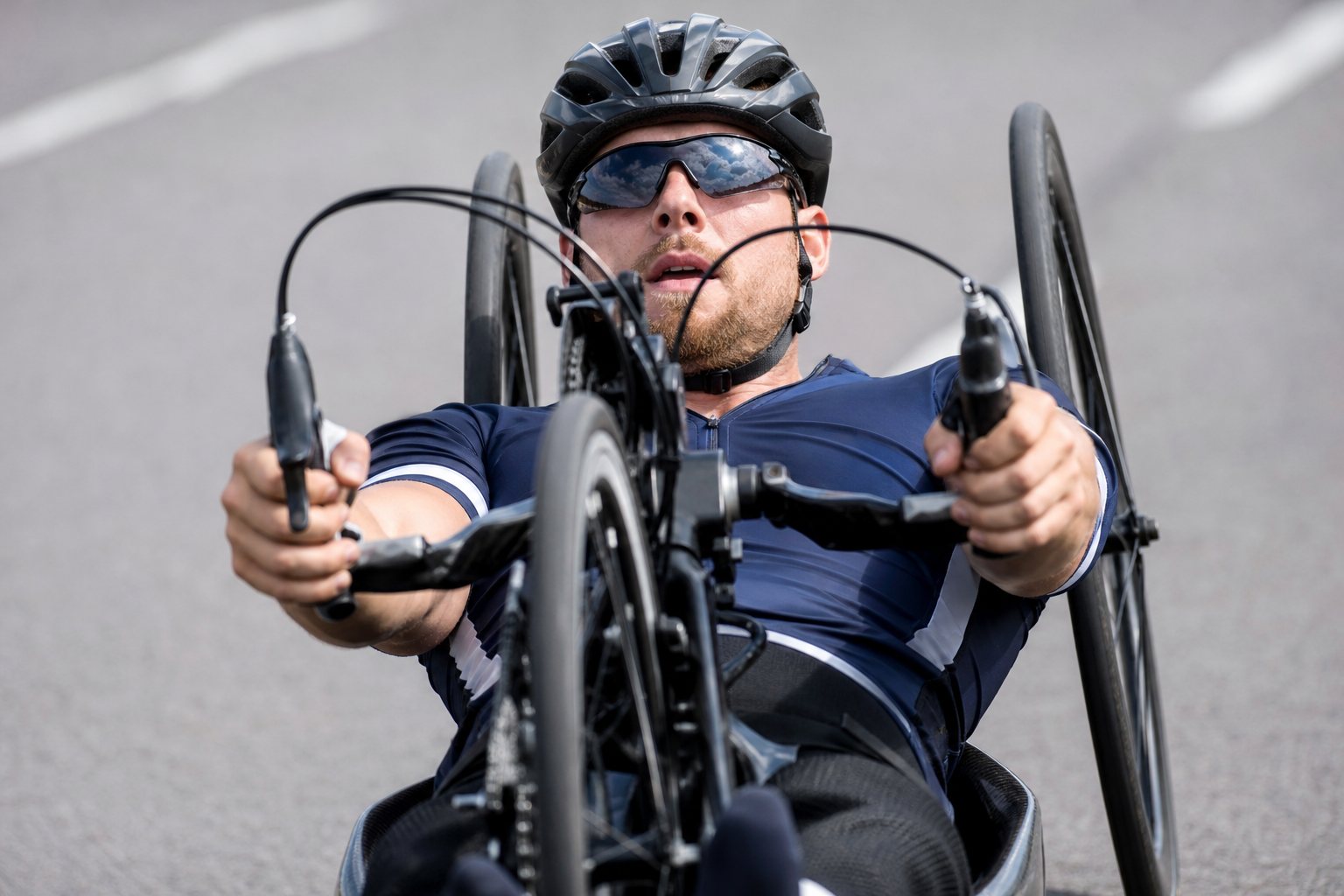
After a hard Saturday ride, one handcyclist lies flat for twenty minutes, checks his skin, eats, and goes to bed early. Another rider spends the evening on a foam roller and a compression boot and sleeps badly. Which approach helps more is a good question, and an honest answer is that sleep, food and an easy next day have better support than gadgets. Recovery is the time and habits that let the body adapt to training: sleep, nutrition, easier days and attention to skin, joints and heat.
Quick answer: For Para cyclists, the best-supported recovery steps are enough sleep, easier days after hard ones, eating enough, and not ramping load too fast. Sleep problems are common among Paralympic athletes. Evidence for gadgets such as massage, compression and cold water is mixed. Soreness that fades is normal; pain that lasts or sharpens, numbness or skin damage deserves a professional.
General information, not medical advice. For the training that creates the need to recover see training; for injuries see injuries. Standard cycling recovery: cycling recovery.
Sleep comes first
A systematic review of the sleep parameters of Paralympic athletes found poor sleep quality and quantity and high rates of daytime sleepiness. Most of the studies used questionnaires; 11 relied on subjective instruments and only 2 used actigraphy, a wrist-worn movement sensor, so the picture is approximate. A review by Roberts and colleagues on Tokyo 2020 argued that impairment may change how athletes respond to the environment and sleep, that melatonin secretion may be disrupted in some groups, and that sleep extension, napping and sleep hygiene are the techniques developed so far. An athlete with a cervical spinal cord injury reported worse sleep in one thesis on wheelchair court sport. Heat and travel also affect sleep.
Practical, general habits: a regular sleep schedule, a cool dark room, limiting caffeine late in the day, and talking to a doctor if you snore, stop breathing in your sleep or are always sleepy. If your impairment needs night-time repositioning or care, build recovery around it.
Load management
Hard sessions followed by easier ones, a full day off each week, and a lighter week every few weeks are common coaching habits. They are general practice, not Para-cycling rules. Handcyclists should watch the shoulders: studies suggest the shoulder is prone to overuse, so a gradual build is safer than a jump in volume. Track sessions and how you feel, and cut back early if soreness is not settling. See injury prevention.
Mobility and flexibility
Mobility work helps you keep the range of movement the machine needs. General suggestions:
- Shoulders and chest. Gentle stretches and mobility drills for the chest, shoulders and upper back, since handcyclists spend hours in a forward-flexed position.
- Hips and legs. For riders who pedal, hip flexors, hamstrings and calves can get tight.
- Neck and wrists. Easy range-of-motion work for the neck and wrists.
- Spasticity and contractures. If your impairment affects muscle tone or range, ask a physical therapist what stretching is safe for you.
We did not find Para-cycling studies showing that a specific stretching routine prevents injury, so treat it as comfort and range-of-motion work.
Recovery methods and the evidence
- Cool-down and easy spin. Widely used; the evidence for performance is limited but it is low risk.
- Food and fluid. See our nutrition guide.
- Massage, foam rolling, compression, cold or contrast water. A 2023 narrative review of recovery strategies and devices (Sports Medicine, PMID 37999430) found that newer devices such as sauna, recovery boots, occlusion cuffs and massage guns have a lower level of evidence and mixed results, and other reviews report benefits that are mostly in perceived soreness rather than performance. These studies were not done in Para athletes. If you have reduced sensation, poor circulation, skin fragility or altered temperature control, ask a clinician before using cold, heat or compression, since sensation and temperature responses can differ.
- Cooling after hard efforts. For athletes with higher-level spinal cord injury, a thesis summarised in research notes monitoring after exercise until core temperature falls, because limited sweating slows heat loss. Use a plan agreed with your clinician.
Skin and seating after rides
Check your skin after long rides using a mirror or a helper, look for red areas that do not fade, and ask a clinician about cushions and seat setup. The Australian Institute of Sport has a clinical guideline on pressure injuries and skin health in Para sport. We found no handcycling-specific pressure data.
Soreness or injury?
Muscle soreness is usually spread across a muscle, peaks a day or two after unusual effort and eases with gentle movement. Warning signs of injury include sharp or focal pain, pain at rest or at night, pain that is getting worse, swelling, numbness or tingling, weakness, or pain that changes how you ride. In those cases stop and see a sports medicine doctor, physical therapist or athletic trainer. For riders with a spinal cord injury at or above T6, a sudden pounding headache and high blood pressure can be autonomic dysreflexia and needs urgent help.
Para cycling recovery FAQs
How much sleep do I need?
We did not find a Para-cycling-specific figure. Your doctor can advise, particularly if you are always tired or your sleep is broken.
Do compression boots or massage guns work?
Evidence is mixed and the newer devices have the weakest support. They are not harmful for most people but they are not a replacement for sleep and food, and some are not suitable with reduced sensation or skin problems.
Should I stretch after riding?
Gentle mobility work is fine for many riders. Ask a clinician if your impairment affects tone or range of movement.
How many rest days do I need?
Many plans include one or two a week, but it varies with your training and your body; ask a coach.
How do I know I am overtraining?
Persistent fatigue, poor sleep, falling performance, mood changes and repeated niggles are common warning signs; take them to a coach or doctor.
Sources
- The Sleep Parameters of Paralympic Athletes: Characteristics and Assessment Instruments (PMID 36150706)
- Sleep disruption considerations for Paralympic athletes competing at Tokyo 2020
- Loughborough thesis: exercise recovery and sleep in wheelchair court athletes
- AIS: pressure injuries and skin health in Para sport
- Fundamentals or Icing on Top of the Cake? A narrative review of recovery strategies and devices for athletes (PMID 37999430)
- Autonomic dysreflexia (PMID 36120615)
- Sweat and thermal responses in athletes with SCI (PMID 38535744)
This page is general information for education only, not medical advice. See our editorial policy. More: Para cycling hub, all sports.