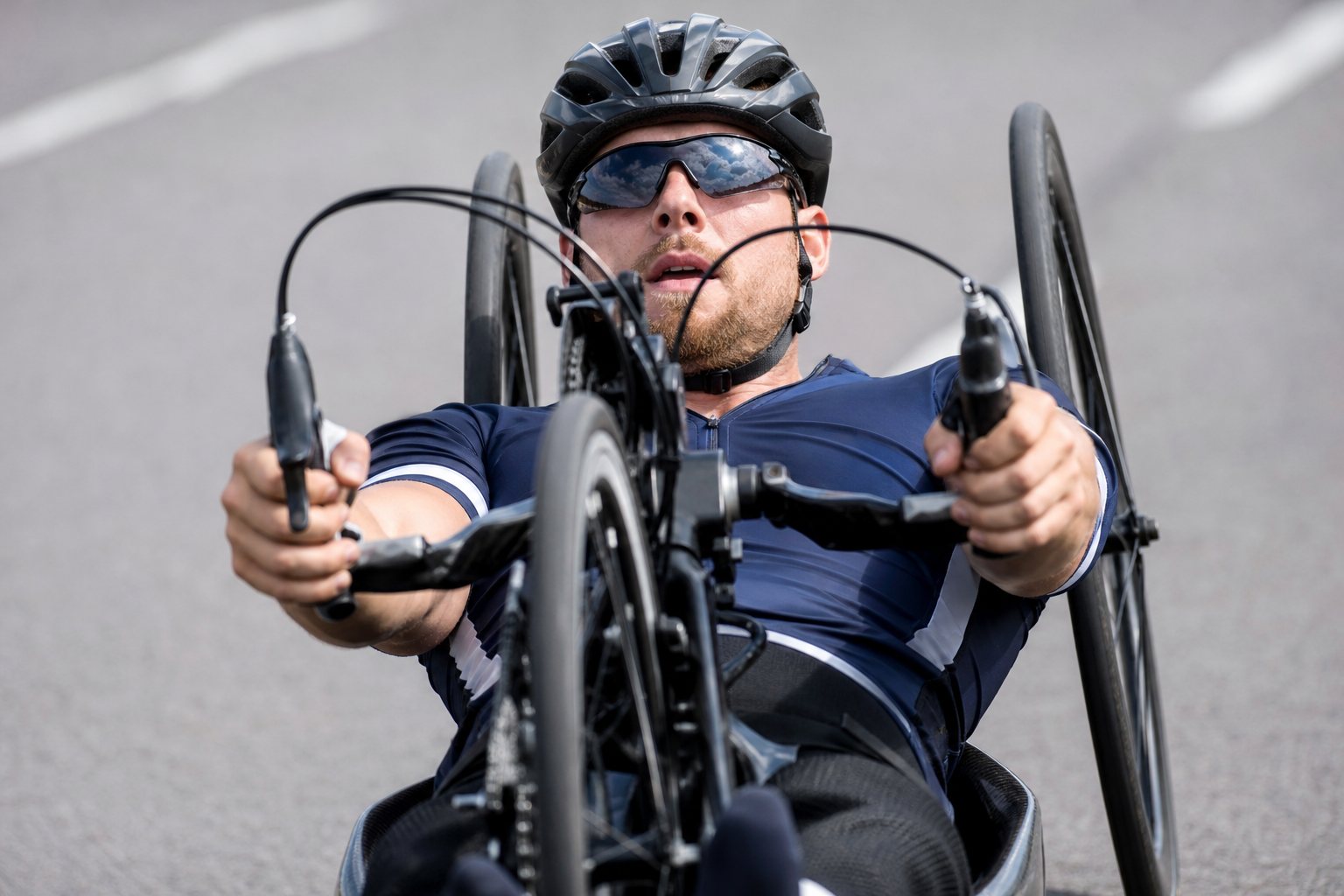
Two riders leave the same velodrome at the same time. One pushes through her legs on a C4 bicycle, the other drives a handcycle with his arms, shoulders and back. Their sessions look alike on a whiteboard, an easy ride, a few hard efforts, a rest day, yet the muscles doing the work, and the parts most at risk of getting overloaded, are very different. Para cycling training is endurance and power training built around the muscles an athlete can use, the equipment they ride, and how their body responds to effort.
Quick answer: Para cycling is mostly aerobic work with some high-power efforts. A typical week mixes easy volume, a few structured harder sessions, strength work and rest, adjusted to your class and impairment. Handcyclists load the shoulders every stroke, so build gradually. Heart rate and pacing can behave differently after a spinal cord injury, so ask a coach or clinician who knows your impairment.
General information, not medical advice. Training principles here are general coaching practice unless a source is named. For the sport see the Para cycling guide and how classes work; for standard cycling training see cycling training.
What the sport asks of the body
Para cycling events range from a 500 m or kilo time trial on the track to road races and time trials that last from minutes to over an hour. That means two main systems: the aerobic system for steady power, and short high-power efforts for starts, sprints, climbs and attacks. What changes by class is where the power comes from. Bicycle and tricycle riders drive with the legs (and with whatever leg function their impairment leaves). Handcyclists produce power through the shoulders, chest, back and arms while the trunk stabilises, and tandem stokers add power without steering.
The handcycling research base is smaller than road cycling’s. A narrative review summarised on the IAT research database cautions that results from early handcycling studies transfer poorly to current international athletes. In a 2019 study in the Scandinavian Journal of Medicine and Science in Sports, Stone and colleagues compared 7 competitive and 6 recreational handcyclists and found peak aerobic power of about 247 W in the competitive group against about 198 W in the recreational group, with differences in shoulder and shoulder-blade movement at training intensities. These are small groups, so treat the numbers as a snapshot, not a target.
A sensible weekly shape
There is no single plan for every class. As general coaching practice, a week for a developing rider often includes:
- 2 to 3 easy aerobic rides. Conversational effort, building the base. This is where most volume should sit.
- 1 to 2 structured harder sessions. For example intervals at a hard but repeatable effort, or hill or sprint work for track riders. Keep them separated by easier days.
- 1 to 2 strength sessions. See below.
- 1 or 2 rest days. Recovery is when the body adapts; see our recovery guide.
- Warm-up and cool-down every ride. Ten to fifteen minutes of easy riding before hard efforts is a common coaching habit.
A beginner might start with two or three short sessions a week and lengthen one ride gradually. A coach, ideally one who has worked with riders in your class, can set the plan; USA Cycling offers a coaching course specifically for Para-cycling athletes.
Strength and conditioning
Strength work for Para cyclists is mainly about protecting joints and supporting the trunk. Common emphases, as general practice rather than a prescription:
- Pulling and rotator-cuff strength to balance the pushing and reaching that handcycling and wheelchair use involve. The Consortium for Spinal Cord Medicine’s guideline on preserving upper-limb function after spinal cord injury notes that research on preventing upper-limb pain is limited, and recommends avoiding positions that place the hand above the shoulder, among other steps. A strengthening protocol called STOMPS is described as having evidence for reducing chronic shoulder pain.
- Core and trunk stability adapted to the rider’s trunk function, since the trunk holds the position on the machine.
- Leg strength for riders who pedal, including single-leg work for riders with a limb difference, if the clinician agrees.
Ask a physical therapist or athletic trainer to set exercises for your impairment; do not copy a standard cyclist’s gym plan.
Shoulder load for handcyclists
A 2022 study of a 15-second all-out handcycling sprint found the largest changes in shoulder movement and in how hard the deltoid muscles worked, and its authors judged the shoulder probably prone to overuse injury in handcycling. A separate study of high-intensity intervals in handcycling noted that the musculoskeletal safety of that type of training is still unknown. For the injury side, see our injuries guide. Practical steps: increase volume and intensity gradually, keep hard sessions few, and report shoulder pain early.
Periodisation basics
Periodisation means planning the year in blocks. A common general pattern is a base period of easier volume, a build period with more structured intensity, a short peak before the main events, and a recovery break afterwards. Para racers should also plan for the classification calendar, travel and heat. We did not find a published periodisation model specific to Para cycling, so this is general coaching practice to adapt with a coach.
Measuring effort
Power meters work for pedal bikes and some handcycles; speed, time and perceived effort work for everyone. Heart rate can behave differently in riders with a spinal cord injury, particularly at higher levels of injury, so a coach should interpret it. Our cycling wearables page covers standard cycling devices; check compatibility with your machine.
Heat and training
Athletes with a higher-level spinal cord injury may cool differently. Research on athletes with tetraplegia found that pre-cooling and cooling during exercise improved repeated sprint performance in the heat. Plan hard sessions for cooler times and talk with your clinician about a strategy.
Para cycling training FAQs
How many hours a week should I train?
It depends on your goals, class, health and experience, and we did not find a source-backed number for beginners. Start with a few short sessions, add time slowly, and ask a coach.
Is handcycling hard on the shoulders?
It loads the shoulders in every stroke, and studies suggest they are prone to overuse. Gradual progression, balanced strength work and early attention to pain help; see a clinician if pain persists.
Can I train indoors?
Many riders use trainers or rollers. Check that your machine fits a trainer; some handcycles and trikes need a special trainer.
Do Para cyclists lift weights?
Many do. The focus is on joint protection and trunk stability, set by someone who knows your impairment.
What is the best way to track progress?
Keep a simple log of sessions, how hard they felt and any pain, and add power or timed tests if you have the equipment.
Sources
- Physiology of handcycling: a current sports perspective (IAT record)
- Stone et al. 2019, shoulder and thorax kinematics in competitive handcyclists (Loughborough repository)
- Stone et al., Scandinavian Journal of Medicine and Science in Sports (DOI 10.1111/sms.13402)
- Consortium for Spinal Cord Medicine: Preservation of Upper Limb Function Following SCI
- Cooling strategies in athletes with tetraplegia (PubMed 15677741)
- USA Cycling: Coaching Para-Cycling Athletes
This page is general information for education only, not medical advice or a training prescription. See our editorial policy. More: Para cycling hub, all sports.