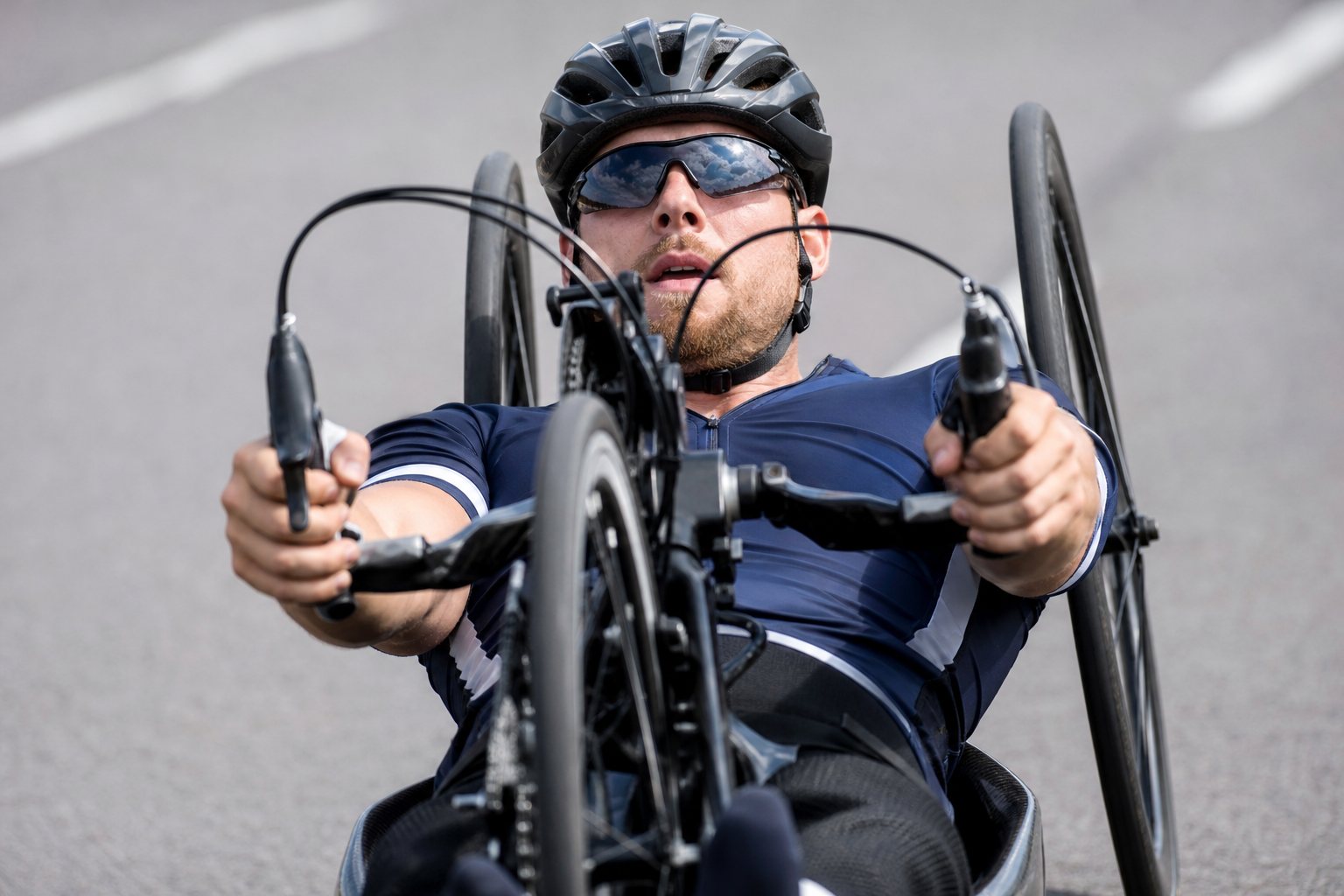
A first-time handcyclist rolls into a parking lot on a loaner machine, lying nearly flat, hands on cranks at chest height, a foot from the ground. The first ten minutes are all about steering, because the front wheel turns with the whole body rather than the handlebars of a bike. Para cycling (also written paracycling) is the part of cycling built for athletes with a physical or vision impairment, and its rules are mostly cycling’s rules plus one extra layer: classification, which decides who races whom and on which kind of machine.
Quick answer: Para cycling has four equipment groups: C (bicycle), T (tricycle), H (handcycle) and B (tandem with a sighted pilot). A lower class number means the impairment affects riding more. You do not need a classification to ride for fun; you need one to race in Para divisions. The first step is an adaptive program or club, not a purchase.
General information, not medical advice. For the whole sport see the Para cycling guide; for standard cycling basics see cycling rules.
How the sport is scored and won
Most Para cycling is ordinary cycling: the fastest rider over the distance wins. According to USA Cycling’s 2025 classification guide, the competitive road events are the road race, the individual time trial and a handcycling team relay, and the track events are the kilo time trial, sprint (individual and team), elimination race, scratch race and individual pursuit. Because riders in different classes can be very different in how much of the body they can use, results are by class, and in some events the times from several classes are adjusted so that they can be compared. Check the event’s technical guide to see how a given race does this.
Paris 2024 had 51 medal events, 17 on track and 34 on the road (15 road races and 19 time trials), according to the Paralympic Games site, and the IPC lists 51 medal events again for LA28 (15-27 August 2028). Qualification rules and the exact event list for any Games can change, so check the official programme for the current Games.
Classification in plain words
Classification is how Para sport decides two things: whether an athlete has an eligible impairment, and which class groups them with athletes whose impairment affects cycling to a similar degree. The UCI describes classes as C1 to C5 for bicycles, T1 and T2 for tricycles, H1 to H5 for handcycles and B for tandem riders who are blind or visually impaired, and says that a lower number means more impairment. Classification is done by a panel with both a medical and a technical side, and the UCI’s equipment unit checks bike adaptations.
USA Cycling’s guide lists four groups of eligible physical impairment: impaired muscle power (for example spinal cord injury, muscular dystrophy, spina bifida), impaired passive range of movement, limb deficiency or limb length difference, and coordination impairment (ataxia, hypertonia or spasticity, dyskinesia). Visual impairment is the fifth route and is classified into B1, B2 and B3 profiles by acuity and visual field. The same guide lists examples that are not eligible on their own, including pain, hearing impairment, low muscle tone, hypermobility and joint instability. If you are unsure, a federation can tell you whether your condition qualifies; do not rely on a website to decide.
The process in the US, per USA Cycling: join and buy a Para-eligible racing license, send the national application with a medical diagnosis form and documentation from a licensed health care provider, then attend an evaluation at a Para event, usually the day before competition. A panel (typically two trained classifiers) reviews the medical history, tests range of motion, strength and coordination, observes you on the bike, and assigns a class and a status: Confirmed, or Review if you should be re-evaluated later. Outside the US, your national cycling federation runs the equivalent steps, and international classification goes through the UCI.
The first skills to learn
These are general coaching practice, not rules, and they apply to everyone on two, three or four wheels:
- Control first. Learn to steer, brake and stop smoothly on a quiet, flat, traffic-free surface. Handcycle steering is by the whole upper body and the speed of a low machine feels fast.
- A steady cadence. Smooth, even turns of the pedals or cranks are more efficient than bursts, and they are kinder on the shoulders.
- Getting on and off. Practice transfers and mounting with a helper until they are routine, and learn how to get going again after a stop.
- Group riding. Learn hand signals, how to hold a line and how to stay predictable. On a tandem, pilot and stoker learn to communicate before they ever race: the pilot steers, brakes and calls turns, and the stoker adds power.
- Cornering and descending. Low machines and three-wheelers handle differently from upright bikes; a coach or experienced rider should show you, not a video.
How a beginner starts
- Try before you buy. Adaptive sports programs, rehabilitation centres, local cycling clubs and some hospital-based programs offer loaner handcycles, tricycles and tandems. USA Cycling’s Para pages point to this route and to local velodromes for track camps and clinics.
- Ride for fun first. No classification is needed for recreational rides or mass-participation events.
- Find the federation. In the US, USA Cycling now includes the former U.S. Paralympics Cycling program. Elsewhere, ask your national cycling federation or Paralympic committee about clubs and talent programs.
- Get a professional fit and a medical check. Machines are fitted to the rider, and a doctor or physical therapist who knows your impairment can help you plan sessions. See our gear guide and injury prevention guide.
- Enter a first event. USA Cycling suggests starting with a Para event on the national calendar. Read the technical guide for the event first.
Levels
We did not find a single national youth or college Para cycling structure to report. The usual pathway is from adaptive recreation to club and regional racing, then national championships and international UCI events, with the Paralympic Games as the top. Ask your federation what talent-identification and development programs exist in your country.
Official rulebooks
The UCI’s Part 16 covers Para-cycling regulations, and the UCI also publishes classification information; USA Cycling publishes its Guide to Paracycling Classification. Rulebooks change each season, so always read the current edition and the event’s own technical guide before you race.
Para cycling rules FAQs
What do C, T, H and B mean?
They are equipment groups: C for conventional bicycle, T for tricycle, H for handcycle and B for a tandem ridden with a sighted pilot. The number after C, T or H is the sport class, and a lower number means the impairment affects riding more.
Do I need a classification to ride?
Not to ride for fun. To race in Para divisions you need a national classification, and for UCI international events an international one.
Can a sighted person pilot a tandem?
Yes, that is how tandem racing works: the visually impaired athlete rides as the stoker behind a sighted pilot. Each federation sets its own rules for pilots, so ask yours.
Are there Para cycling events for beginners?
Many adaptive programs and local rides welcome beginners, and USA Cycling suggests starting at a Para event on its national calendar once you have a classification. Rules and calendars differ by country.
Is Para cycling in the next Paralympics?
The IPC lists Para cycling in the LA28 programme with 51 medal events, announced June 2025. Check the official programme for the current Games before you plan.
Sources
- UCI: Para-cycling classification, explanations, information and education
- USA Cycling: Guide to Paracycling Classification (2025)
- USA Cycling: Paracycling classifications
- USA Cycling: Paracycling
- USA Cycling: U.S. Paralympics Cycling program joins USA Cycling
- Paralympic Games: Paris 2024, introduction to Para cycling
- IPC: LA28 Paralympic medal event programme and athlete quotas
This page is general information for education only, not medical advice or a classification decision. Read how we work in our editorial policy. More: training, Para cycling hub, all sports.