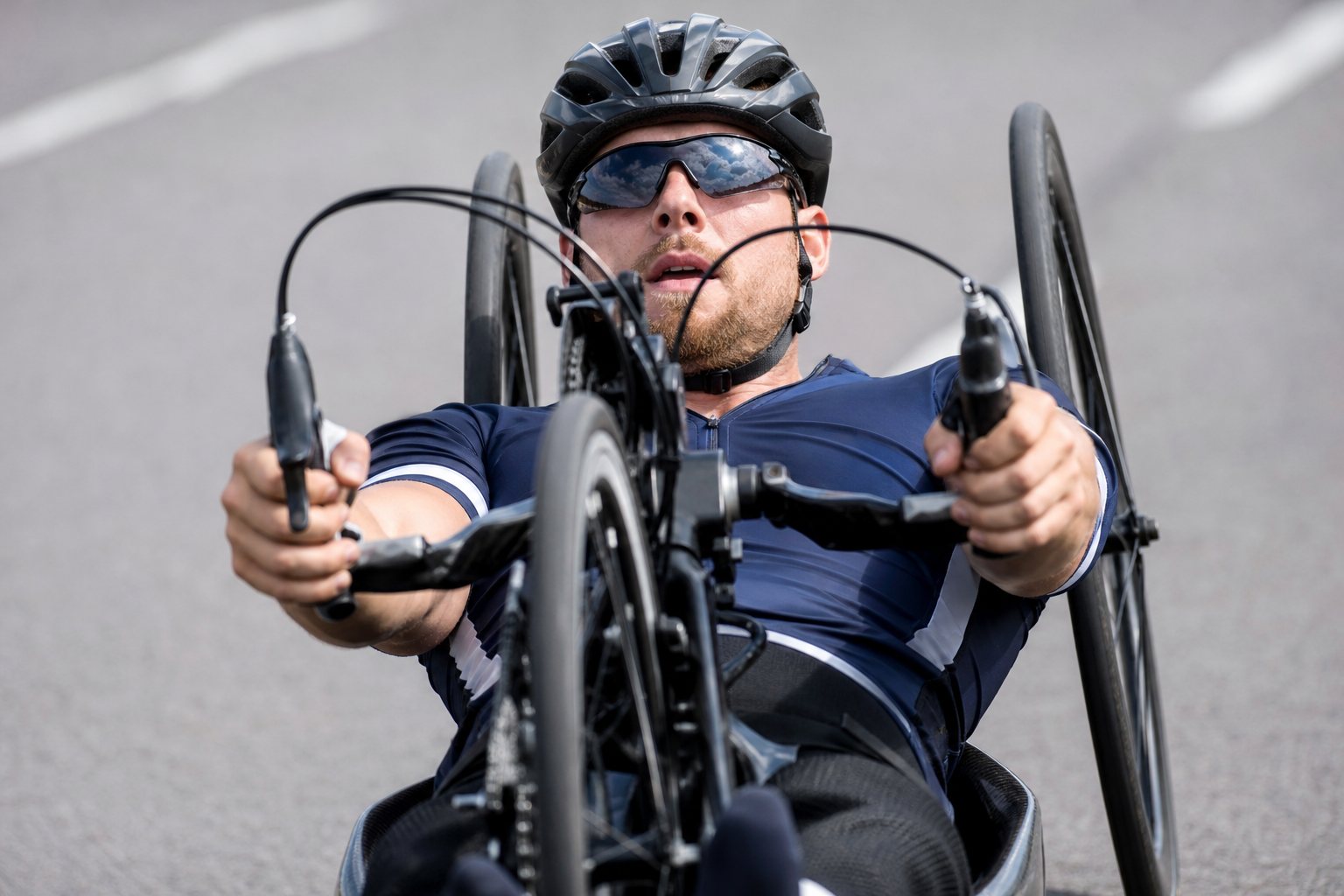
The group ride rolls out at 7 a.m., and the handcyclist at the back is the lowest thing on the road, a bright flag on a whip behind her head, a second rider tucked beside her. Nobody called it a safety plan, but it is one. Para cycling injury prevention means the habits, setup and planning that lower the chance of a crash, an overuse problem or a heat illness. It cannot remove the risk.
Quick answer: The best-supported steps are a machine that is fitted to you, a gradual increase in training, balanced strength work for the shoulders and trunk, a helmet that fits, being seen, and a heat plan if your injury affects sweating. Evidence specific to Para cycling is thin. See a sports medicine doctor, physical therapist or athletic trainer if you have pain that lasts, a head injury or any danger sign.
General information, not medical advice. This page is about lowering risk. For what injuries look like and how rehabilitation works, see our Para cycling injuries guide, which we do not repeat here. Sport overview: Para cycling.
What the numbers say, and do not say
Para-cycling-specific data are scarce. A 2025 study in Sports followed ten professional Para cyclists through the 2024 season (35 weeks, weekly OSTRC-H2 questionnaire) and recorded 7.36 health problems per 365 days, with an injury rate of 1.94 and an illness rate of 3.60 per 365 athlete days; illness was higher in the women (5.40 against 1.80). It is a small single-centre group, so it shows what can be measured, not a rule for every rider. At the Paris 2024 Paralympics the surveillance study recorded 8.6 injuries per 1,000 athlete days across all sports (535 injuries among 4,450 athletes). Prevention advice below borrows from wheelchair sport, standard cycling and spinal cord injury guidelines and is labelled as general practice where it is not Para-cycling data.
Warm up before hard efforts
We did not find a published warm-up programme tested in Para cyclists. General coaching practice is 10 to 15 minutes of easy riding before intervals or racing, with a few short higher-effort pick-ups, plus arm circles and shoulder mobility for handcyclists. Ask your clinician whether anything should be left out for your impairment.
Fit, setup and technique
Machines are fitted to the rider, and the UCI’s technical classification check includes the bike adaptations. A poor fit loads the shoulders, wrists, neck and skin. Ask a specialist dealer or adaptive program to check crank length and height, seat angle, hand interface and how your body is supported; and get it rechecked after weight, strength or equipment changes. Technique is general coaching practice: smooth, even strokes, relaxed hands and a neutral wrist.
Training load and shoulders
A 2022 study of all-out handcycling sprints judged the shoulder probably prone to overuse injury, and a study of high-intensity intervals said the musculoskeletal safety of that training is still unknown. The Consortium for Spinal Cord Medicine’s guideline for preserving upper-limb function after spinal cord injury says that around 75% of people with spinal cord injury have shoulder pain at some point, that the rate rises with years since injury, and that research on prevention is limited. Its advice includes avoiding positions that put the hand above the shoulder and using aids for transfers. Rules of thumb for training load: add volume and intensity gradually, keep hard sessions few, and rest when pain builds. We did not find a Para-cycling-specific numeric rule (such as a percentage increase per week), so we do not give one.
Strength and conditioning
Balanced strength work that includes pulling and rotator-cuff exercises and trunk stability is the usual approach, and a strengthening protocol called STOMPS is described as having evidence for chronic shoulder pain in people with spinal cord injury. For your own programme, ask a physical therapist or athletic trainer who knows your impairment.
Skin, seating and pressure
Pressure injuries are a particular risk for riders who sit or lie for long periods without full sensation. The Australian Institute of Sport and Paralympics Australia published a clinical practice guideline on pressure injuries and skin health in Para sport. We found no handcycling-specific pressure studies, so check the guideline with your clinician. General advice: check your skin after rides (use a mirror or ask someone), watch for red areas that do not fade, and ask a clinician about cushions and seat setup.
Heat, cold and the road
Athletes with a spinal cord injury can have impaired sweating and heat loss, and the extent depends on the level of injury: studies describe the highest risk in tetraplegia and high paraplegia, with low-level paraplegia more similar to able-bodied athletes. In tetraplegic athletes, pre-cooling and cooling during exercise improved repeated sprint performance in the heat, according to a study in the British Journal of Sports Medicine. Practical steps include riding in the cooler parts of the day, using shade and cool water, and learning your own warning signs. Riders at or above T6 can also have autonomic dysreflexia, a sudden rise in blood pressure, so ask your medical team about a plan and do not experiment on the road.
Traffic matters because low machines are hard to see. Use bright clothing, front and rear lights, a visible flag or marker, and group rides in advance. This is general safety advice rather than a rule.
Helmets and head injury
The U.S. Consumer Product Safety Commission says bike helmets sold in the US since 1999 must meet its standard (16 CFR 1203), that no helmet has been proven to prevent concussion, and that a helmet should be replaced after a crash. We could not retrieve the UCI’s current helmet and equipment rules for Para cycling; check the current rules for your event. For concussion see the CDC’s HEADS UP: recognise the signs, stop riding and let a health care provider decide when to return. A 2024 review in Healthcare noted that concussion incidence data are needed for athletes with vision impairment, which includes tandem stokers.
What prevention cannot do
Even with a good fit, careful training and a helmet, falls, collisions and overuse injuries still happen. A rider with a high-level spinal cord injury, a vision impairment or a neurological condition may face risks that general lists miss. Prevention lowers risk; it does not guarantee anything.
When to see a professional
See a sports medicine doctor, physical therapist or athletic trainer for shoulder or wrist pain that lasts or wakes you at night, numbness or tingling, a skin area that does not heal, a head injury, or heat symptoms. Call 911 or your local emergency number for danger signs such as loss of consciousness, repeated vomiting, a seizure, chest pain or a very high blood pressure episode with a pounding headache in someone with a spinal cord injury.
Para cycling injury prevention FAQs
What is the most common injury in Para cycling?
Reports from Para-cycling studies cited in a 2025 paper point to the shoulder as the most common site, but data are limited, so see our injuries guide and a clinician for your own situation.
Do I need a helmet to ride a handcycle?
Wear one on every ride. Races have their own rules; check the current UCI or federation rules for your event.
How can I stay cool if my injury affects sweating?
Ride in cooler times, use shade and cool water, and ask your clinician about cooling options such as ice vests, which have been studied in athletes with spinal cord injury.
Can I prevent shoulder pain?
Not completely. Gradual training, balanced strength work, a good fit and early attention to pain may reduce the risk.
How often should my bike be checked?
Check tyres, brakes, steering, cranks and straps before every ride, and have a specialist inspect it regularly and after any crash. This is general advice.
Sources
- Injury and Illness Surveillance in Para-Cycling, Sports (Basel) 2025
- Paris 2024 Paralympic injury surveillance (PMID 42103446)
- Consortium for Spinal Cord Medicine: upper limb preservation guideline
- AIS and Paralympics Australia: pressure injuries and skin health in Para sport
- Cooling strategies in tetraplegic athletes (PubMed 15677741)
- Sweat and thermal responses in athletes with SCI (PMID 38535744)
- Autonomic dysreflexia (PMID 36120615)
- Concussion measures in Para sport, vision impairment (PMID 38470636)
- CPSC: which helmet
- CDC HEADS UP: signs and symptoms
- UCI: Para-cycling classification (technical check)
This page is general information for education only, not medical advice. See our editorial policy. More: gear, recovery, all sports.