This article contains affiliate links: if you buy through them we may earn a commission, at no extra cost to you. Read our affiliate disclosure.
The final day of the Paris 2024 Paralympics. Bobby Body of the United States, in the men’s up to 107 kg class, put up a best lift of 218 kg and finished fourth, missing a medal narrowly after judges ruled his third attempt invalid for an insufficient pause before re-racking the bar. In the same session Ashley Dyce made her Paralympic debut in the women’s heaviest class, finishing eighth with a season-best 112 kg. It was the first time in 24 years that the US had two athletes in the sport at the same Games. Para powerlifting (also called Paralympic powerlifting) is a bench-press competition for athletes with eligible lower-limb or hip impairments: lift the most weight, with control, and the medal is yours.
Para Powerlifting guides: what do you need?
New to para powerlifting? Start with the first card. Everything here is general education, not medical advice.
History & Origins of Para Powerlifting
Weightlifting first appeared at the Paralympic Games in Tokyo 1964, at first for male athletes with spinal cord injuries, and was later opened to other impairment groups. Powerlifting itself debuted at New York 1984, with 16 male athletes from six countries. After Barcelona 1992 only powerlifting remained on the programme. Women first competed at Sydney 2000, and Tokyo 2020 was the first Games with an equal male-female split, making it one of the first Paralympic sports to reach gender parity (Paralympic.org).
- 1964: Weightlifting debuts at the Tokyo Paralympics (men with spinal cord injuries).
- 1984: Powerlifting debuts in New York: 16 men, six countries.
- 1992: After Barcelona, powerlifting is the only lifting sport left on the programme.
- 1994: First World Championships under World Para Powerlifting governance, Uppsala, Sweden, 137 athletes.
- 2000: Women compete in Paralympic powerlifting for the first time, at Sydney.
- 2016: Rio hosts 180 athletes in 20 medal events; Siamand Rahman (Iran) lifts 310 kg, the first Paralympian over 300 kg.
- 2017: World Championships in Mexico City begin a two-yearly format.
- 2020: Tokyo is the first Games with equal numbers of men and women.
Notable Athletes
Medal counts below are the ones Paralympic.org lists on its sport page; they are not a ranking.
- Siamand Rahman (Iran): At Rio 2016, the first Paralympian to lift over 300 kg (310 kg).
- Haidong Zhang (China): Four golds, 1996 to 2008.
- Lei Liu (China): Four golds, 2008 to 2020.
- Sherif Osman (Egypt): Three golds and a silver, competing from 2008.
- Amalia Perez (Mexico): Four golds, two silvers and a bronze, competing from 2000.
- Fatma Omar (Egypt): Four golds and two silvers, 2000 to 2020.
- Taoying Fu (China): Four golds, 2000 to 2012.
- Lucy Ejike (Nigeria): Three golds, two silvers and a bronze, 2000 to 2020.
Official results and records
We list official sources instead of repeating results tables we have not checked line by line.
- Paralympic.org: results books (Paris 2024, Tokyo 2020 and World Championships, including Cairo 2025)
- World Para Powerlifting records
- Rankings
How we keep this current: we re-check facts after each major championship and update this page. Spot an error? See our editorial policy.
This page explains the lift and the judging in plain words, how eligibility and classification work, the Paralympic picture, and the health points specific to a sport where the shoulders, chest and arms carry heavy loads for a few seconds at a time. For the standard sport, see our powerlifting guide.
Para powerlifting at a glance
| What it is | A bench-press-only strength sport for athletes with eight types of eligible physical impairment. |
|---|---|
| How it is won | Each athlete has three attempts; the athlete who lifts the most kilograms wins. Three referees judge every lift with white and red lights, and two or more white lights make a good lift. |
| Divisions | One sport class, with competition split by sex and 10 body-weight categories each for men and women. |
| Who can compete | Athletes with one of eight eligible impairments who also meet the minimum impairment in the lower limbs or hips. |
| Governing body | World Para Powerlifting, under the International Paralympic Committee, based in Bonn, Germany. In the US, U.S. Para Powerlifting is run through the Lakeshore Foundation (since 1 January 2025). |
| Paralympic status | Paralympic sport since New York 1984; women since Sydney 2000. Paris 2024 had 20 medal events and 176 athletes. The IPC’s LA28 programme (announced 3 June 2025) lists 20 events and 180 athlete places. |
How Para powerlifting works
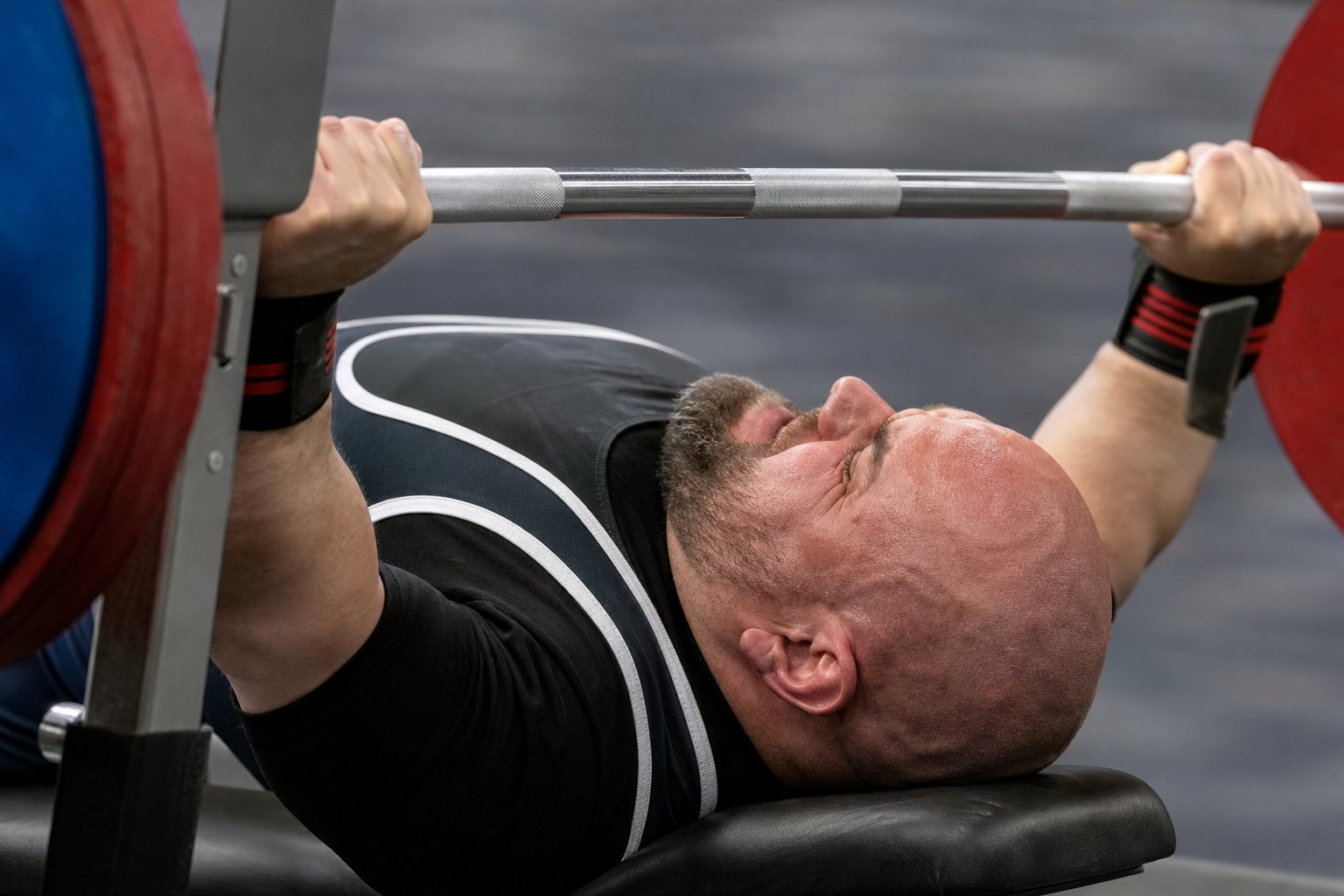
The athlete lies on a bench, receives the bar, lowers it to the chest, holds it motionless, and then presses it up to locked arms. Paralympic.org describes exactly that sequence, with three attempts per athlete. A fourth attempt may be allowed at the jury’s discretion to try for a world record, but it does not count toward the final result. The bench is 2.1 m long, 61 cm wide narrowing to 30 cm at the head end, and 48 to 50 cm high. Only bars, collars, weights, platforms and benches from World Para Powerlifting approved suppliers may be used at recognised competitions, and the current rules and regulations took effect on 1 May 2025.
Why do lifts fail? As Bobby Body’s near-miss in Paris showed, the pause matters: a lift that is not controlled at the chest, or a bar that is not locked out, can be turned down. The three referees decide independently, each with a white (good) or red (no lift) light.
Weight categories
Men: 49, 54, 59, 65, 72, 80, 88, 97, 107 and over 107 kg. Women: 41, 45, 50, 55, 61, 67, 73, 79, 86 and over 86 kg. Because the whole sport is one class, body weight is the only way athletes are split, which is why weigh-ins matter.
Eligibility and classification in plain words
Classification decides who is eligible to compete and how athletes are grouped, to reduce the effect of the impairment on performance. In Para powerlifting the eight eligible impairments are impaired muscle power, impaired passive range of movement, limb deficiency, leg length difference, short stature, hypertonia, ataxia and athetosis. Having an impairment is not enough on its own: the athlete must have an impairment in the lower limbs or hips that meets the sport’s minimum criteria, because classification is sport-specific. All eligible athletes then compete in a single sport class. The sport follows the IPC Athlete Classification Code, and the World Para Powerlifting rules prevail over any summary, including ours.
Who lifts, and at what level
Beginners and clubs. Many lifters begin at a gym or adaptive sports program with a coach who can set up a safe bench, spotters and loading. You do not need classification to lift for fitness. We did not find a current national youth, school or college structure for Para powerlifting in the US to report; ask U.S. Para Powerlifting at Lakeshore about development options.
Competitive and national. U.S. Para Powerlifting moved to the Lakeshore Foundation on 1 January 2025, and Lakeshore is also the national governing body for Boccia and wheelchair rugby. The 2025 US National Team Qualifier took place on 31 May 2025 in Birmingham, Alabama. The USOPC-era team standards were based on Tokyo 2020 results (third place plus 3 percent for the A team, with wider margins for B and C); these plans update every year, so check the current selection procedures.
Elite and Paralympic. Weightlifting debuted at the Paralympics in Tokyo 1964, but powerlifting was first included at the 1984 Games in New York, with 16 male athletes from six countries, initially only men with spinal cord injuries. After Barcelona 1992 only powerlifting remained on the programme. Women first competed at Sydney 2000, and Tokyo 2020 reached an equal split of male and female participation. The first World Championships were in Uppsala, Sweden, in 1994; beginning with Bahrain 2026 they are held in three consecutive years between Paralympic Games. For the current Games, check the official programme: the IPC’s LA28 table lists 20 events and 180 places (90 men and 90 women), but qualification can change.
Physical demands
A Para powerlifting attempt lasts seconds, so it draws on maximal strength and power from the chest, shoulders, triceps and upper back, plus the lats and trunk that stabilise the lifter on the bench. Training is mostly about heavy, well-controlled repetitions, technique under a pause, and recovery between sessions. A 2025 Sports Medicine systematic scoping review found 218 studies on powerlifting and Para powerlifting, of which 45 were about Para powerlifting (mostly from Brazil), and most of the studied topics were physical qualities, competition, training and biomechanics. It concluded that more research is needed, so be wary of confident one-size-fits-all programs.
Health and safety for Para powerlifting
This is general information, not medical advice. For anything specific to your body or your impairment, see a sports medicine doctor, physical therapist or athletic trainer who works with Para athletes.
Shoulders carry the load
A one-year prospective study of 102 Brazilian Para athletes (swimming, athletics, powerlifting and taekwondo) recorded 612 health problems and found the shoulder complex had the greatest injury burden, followed by the ankle and knee. Powerlifting had the highest burden of injuries among the four sports. In the same study, the injury prevalence across the athletes was 31.8 percent, and taekwondo had the highest prevalence of injuries. It is one small study from two centres in one country, so treat it as a signal and not a rate for every lifter. For athletes who also use their arms for wheelchair propulsion or transfers, the shoulders are already working hard outside the gym: ask your clinician how to share the load across the week.
At the Paralympic Games
The Paris 2024 surveillance study in the British Journal of Sports Medicine recorded 535 injuries among 4,450 athletes over 14 days, 8.6 per 1,000 athlete days, with the highest injury rates in taekwondo, 5-a-side football and sitting volleyball. It did not single out powerlifting in its abstract, and we did not find sport-specific injury rates for Para powerlifting at the Games.
Safe lifting basics
- Spotters and loaders: lift with trained spotters on a stable bench, with safety arms or catchers set for the bench, never alone with heavy weight.
- Transfers and positioning: practise getting on and off the bench and securing the legs with your coach so the setup is the same every time.
- Build gradually: increase loads step by step and keep rest days; pain that does not settle, numbness or swelling needs a professional.
- Blood pressure and spinal cord injury: athletes with an injury at or above T6 can have autonomic dysreflexia, a potentially life-threatening rise in blood pressure; the IPC bans deliberately inducing it (“boosting”). Learn your warning signs and emergency plan with your medical team.
Any head knock, for example from a fall during a transfer or an unstable bar, calls for the CDC’s HEADS UP steps: recognize the signs, remove the athlete from activity, and let a healthcare provider decide when to return.
Training, recovery and nutrition pointers
Technique with a pause, steady progression and enough sleep are the basics. The standard sport’s pages give a base to adapt with your coach: powerlifting training, recovery and nutrition and supplements. Para powerlifters are subject to anti-doping rules, and World Para Powerlifting has its own anti-doping section, so check any supplement with the federation before use and read our supplement guidance first. Recovery tools are in our recovery guide.
Gear for Para powerlifting
At recognised competitions the bar, collars, plates, platform and bench must come from World Para Powerlifting approved suppliers, and uniforms (lifting suits, t-shirts) also come from approved suppliers, so there is little to buy for the platform itself. Personal items such as chalk, wrist wraps or recovery tools may or may not be allowed at a given event: check Appendix 5 of the rules (Equipment Regulations and Requirements) or ask the meet organiser before you pack. We have not verified that any product below is permitted in Para competition.

Cannon Sports Gym Chalk
- Magnesium carbonate
- Eight 2 oz blocks
- Check meet rules
$17.99 at Amazon, as of Nov 17, 2026 01:07 UTC
Check price on Amazon
Gymreapers 18" Wrist Wraps
- 18 x 3 in
- Reinforced thumb loop
- Check meet rules
$19.99 at Amazon, as of Nov 17, 2026 01:07 UTC
Check price on Amazon
TriggerPoint GRID 1.0 Foam Roller
- 13 in multi-density
- Hollow core
- Keeps its shape
Related sports and disciplines
Parent sport: powerlifting, with its rules, gear and injuries pages. Related: weightlifting, and the other Paralympic sports Para athletics, Para cycling, Para rowing and Para triathlon.
Para powerlifting FAQs
Is Para powerlifting only the bench press?
Yes. Unlike standard powerlifting (squat, bench press, deadlift), the only discipline in Paralympic powerlifting is the bench press.
Is Para powerlifting in the Paralympics?
Yes, since 1984, with women competing since Sydney 2000. The IPC’s LA28 programme lists 20 medal events. Check the official programme for the current Games.
Who is eligible?
Athletes with one of eight eligible impairments who also meet the minimum impairment in the lower limbs or hips. Eligibility is decided by classification, and all eligible athletes compete in one sport class.
How are lifts judged?
Three referees each show a white or a red light. Two or more white lights make a good lift. The bar must be lowered to the chest, held motionless and pressed to locked arms.
How do I get started in the US?
Contact U.S. Para Powerlifting at the Lakeshore Foundation, the national governing body since 2025, about classification and competitions, and start with a coach who can set up a safe bench and spotters.
Sources
- World Para Powerlifting: history of Para powerlifting
- World Para Powerlifting: classification
- World Para Powerlifting: rules
- IPC: LA28 Paralympic medal event programme and athlete quotas
- Team USA: Para powerlifters make Paralympic debut
- U.S. Para Powerlifting joins Lakeshore
- Sports Medicine: applied sport science and medicine of powerlifting and Para powerlifting (scoping review, 2025)
- Brazilian Journal of Physical Therapy: burden of injuries and illnesses in Para athletes
- British Journal of Sports Medicine: Injury and illness at the Paris 2024 Paralympic Games
- Autonomic dysreflexia following spinal cord injury (PubMed)
- CDC HEADS UP: respond to a concussion
Keep exploring: best wearables for powerlifting, the knee sleeves guide, the recovery tools guide and every other sport on our sports hub.