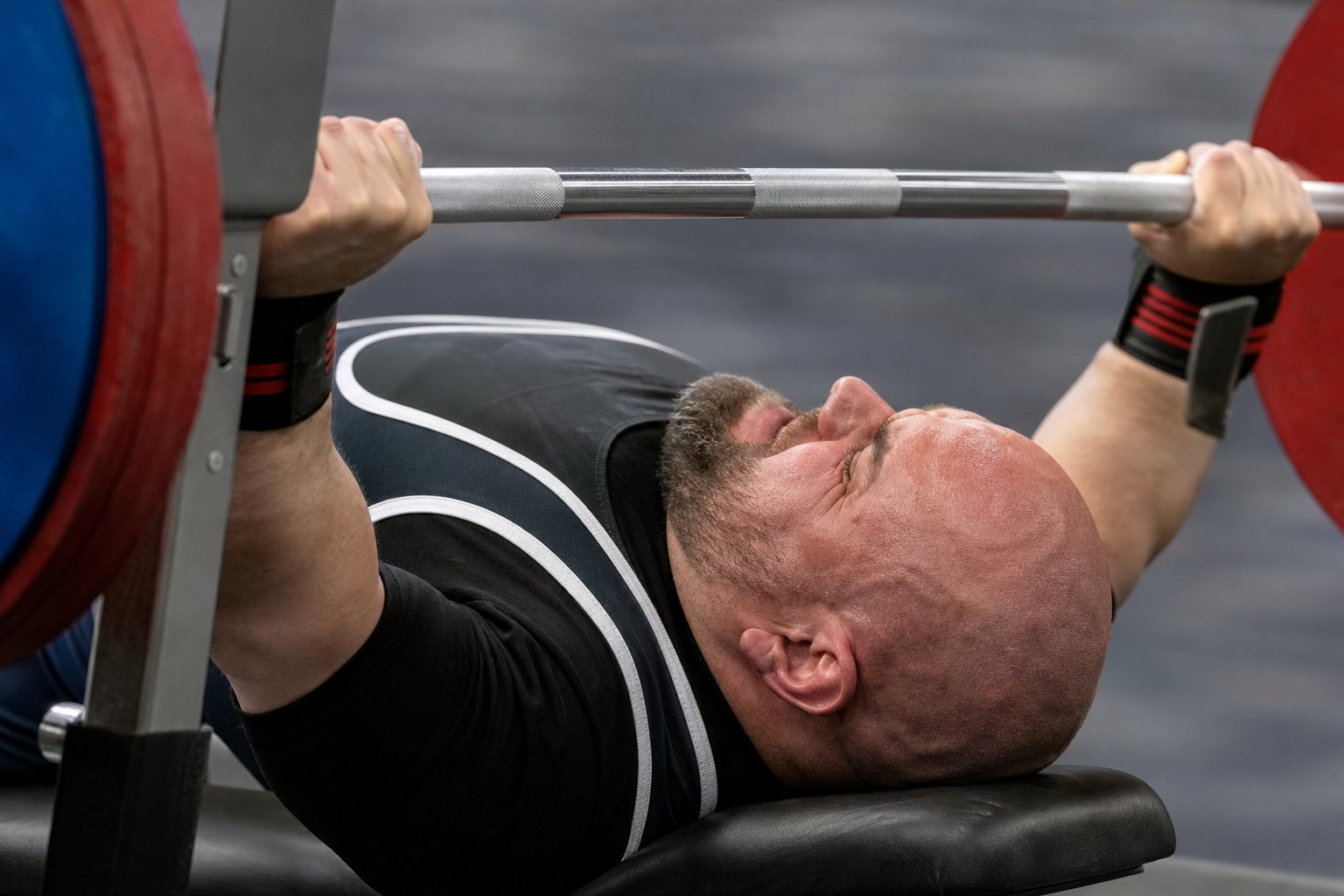
Third attempt, the bar in the rack, the referees watching. At Paris 2024 an American lifter missed a medal narrowly when a pause was judged too short on the last attempt, according to Team USA. Every Para powerlifter faces a version of that moment: one chance, a few seconds, a lot of noise. Mental training for Para powerlifting is the set of skills, focus, routines, goal setting and ways of handling pressure, that help an athlete perform what they have trained. It is different from mental health care, which has its own section below.
Quick answer: Para powerlifting has very little published sport-psychology research of its own (a 2022 scoping review found two psychological studies among 37), so these skills come from general sport psychology and coaching practice and are labelled that way. The most useful basics are a repeatable pre-lift routine, process goals, attempt choices you can make calmly, and a plan for after a missed lift. Anxiety, depression, disordered eating or burnout are health matters: talk to a doctor or a qualified mental health professional, and in the US call or text 988 in a crisis.
General information, not medical advice. Start at the Para powerlifting hub; competition rules are on the rules page.
What the research does and does not say
Puce and colleagues’ 2022 scoping review retained 37 studies on Paralympic powerlifting and found only two on psychological aspects. A 2026 study followed 24 athletes of the Brazilian national Para powerlifting team across a competitive cycle and found that negative mood states decreased over time and that baseline vigor was higher in the higher-performing group; sleep duration was the variable most consistently linked to performance change. It is a small observational study, so it describes patterns and does not show that any technique improves lifting. In another study, 61 Para athletes (including powerlifters) who reported high stress had 1.73 times the odds of a gradual-onset injury the next week (Madaleno and colleagues, 2026). Mind and body are linked, but we cannot promise any technique guarantees a result.
Confidence and focus
The following techniques are general sport-psychology and coaching practice, not tested in Para powerlifting. Confidence usually comes from evidence you have gathered: heavy lifts completed in training, rehearsed attempts and a plan. Focus in a bench press is narrow and short, so many athletes pick one or two cues for the whole attempt, such as a controlled descent, a still pause and a smooth press, and practise saying them in the same order each time.
Goals and motivation
Split goals into three kinds, again general practice: outcome goals (a medal, a total), performance goals (a personal best opening attempt) and process goals (the same setup, the same pause every lift). Process goals are the ones you control on the day, so lean on them. Check progress against your training log, and revisit goals when classification, injury or life changes the picture. Note that national and World Para Powerlifting results show the field strengthens at each level; set goals that fit your level.
Imagery and routines
- Imagery. Mentally rehearse the whole attempt, from unracking to the referee’s decision, including the pause, in the position and setup you will actually use (general practice).
- Pre-lift routine. A short, fixed sequence on the bench: breathing, grip, cue words. A routine gives you something to do when nerves arrive.
- Breathing. Slow breaths before getting on the bench can ease arousal; do not hold your breath in a way your medical team has warned against, especially with blood pressure concerns (autonomic dysreflexia is a risk after spinal cord injury at or above T6).
Handling pressure and attempt choices
Under the rules each athlete has three attempts, each at least 1 kg heavier than the last successful one, according to ParalympicsGB. A common coaching approach, general practice, is an opening attempt you could make on a bad day, a second that is a solid but not maximal choice and a third that reaches for the result. Writing attempts down before the meet and agreeing changes with your coach in advance reduces rushed decisions. Competition day logistics, weigh-in and food are on our nutrition and athlete health page.
When a lift is missed
Referees decide each lift with white or red lights, and the pause is a documented reason for failure, as shown at Paris 2024. A missed lift is information. Many coaches use a short reset: one breath, one thing to fix, then focus on the next attempt. After the meet, review calmly with your coach, using the video and notes, not just the result.
Mental health is not mental performance
Skills training will not treat anxiety, depression, disordered eating or burnout. The IOC’s 2026 consensus statement on mental health in elite athletes (Reardon and colleagues) says mental health symptoms and disorders are common among elite athletes, may have sport-related causes and can affect performance, and that appropriate support and treatment can help; it recommends screening and monitoring. A 2026 meta-analysis of 72 studies (Gouttebarge and colleagues) found symptom prevalence in current elite athletes ranging from 4 percent for drug misuse to 33 percent for distress, with large differences between studies, and it did not focus on Para athletes. If you are struggling, tell a doctor, a mental health professional or someone you trust. In the US you can call or text 988, the Suicide & Crisis Lifeline, at any time. Outside the US, use your local emergency number or crisis line. U.S. Para Powerlifting’s site links to athlete safety resources, including the U.S. Center for SafeSport.
Youth
We found no sourced mental-training guidance specific to young Para powerlifters, so none is given here.
Frequently asked questions
Is there sport psychology research on Para powerlifting?
Very little. A 2022 scoping review found two psychological studies among 37, so most advice comes from general sport psychology.
How do I stay calm before an attempt?
Many athletes use a fixed routine and slow breathing. These are general techniques, and they do not guarantee results. If your blood pressure is a concern, follow your medical team’s plan.
How should I choose my attempts?
Each attempt must be at least 1 kg heavier than your last successful lift (ParalympicsGB). Many coaches plan an opener you can almost always make, then build; agree the plan in advance.
What if I feel anxious most of the time?
That is a health matter, not a mental-skills problem. Talk to your doctor or a qualified professional; in the US call or text 988 in a crisis.
Does sleep affect performance?
In a 2026 study of 24 Brazilian national-team Para powerlifters, sleep duration was the variable most consistently linked with performance change, though the study cannot prove cause.
Sources
- Puce et al. 2022 scoping review of Paralympic powerlifting (PMID 36421643)
- Giacomini et al. 2026, health and performance in the Brazilian national Para powerlifting team (PMID 42074398)
- Madaleno et al. 2026, stress, sleep, fatigue and injury in Para athletes
- Reardon et al. 2026, IOC consensus statement on mental health in elite athletes (PMID 42580854)
- Gouttebarge et al. 2026, prevalence of mental health symptoms in elite sport (PMID 42506839)
- 988 Suicide & Crisis Lifeline
- Team USA: Para powerlifters make Paralympic debut (Paris 2024)
- ParalympicsGB: Para powerlifting
- Paralympic.org: Para powerlifting about
- U.S. Para Powerlifting (safe sport and athlete resources)
General information for education only, not medical advice. It does not replace a sports medicine doctor, physical therapist, athletic trainer or your classifier. See how we research our pages in our editorial policy. Back to the Para powerlifting hub, the sports index and the standard sport’s powerlifting guide.