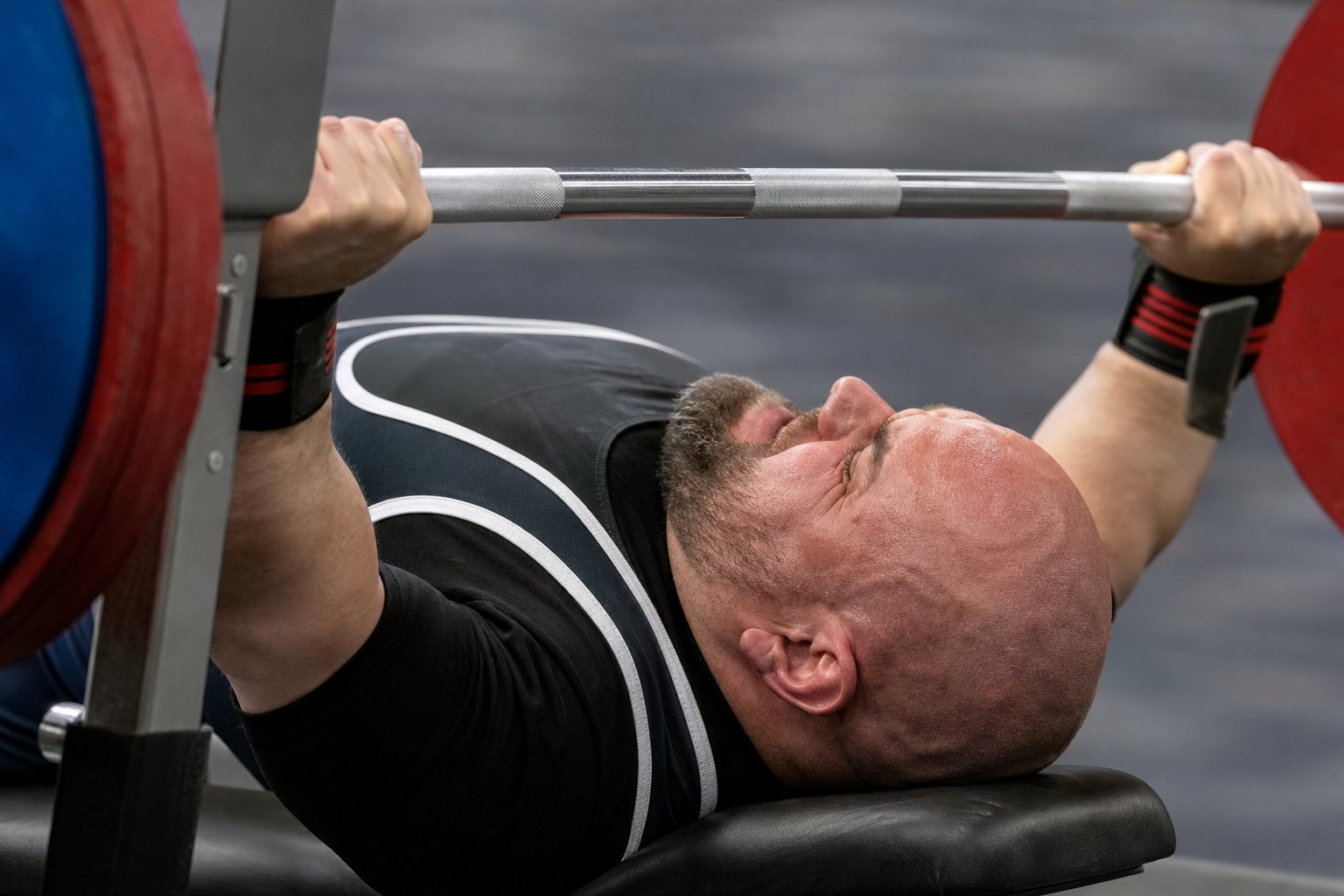
A new lifter lies back on the bench at an adaptive sports club, a coach standing at the head of the bar and a friend ready to spot. The bar comes down to the chest, stops, and goes back up. That small pause is the difference between a lift that counts and one that does not. Para powerlifting (also called Paralympic powerlifting) is a bench-press-only strength sport for athletes with an eligible impairment of the lower limbs or hips. This page explains how a lift is judged, the basic skills, how classification works in plain words, and how a beginner can find a way in.
Quick answer: Para powerlifting is a bench press: lower the bar to the chest, hold it still, press to locked elbows. Each athlete gets three attempts and the most kilograms lifted wins, within a body-weight category. To compete you need an eligible impairment that meets the minimum criteria in the lower limbs or hips; you do not need classification to start lifting for fitness. In the US, begin at U.S. Para Powerlifting (Lakeshore); elsewhere, ask your national Paralympic committee or weightlifting federation. Always check the current World Para Powerlifting rulebook, which overrides any summary here.
General information, not medical advice. For the sport as a whole, start at the Para powerlifting hub. For the standard sport, see our powerlifting guide.
How a lift works
Paralympic.org describes the sequence: the athlete lies on the bench, receives the bar, lowers it to the chest, holds it motionless, and then presses it up to locked arms. Three referees judge each attempt independently with a white light for a good lift and a red light for no lift, and two or more white lights make the lift good. The athlete has three attempts. ParalympicsGB adds that each attempt must be at least 1 kg heavier than the last successful one, and that a tie goes to the athlete who weighed in lighter. A fourth attempt may be granted to try for a record, but it does not count toward the result.
Why does a lift fail? Paris 2024 gave a clear example. American lifter Bobby Body finished fourth in the men’s up to 107 kg class after his third attempt was ruled invalid for an insufficient pause before re-racking, according to Team USA. We could not open the full rulebook text to list every failure reason, so use the official document for the complete list rather than a summary.
Scoring, classes and weight categories
There is one sport class in Para powerlifting, and competition is divided by sex and body weight. Paralympic.org lists men’s categories of 49, 54, 59, 65, 72, 80, 88, 97, 107 and over 107 kg, and women’s categories of 41, 45, 50, 55, 61, 67, 73, 79, 86 and over 86 kg. Because body weight is the only split, the weigh-in matters; our nutrition and athlete health page covers weight-making cautions.
The bench is a standard item: 2.1 m long, 61 cm wide narrowing to 30 cm at the head end, and 48 to 50 cm high, according to Paralympic.org. At recognised competitions bars, collars, weights, platforms and benches must come from World Para Powerlifting approved suppliers.
Classification in plain words
Classification decides who is eligible and how athletes are grouped. The eight eligible impairments are impaired muscle power, impaired passive range of movement, limb deficiency, leg length difference, short stature, hypertonia, ataxia and athetosis. An impairment alone is not enough: it must be in the lower limbs or hips and meet the sport’s minimum impairment criteria. Everyone who is eligible then competes in the single sport class. The process follows the IPC Athlete Classification Code, and the sport-specific classification rules take precedence. For questions, Paralympic.org gives [email protected] as the contact.
Basic skills a beginner learns
The following points are general bench-press coaching practice, not rules from a Para source. Your coach and the current rulebook decide how they apply to your setup and impairment.
- Setup you can repeat. The same position on the bench, the same way of getting on and off, and the same hand position every time, so the lift feels familiar under pressure.
- A controlled descent. The bar comes to the chest under control; the competition lift requires it to be held still before the press.
- The pause. Practise a real, visible stop in training, because a rushed pause is a documented reason for a failed attempt at the Paralympic Games.
- A smooth press to lockout. Both arms finish locked, with the bar steady, before you re-rack.
- Spotting and loading. Learn to work with spotters and loaders, and to use the referee’s commands in practice sessions.
Levels and how to get started
In the United States. U.S. Para Powerlifting’s Get Started page lists four steps: complete the Para Eligible Athlete Questionnaire, learn about classification, review the World Para Powerlifting rules, and find a competition. The organization joined the Lakeshore Foundation on 1 January 2025. Check its licensing and classification pages for what you need before you enter an event.
In the UK. ParalympicsGB points interested people to British Weightlifting for Para powerlifting, and its page lists no talent pathway.
Elsewhere. Contact your national Paralympic committee or national weightlifting or powerlifting federation, or write to World Para Powerlifting. We did not find a worldwide youth or school structure to report; ask your national body.
Elite level. Powerlifting has been on the Paralympic programme since New York 1984. Check the official programme for the current Games; the IPC’s LA28 programme lists 20 medal events.
Official rulebook
The World Para Powerlifting Rules and Regulations took effect on 1 May 2025 and are published with eleven appendices, including technical requirements, equipment regulations, scoring, the loading chart and the announcer script. Read them on the Paralympic.org rules page before your first event.
Frequently asked questions
Do I need classification to start lifting?
No. You can train the bench press at a gym or adaptive sports program without classification. Classification matters when you want to enter World Para Powerlifting-recognised competition.
How many attempts do I get?
Three. A fourth may be granted for a record attempt, but it does not count toward your result, according to Paralympic.org.
Are Para powerlifters split by disability type?
No. All eligible athletes compete in one sport class and are divided only by sex and body-weight category.
What is the difference from standard powerlifting?
Standard powerlifting has three lifts: squat, bench press and deadlift. Para powerlifting is the bench press only.
Where can I find a coach?
Start with U.S. Para Powerlifting in the US, British Weightlifting in the UK or your national Paralympic committee elsewhere, and look for a coach experienced with adaptive athletes.
Sources
- World Para Powerlifting / Paralympic.org: history, rules and weight categories
- Paralympic.org: World Para Powerlifting rules page (rules effective 1 May 2025, appendices, approved suppliers)
- Paralympic.org: Para powerlifting classification
- ParalympicsGB: Para powerlifting
- U.S. Para Powerlifting: Get Started
- U.S. Para Powerlifting (Lakeshore)
- Team USA: Para powerlifters make Paralympic debut (Paris 2024)
- IPC: LA28 medal event programme and athlete quotas
General information for education only, not medical advice. It does not replace a sports medicine doctor, physical therapist, athletic trainer or your classifier. See how we research our pages in our editorial policy. Back to the Para powerlifting hub, the sports index and the standard sport’s powerlifting guide.