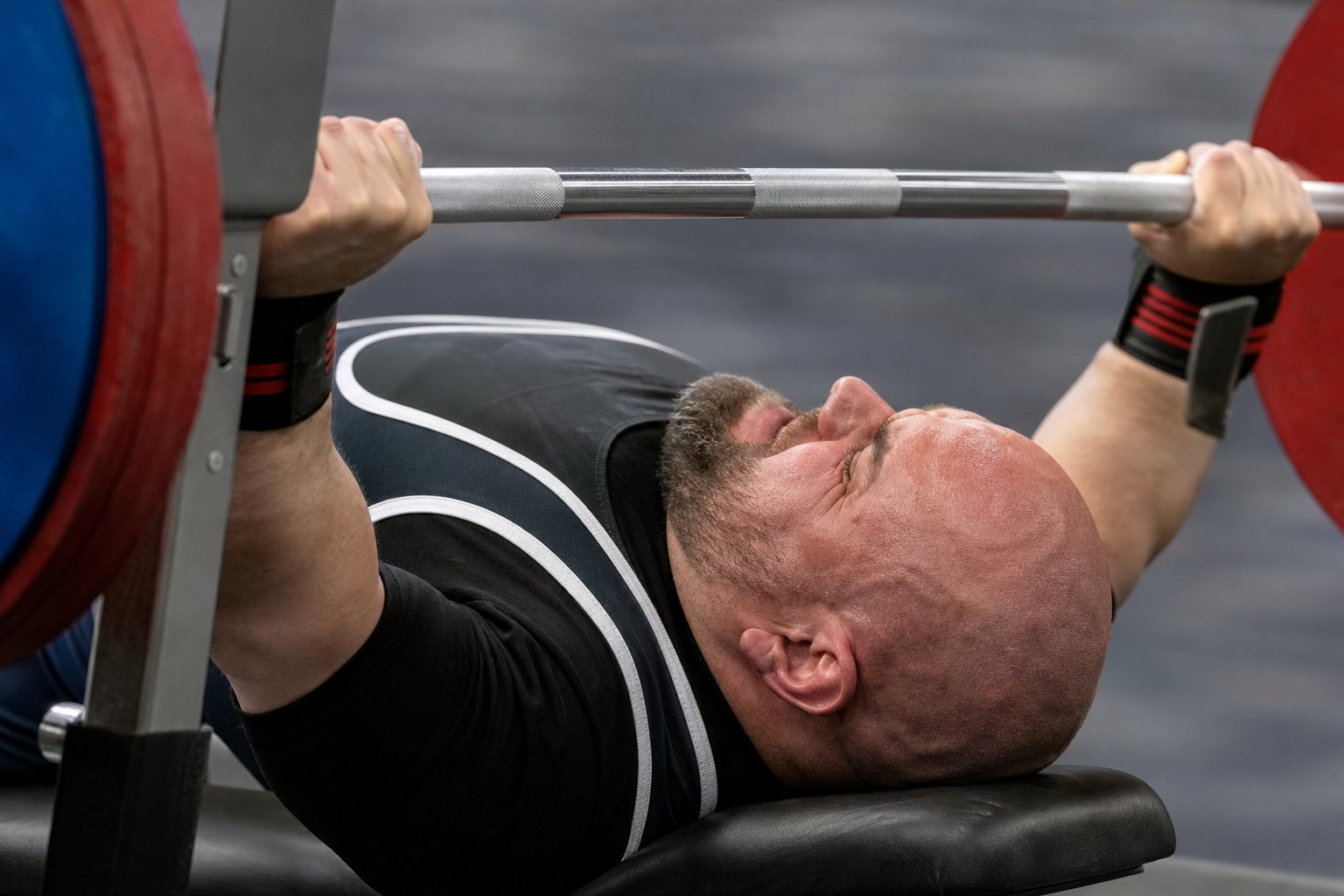
Meet morning, weigh-in done, a banana in one hand and a bottle of drink with electrolytes in the other. The lifter has practised this exact routine in training because a competition day is no time to try new foods. Para powerlifting nutrition means eating and drinking to support heavy training, to make a weight category safely, and to stay healthy, with special thought for athletes whose impairment affects temperature control, body composition or energy needs. This page keeps to sources, says where they stop, and treats supplements strictly.
Quick answer: Eat enough to train and recover, plan the weigh-in in advance and never rely on severe dehydration. Paralympic.org’s nutrition tips advise being within 2 to 3 percent of competition weight a week out and rehydrating with electrolyte fluids after weigh-in; athletes with spinal cord injury sweat less, so fluid cuts work less well and heat is riskier. Supplements make at most a small contribution (IOC), come with a banned-substance risk, and are the athlete’s responsibility under strict liability. Talk to a registered sports dietitian and your doctor first.
General information, not medical or nutrition advice. Talk to your doctor or a registered sports dietitian before changing your diet or starting a supplement. Start at the hub; standard-sport guidance is on our powerlifting guide, which may not fit your body.
Food and fluids for training
The International Society of Sports Nutrition position stand (Jager and colleagues, 2017) says 1.4 to 2.0 grams of protein per kilogram of body weight a day is enough for most people who exercise, and that whole foods can meet it. That is a general adult figure; a 2021 Frontiers review notes that specific protein recommendations for athletes with spinal cord injury are lacking, so individual advice matters. Carbohydrate also matters for repeated heavy sets; the ACSM, Academy of Nutrition and Dietetics and Dietitians of Canada joint position (Thomas and colleagues, 2016) gives 3 to 5 grams per kilogram a day for light training and 5 to 7 for about an hour a day of moderate exercise, general figures for other sports.
Health points for athletes with an impairment
- Energy needs. Reviews of athletes with spinal cord injury report a reduced resting metabolic rate and more body fat from lower active muscle mass; a 2018 review in Nutrients found no studies that had measured energy availability in these athletes. Needs vary a lot.
- Temperature and fluids. Paralympic.org notes lifters with a spinal cord injury sweat less and are prone to a rising core temperature, so dehydration-based weight cutting is less effective and riskier.
- Relative energy deficiency (REDs). The IOC’s 2023 consensus (Mountjoy and colleagues) links long-term low energy availability with problems in hormones, bones and performance in women and men. It is a health matter for a doctor and dietitian, not a weight-management trick.
Making a weight category
Because body weight is the only way Para powerlifters are divided, weight management is a real topic. Elizabeth Broad’s Paralympic.org article (2014) suggests being within 2 to 3 percent of your weight a week before the event, practising weight-making in training, limiting any fluid reduction to the last 24 hours and cutting fluid only to about half the usual amount, and taking care with heat if you have a spinal cord injury. It also recommends rehydrating with electrolyte-containing fluids and eating a meal soon after weighing in. It is an older article by one specialist, not an IPC position, and we do not recommend dehydration cuts; a registered dietitian can plan this for you. For teen athletes, the American Academy of Pediatrics clinical report on healthy weight-control practices in young athletes is the place to start.
Competition-day eating
Broad advises a small, carbohydrate-based snack one to two hours before the first lift, using familiar foods tested in training, and sipping a sports drink or eating small carbohydrate foods between lifts. The amount depends on how many athletes are in the session and how long it runs.
Supplements: strict rules
The IOC’s 2018 consensus statement (Maughan and colleagues) says supplements make at most a small contribution and that only a few, including caffeine and creatine, have good evidence for performance; it recommends a nutrition assessment first. The ISSN position stand on creatine (Kreider and colleagues, 2017) calls it effective for high-intensity exercise and lean mass and safe at recommended doses in healthy people; the IOC notes it typically adds 1 to 2 kg of body mass, which matters in a weight category. Follow the label, and note that caffeine is not for everyone and can disturb sleep.
Contamination is a real risk: in a widely cited study of 634 supplements from 13 countries, about 15 percent contained anabolic steroid precursors not on the label. Third-party certification such as NSF Certified for Sport or Informed Sport lowers the risk but does not remove it. Para powerlifters fall under anti-doping rules, and under strict liability the athlete is responsible for anything in the body. Check the current IPC and World Para Powerlifting anti-doping rules, and in the US U.S. Para Powerlifting points athletes to USADA. Check every product and every medication before use. Finally, the IPC bans deliberately inducing autonomic dysreflexia (“boosting”), which is a health danger, not a nutrition tool.
Frequently asked questions
How much protein do I need?
The ISSN says 1.4 to 2.0 grams per kilogram a day suits most people who train. For athletes with spinal cord injury, specific advice is lacking, so ask a dietitian.
Should I cut water to make weight?
Paralympic.org’s tips limit fluid cuts to the last 24 hours and warn about heat, but we do not recommend dehydration. Ask a dietitian for a plan well before the meet.
Is creatine allowed?
The sources we used say creatine is well studied; whether a given product is allowed for you must be checked against current anti-doping rules and with USADA or your national agency.
What does third-party tested mean?
Programs like NSF Certified for Sport and Informed Sport test products for banned substances. It lowers but does not remove the risk.
What is REDs?
Relative energy deficiency in sport: long-term low energy availability that can affect hormones, bones and performance, according to the IOC 2023 consensus. See a doctor if you suspect it.
Sources
- Paralympic.org: Elizabeth Broad, five nutrition tips for powerlifters (2014)
- Jager et al. 2017, ISSN position stand on protein (PMC5477153)
- Thomas, Erdman and Burke 2016, ACSM/AND/DC joint position (PMID 26891166)
- Mountjoy et al. 2023, IOC consensus on REDs (PMID 37752011)
- Maughan et al. 2018, IOC consensus on dietary supplements (PMC5867441)
- Kreider et al. 2017, ISSN position stand on creatine (PMC5469049)
- Flueck and Parnell 2021, nutrition in spinal cord injury athletes (Frontiers in Nutrition)
- Nutrients 2018 review, nutrition for athletes with spinal cord injury
- NSF Certified for Sport
- USADA
- AAP clinical report on weight control in young athletes (PMID 28827381)
- Hodgkiss et al. 2026 on boosting (PMID 41082173)
General information for education only, not medical advice. It does not replace a sports medicine doctor, physical therapist, athletic trainer or your classifier. See how we research our pages in our editorial policy. Back to the Para powerlifting hub, the sports index and the standard sport’s powerlifting guide.