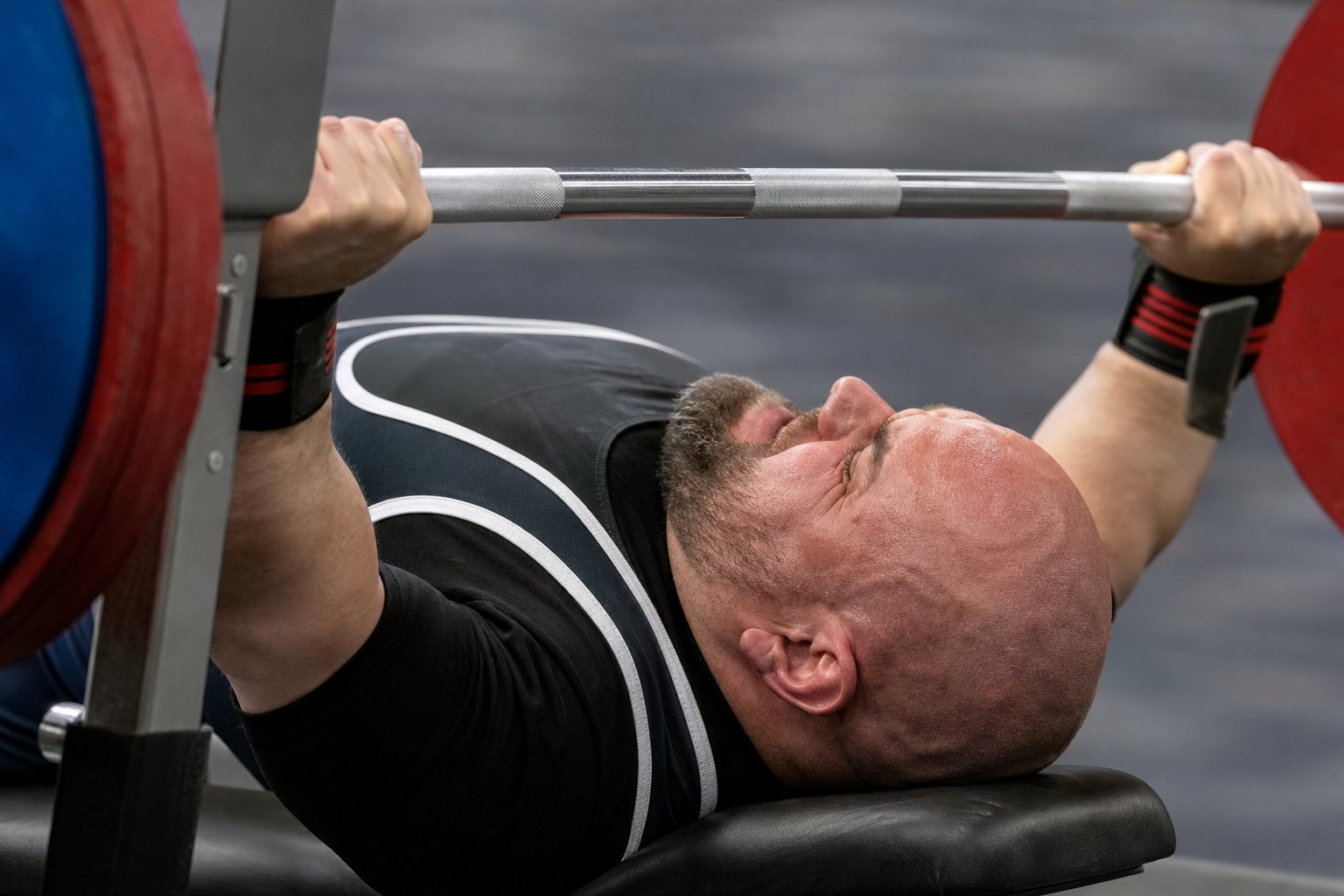
Early evening, the club bench free at last. The lifter works through a few light warm-up sets, then three heavy singles, each one held on the chest for a beat, with a coach watching the bar path and counting the pause. Para powerlifting training is the planning of heavy bench work, supporting strength exercises and rest so that an athlete can lift the most possible weight on one day, under the competition rules. This page covers the physical demands and a sensible weekly shape, and is careful to say where the evidence stops.
Quick answer: Para powerlifting is a seconds-long maximal effort of the chest, shoulders, triceps and upper back, so training centres on heavy, controlled bench work with a competition-style pause, plus upper-back and trunk strength and enough rest. Published Para-specific training research is thin (45 of 218 studies in a 2025 scoping review), so most weekly plans rest on general strength-training practice and a coach who knows your impairment. See a sports medicine doctor, physical therapist or athletic trainer before you start if you have any health condition or pain.
General information, not medical advice. Start at the Para powerlifting hub; rules are on the skills and rules page.
What the sport demands
A lift lasts seconds, so it draws on maximal strength and power rather than endurance. The 2025 Sports Medicine systematic scoping review by Silverthorne and colleagues found 218 studies on powerlifting and Para powerlifting up to June 2025; the most researched topics were physical qualities, competition, training and biomechanics. A 2022 scoping review of Paralympic powerlifting (Puce and colleagues) retained 37 studies and found only a handful in each theme, for example two on warm-up strategies, two on training aspects and eight on bench-press biomechanics. In plain words: there is real research, but not enough to prescribe one best program.
What one study says about tempo
A 2026 study in Frontiers in Sports and Active Living tested 13 competitive Para powerlifters (8 women, 5 men) on single repetitions at 80 percent of their one-repetition maximum under six conditions, including different lowering speeds with and without a competition-valid pause. The fastest, self-chosen lowering produced the highest bar velocity and power, and the slowest controlled lowering (6 seconds) produced the lowest; the authors associated volitional tempos under 4 seconds with greater velocity and power. This was a single-session lab test, not a training outcome, so treat it as a clue for you and your coach to explore, not a rule.
A sensible weekly shape
The shape below is general strength-training practice, not a Para-specific prescription. We found no sourced numbers for sets, repetitions or frequency in Para powerlifting, so none are given here. The World Health Organization’s 2020 guidelines (Bull and colleagues, British Journal of Sports Medicine) recommend muscle-strengthening activity on at least two days a week for adults, including adults living with disability; competitive lifters usually do more, which is where a coach comes in.
- One heavy bench day. Work up to heavy sets with a competition-style pause, with the rest of the week keeping the main lift fresh.
- One lighter or technique day. More repetitions at a lower load, or paused work, to practise the same setup and bar path.
- Supporting strength. Upper-back rowing and pulling, triceps and shoulder-stabiliser work, and trunk exercises that suit your impairment, chosen with a therapist.
- Planned rest. At least one full day off the bench each week; if you also push a wheelchair or transfer with your arms, count those hours as arm load too.
Periodisation basics
Periodisation simply means organising training into phases. A common coaching pattern, again general practice and not from a Para study, is a base phase of more volume and technique work, a strength phase with heavier loads, a short peak that rehearses competition attempts, and a lighter week before the meet, followed by an easier block afterwards. Keep notes of your top sets, how you slept and how your shoulders felt, so that you and your coach can adjust. A 2026 analysis of World Para Powerlifting and open-access data (Latella and colleagues) covered 6,064 male and 3,187 female entries from 2013 to 2025 and found the highest normative strength values at the Paralympic Games, then World Championships, World Cups, regional and national events. It is a useful reminder that goals should match your level.
Skills practice
Because a rushed pause can fail a lift, as happened to Bobby Body at Paris 2024 according to Team USA, rehearse the full sequence in training: setup, unrack, descent, hold, press, lockout, re-rack. Film a set from the side and show it to your coach. Our injury prevention page explains why the shoulders need a smart plan, and the recovery page covers sleep and load.
Frequently asked questions
How often should I bench?
There is no sourced answer for Para powerlifting. Many lifters use two to three bench-focused sessions a week with one heavy day, but your coach should set this around your impairment, other arm use and recovery.
Do I need to train my legs?
That depends on your impairment and your doctor or therapist’s advice. Ask a clinician or coach familiar with Para athletes; we did not find sourced guidance to give here.
Is a slow lowering phase better?
In one 2026 test of 13 Para powerlifters, faster self-chosen lowering gave the highest velocity and power at 80 percent of one-repetition maximum. It was a single-session study, so discuss it with your coach.
How do I know my level?
Use the national or World Para Powerlifting results and records for your weight category, and remember that the 2026 Latella analysis found strength values rise from national to Paralympic level.
Can I train with a standard powerlifting program?
You can borrow ideas from our powerlifting guide, but squat and deadlift work may not fit your body, and the bench rules differ, so adapt with your coach.
Sources
- Silverthorne et al. 2025, Sports Medicine scoping review (PMID 40924269)
- Puce et al. 2022, scoping review of Paralympic powerlifting (PMID 36421643)
- Luz dos Santos et al. 2026, eccentric tempo in Paralympic bench press (PMID 43005533)
- Latella et al. 2026, minimum standards for medaling in Para powerlifting (PMID 42632638)
- Bull et al. 2020, WHO guidelines on physical activity and sedentary behaviour (PMID 33239350)
- Team USA: Para powerlifters make Paralympic debut (Paris 2024)
- World Para Powerlifting / Paralympic.org: history, rules and weight categories
General information for education only, not medical advice. It does not replace a sports medicine doctor, physical therapist, athletic trainer or your classifier. See how we research our pages in our editorial policy. Back to the Para powerlifting hub, the sports index and the standard sport’s powerlifting guide.