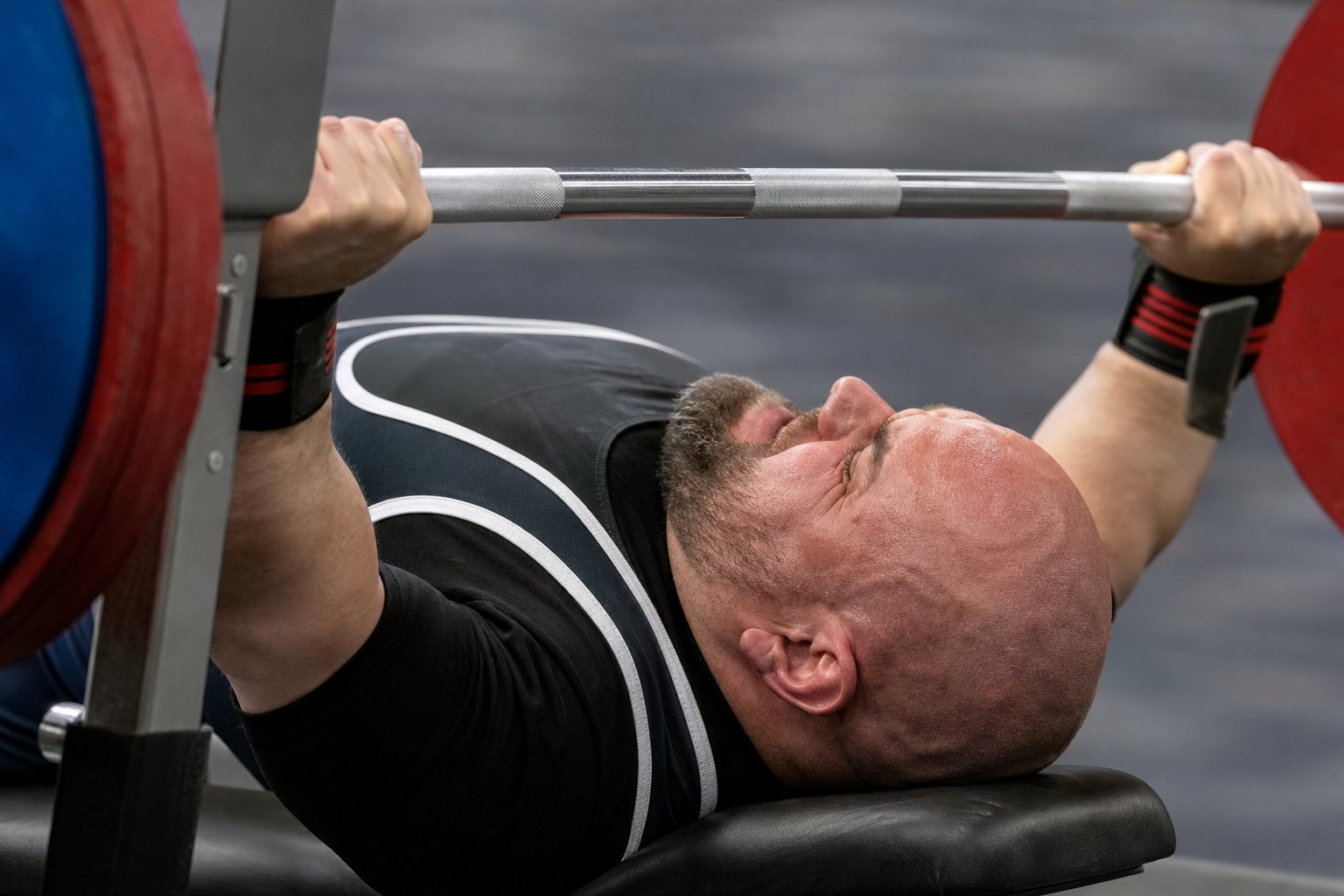
The final set of a heavy week and a sharp pinch at the front of the shoulder as the bar leaves the chest. The lifter stops, racks, and wonders whether to keep going. Para powerlifting injuries are the health problems that show up in athletes who bench-press heavy loads, most often in the shoulder. This page sets out what the surveillance numbers say, the general principles of rehabilitation, and when to hand the problem to a professional. It does not diagnose, and it never clears anyone to return.
Quick answer: At two Paralympic Games, most powerlifting injuries were overuse, and the shoulder was the most affected region: 32 percent at London 2012 and 45.5 percent at Rio 2016. General rehabilitation principles are an early professional assessment, a gradual return to load and attention to the whole week’s arm use. See a sports medicine doctor, physical therapist or athletic trainer for pain that persists; a clinician, not this page, decides when you can lift again. Get urgent care after a head injury with danger signs or for autonomic dysreflexia symptoms.
General information, not medical advice. Prevention habits are on our injury prevention page; recovery is on the recovery page. Start at the hub.
What surveillance shows
- London 2012. Willick and colleagues followed 163 powerlifters: 38 injuries, 33.3 per 1,000 athlete-days, 23.3 per 100 athletes, 61 percent chronic overuse. The shoulder and clavicle accounted for 32 percent of injuries, the chest and the elbow 13 percent each.
- Rio 2016. Ayala and colleagues analysed 1,410 athlete-days: 15.6 injuries per 1,000 athlete-days, 63.6 percent chronic overuse, shoulder 45.5 percent. Rates did not differ significantly between men and women, and the oldest group (35 to 75) had the highest rate.
- Brazil, one year. In 102 Para athletes from four sports, Madaleno and colleagues recorded 612 health problems; the shoulder complex had the highest burden and powerlifting the highest injury burden of the four sports. It is a small two-centre study in one country.
- Paris 2024. The Games-wide surveillance study counted 535 injuries in 4,450 athletes over 14 days; its abstract did not single out powerlifting and we found no sport-specific rate.
Different methods and reporting systems make the numbers hard to compare, and surveillance at the Games covers a few days, not a training year.
Shoulder, chest and elbow
The sources report regions, not exact diagnoses, so we do not list specific conditions as proven patterns. In plain words, the repeated heavy pressing loads the front of the shoulder, the chest and the elbow, and the numbers above show those areas carry most of the burden. Wheelchair users and others who rely on their arms for daily movement add load outside the gym, which is why the Brazilian authors’ focus on shoulder burden is worth taking seriously.
Head injuries
A fall during a transfer or a bar accident can cause a concussion. The CDC HEADS UP guidance is to remove the athlete from play, keep them out until a healthcare provider says otherwise, and seek emergency care if danger signs appear. The return decision is medical and is a step-by-step process, not a one-day call.
Autonomic dysreflexia
For athletes with a spinal cord injury at or above T6, Balik and Sulla (2022) describe autonomic dysreflexia as potentially life-threatening, with a sudden rise in blood pressure. It can be triggered by a painful or irritating stimulus below the level of injury, such as an injury that goes unnoticed. The IPC bans deliberately inducing it. Know your own warning signs and emergency plan from your medical team.
General rehabilitation principles
These are general principles drawn from the injury-surveillance conclusions and common practice in sports medicine, not a treatment plan. First, get an assessment from a clinician who understands your impairment, so that the cause is identified. Second, rehabilitation usually aims to reduce irritated tissue load, restore movement and strength, and then bring the lifting back in steps, with a professional deciding the steps. Third, look at the whole week, including transfers and wheelchair use, because arm load adds up. Fourth, support sleep and nutrition. We give no recovery times, since they vary with the problem and the person.
When to see a professional
- Pain in one spot that lasts, returns every session or wakes you at night.
- Numbness, tingling, swelling, a sudden “pop” or visible change in the shape of the chest or arm.
- A head knock, or any danger signs after one.
- Pounding headache, flushing or sweating with a very high blood pressure reading if you have a spinal cord injury at or above T6.
- Any pain you are tempted to hide to protect your place on the team.
Frequently asked questions
Is shoulder pain normal for Para powerlifters?
It is common in the numbers, not normal in the sense of safe to ignore. The shoulder was the most injured region at both London 2012 and Rio 2016.
Are most injuries sudden?
No. About six in ten powerlifting injuries at those two Games were chronic overuse.
Can I keep training with an injury?
That is for a sports medicine doctor or physical therapist to decide for your situation. We cannot clear anyone to lift.
How long will recovery take?
There is no universal time. It depends on the problem, the person and the sport load, so ask your clinician for an individual plan.
Do Para powerlifters get more injuries than other Para athletes?
In the 102-athlete Brazilian study powerlifting had the highest injury burden of four sports, but it was a small study and cannot be generalised.
Sources
- Willick et al. 2016, injuries in Paralympic powerlifting at London 2012 (Scand J Med Sci Sports, DOI 10.1111/sms.12554)
- Ayala et al. 2019, injury epidemiology in powerlifting at Rio 2016 (Translational Sports Medicine)
- Madaleno et al. 2025, burden of injuries and illnesses in 102 Para athletes (PMID 40848418)
- Paris 2024 Paralympic injury surveillance (PMID 42103446)
- CDC HEADS UP: respond to a concussion
- Balik and Sulla 2022, autonomic dysreflexia after spinal cord injury (PMID 36120615)
- Hodgkiss et al. 2026, electroceuticals and boosting (PMID 41082173)
- Silverthorne et al. 2025 scoping review (PMID 40924269)
General information for education only, not medical advice. It does not replace a sports medicine doctor, physical therapist, athletic trainer or your classifier. See how we research our pages in our editorial policy. Back to the Para powerlifting hub, the sports index and the standard sport’s powerlifting guide.