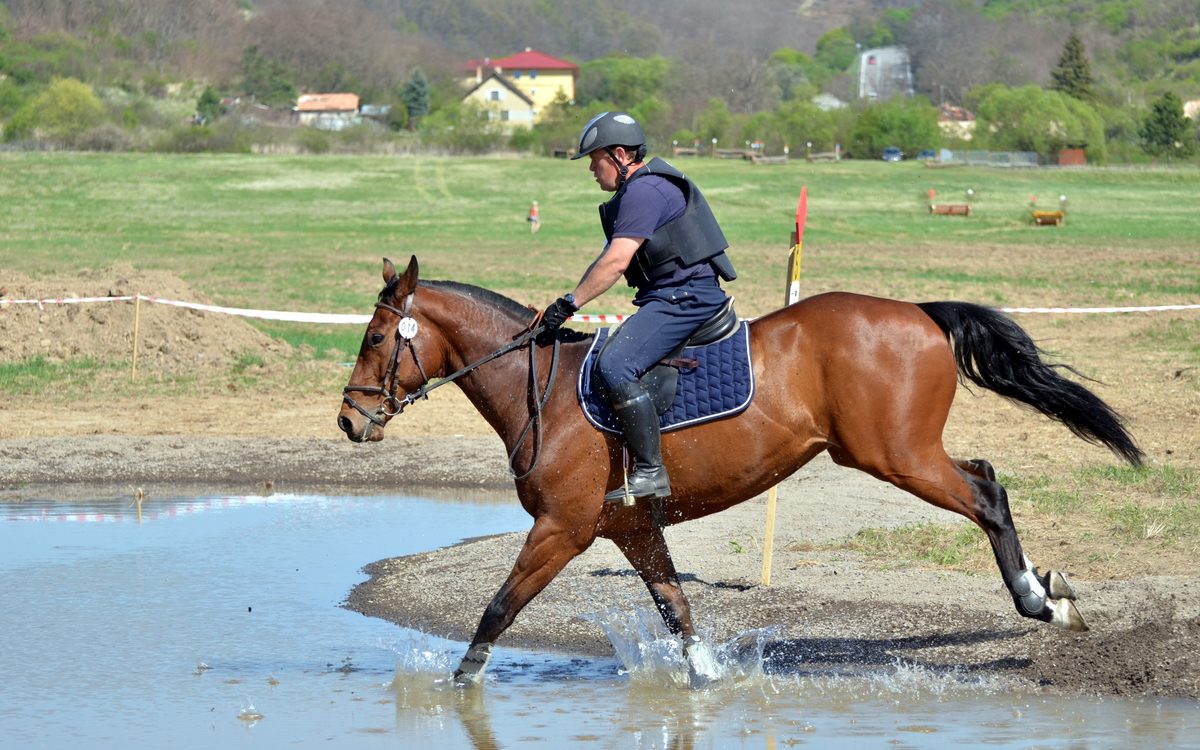
A rider comes off at a ditch at a Beginner Novice event, gets up, waves to the crowd and says she is fine. By evening her neck is stiff and she has a headache that will not go away. Eventing injuries range from bruises to serious trauma, and the pattern depends on level, the type of fall and what the rider wore. This page summarizes what researchers have counted and how rehabilitation generally works. It is general information, not a diagnosis. For ways to lower risk, see eventing injury prevention.
Quick answer: Studies of eventing riders find that injuries are common and that head, face, thorax and spine injuries carry the most serious consequences. If a rider may have hit their head, follow the CDC HEADS UP rule: stop riding, get checked, and let a healthcare provider decide when to return. Rehabilitation is individual. See a sports medicine doctor, physical therapist or athletic trainer rather than guessing, and call emergency services for danger signs.
What the numbers say
- Rider injury prevalence. A Swedish study of adult eventing athletes (513 invited, 70.0% took part) reported a one-year injury prevalence of 26.6%, made up of 19.3% traumatic and 10.9% overuse injuries. The traumatic injury rate was 0.54 events per 1,000 eventing hours for novices and 0.35 for qualified riders, and 27.9% of traumatic injuries were severe, meaning more than three weeks away from riding.
- Cross-country injuries. A study of 16,940 cross-country rides at competitions from 1992 to 1997 recorded 193 injuries (a rate of 1.1%), including two deaths. Head and facial injuries were the largest group at 31%, and a third of those needed hospital treatment. Every rider wore a helmet and body protector, and the authors called eventing one of the most dangerous equestrian sports.
- Horse falls. A British analysis of 749,534 cross-country starts says horse falls are the leading cause of rider fatality in the sport and reports 16 rider and 69 horse fatalities at competition over ten years.
- Registries. A 2025 review of equestrian trauma literature (not just eventing) said injuries to the thorax were the most prevalent location in national and international trauma registries, while head, neck and high cervical injuries were linked to the highest mortality.
For context across all horse-related activity, CDC authors estimated in 2006 that about 103,000 horse-related injuries a year were treated in US emergency departments in 2001 to 2003, and that about two-thirds happened while mounted. That figure covers every kind of riding, not only eventing.
Head injury and concussion
A 2023 review noted a concussion rate in equestrians of 0.19 per 1,000 hours, about half the 0.44 reported for soccer match play, but possibly more severe because rotation and acceleration forces are significant predictors of equestrian concussion. Signs include headache, dizziness, confusion, nausea and trouble with balance or memory, and they may appear hours later. The CDC HEADS UP guidance is simple: if you suspect a concussion, remove the rider from activity, arrange for a healthcare provider to evaluate and let the provider decide when to return in steps. Danger signs, such as repeated vomiting, a seizure, worsening headache, drowsiness or loss of consciousness, need emergency care. Never move someone with a possible neck or back injury.
In a 2025 survey of collegiate riders, concussion was the most commonly reported head injury and more than half of respondents had fallen in the previous year. A rider’s own report is not enough: riders often feel pressure to continue, and medical armbands, event medical teams and coaches exist so someone else can make the call.
Back, neck and overuse problems
Falls are not the only issue. The Swedish study found overuse injuries in 10.9% of riders and advised prevention programs to cover them. Other disciplines show a similar load on the spine: in one South African survey of 100 competitive dressage riders, 71% reported low back pain at the time and 56% had lifetime pain (cross-sectional, so it cannot show cause), and a 2026 survey of 353 female show jumpers aged 12 to 25 found higher training volume at higher levels and a trend toward more lumbar disability, which did not reach statistical significance. These are neighbouring disciplines, not eventing data, but they suggest the repeated loading riders put on their backs is worth taking seriously.
General rehabilitation principles
Nothing here is a rehab plan or a clearance to ride. The staged outline below is general sports-medicine practice; the 2016 consensus statement from the First World Congress in Sports Physical Therapy supports the point about return decisions. In short:
- Get a diagnosis first. Pain is a symptom; the cause decides the treatment.
- Rehabilitation is staged. It usually moves from protecting the injury and restoring movement, to building strength and control, to sport-specific work, and last to return to competition.
- Return is a decision, not a date. The consensus statement says return to sport should be viewed as a continuum alongside rehabilitation, with decisions made collaboratively by clinicians, athletes and coaches. We do not give time frames because they vary by injury and person.
- For concussion the CDC outlines a stepwise return to activity under a provider’s guidance.
- Ride-specific retraining usually starts with flatwork before jumping, a general coaching practice.
Also plan the horse’s side. A rider who is stiff or guarded can unsettle a horse, so coaches often suggest a lower-pressure return. See eventing recovery for daily recovery habits and horseback riding injuries for the wider picture.
When to see a professional
See a sports medicine doctor, physical therapist or athletic trainer for pain that lasts beyond a few days, swelling, numbness, tingling, pain at night or at rest, or anything that changes how you ride. Call emergency services after a fall with loss of consciousness, severe neck or back pain, trouble breathing or chest pain. Go back to the eventing hub for the rest of the discipline.
Eventing injuries FAQs
What are the most common eventing injuries?
The studies we found describe a mix. Swedish riders reported traumatic and overuse injuries; cross-country injury data highlight head and facial injuries; trauma registries for all riding report thorax injuries as most prevalent.
How often do eventing riders get hurt?
In the Swedish study, 26.6% of riders had an injury in a year. In 1990s cross-country data, 1.1% of rides ended in an injury. The numbers differ because the studies measure different things.
Should I keep riding after a fall if I feel fine?
If you hit your head or feel unwell, stop. The CDC says to remove the athlete and let a healthcare provider decide on return. Symptoms can appear hours later.
How long does recovery take?
It depends on the injury and the person, so no universal time frames apply. A clinician who has examined you can give an estimate.
Do body protectors prevent broken ribs?
They are meant to reduce injury to the trunk. The research we found says vests may protect the thorax, but no vest prevents every injury.
Sources
- Swedish eventing injury study (PubMed)
- Injuries in the cross-country phase of eventing, 1999 (PubMed)
- British Eventing horse-fall risk factors (PubMed)
- CNS and thorax injury in equestrian sports (PubMed)
- Non-fatal horse-related injuries in US emergency departments (PubMed)
- Best et al. 2023 (PubMed)
- Collegiate equestrian helmet study (PubMed)
- Low back pain in competitive dressage riders (PubMed)
- Neck and low back disability in female show jumpers (PubMed)
- 2016 Consensus statement on return to sport, Bern (PubMed)
- CDC HEADS UP: signs and symptoms
- CDC HEADS UP: respond
General information for education only, not medical advice. It does not replace a sports medicine doctor, physical therapist, athletic trainer or qualified coach. See our editorial policy for how we research and write.