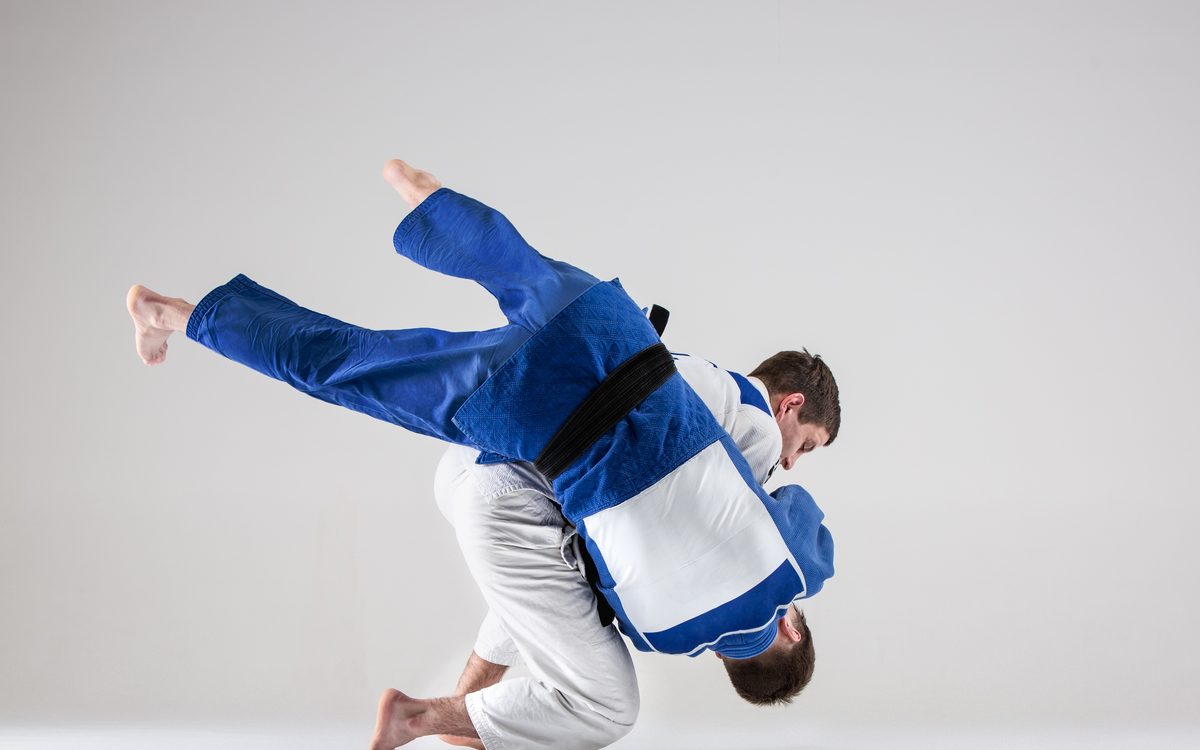
A throw goes slightly wrong. The attacker’s hip is not quite under, the partner lands on a shoulder instead of the back, and there is a dull pop at the top of the arm. The class pauses, and the partner holds the shoulder and says it is nothing. Judo injuries are mostly sprains, strains and joint injuries to the shoulder, elbow, knee and fingers, with rarer but serious head and neck injuries. This page summarizes what surveillance studies report and how to think about rehabilitation. It is education only, with no diagnosis. To lower risk, see injury prevention.
Quick answer: In a 21-season French study, sprains were 54.3% of judo injuries, fractures 15.6% and dislocations 12.5%, and across three Olympic Games judo had a higher competition injury rate than wrestling. Shoulders, elbows, knees and fingers are the usual trouble spots. Head impacts need the CDC HEADS UP approach, and any injury with numbness, severe neck pain, deformity or a joint that will not move should be seen by a sports medicine doctor, physical therapist or athletic trainer. Rehabilitation is individual, and a clinician, not this page, decides when you can return.
How common are judo injuries, and which ones?
A study of 21 seasons of French judo (Orthopaedic Journal of Sports Medicine, 2019) recorded 3,511 injuries among 316,203 judoka, about 1.1%, across 421,670 fights. Sprains made up 54.3%, fractures 15.6% and dislocations 12.5%. The authors found different patterns by sex: women had more knee sprains and elbow dislocations, men more shoulder dislocations. Acromioclavicular (shoulder) sprains were common at ages 18 to 20, and clavicle fractures at ages 10 to 14.
At the Olympic level, International Olympic Committee surveillance across three Games (Beijing 2008, London 2012, Rio 2016) reported a competition injury rate for judo of 9.6 per 1,000 minutes of exposure, against 4.8 for wrestling, and 35.9% of judo injuries led to more than seven days away from competition or training (Lystad and colleagues, 2020 review of Olympic combat sports). A study of elite European under-23 judoka (Clinical Journal of Sport Medicine, 2019) reported that the head and neck accounted for 41% of injuries, and that the competition injury rate was lower than in taekwondo and karate. Numbers differ with how each study counts an injury, so compare them with care.
Shoulder and elbow
A 2026 systematic review of shoulder injuries in judo reported that the shoulder accounted for between 10.2% and 25.5% of injuries, and ranked first or second among injured body parts in 9 of 11 studies, but rated the certainty of evidence very low. The American Academy of Orthopaedic Surgeons (AAOS) describes shoulder separation as typically caused by a fall directly onto the shoulder or a hard bump, and elbow dislocation as often caused by falling on an outstretched hand. Both are classic results of a bad fall. Signs of these injuries include pain, swelling, a visible bump or deformity, and loss of motion. Treatment depends on the injury and is for a clinician to decide.
Knees, fingers and the neck
- Knee: the French study found knee sprains were frequent in women. Knees are loaded when a throw or a grip twists the leg while the foot is planted. Persistent swelling, giving way or locking is a reason for evaluation.
- Fingers and hands: grips are constantly under load. AAOS describes jersey finger, a flexor tendon pulled off the bone, which can affect the ring finger most often and cannot heal on its own because of the gap, and describes finger fractures as causing swelling, tenderness, a finger that will not move fully, and sometimes deformity. A finger that cannot bend or straighten should be assessed promptly.
- Neck and spine: AAOS describes burners and stingers as nerve injuries that cause burning or electric shock pain down an arm. Numbness or weakness in both arms or legs, or severe neck pain after a fall, is an emergency.
Head injuries and concussion
The American Academy of Pediatrics (AAP) clinical report on youth martial arts says judo athletes are injured mostly while being thrown, and notes more concussions in judo than karate in youth. A Japanese study of catastrophic judo injuries from 2003 to 2010 (American Journal of Sports Medicine, 2013) found 72 catastrophic injuries, 30 involving the head, with 27 of those 30 in people under 20 who had been thrown and acute subdural hematoma in 94% of the head injuries; 15 of the injured people died. These cases are rare but are the reason clubs teach breakfalls first. A case report of a 16-year-old judoka described a second head injury 19 days after a first one that had been overlooked.
For any suspected concussion, the CDC HEADS UP approach is: recognize the signs (headache, dizziness, confusion, balance problems), remove the person from practice, and have a healthcare provider decide when to return. Call 911 for danger signs such as repeated vomiting, a seizure, a worsening headache, one pupil larger than the other, or loss of consciousness. The International Judo Federation rules say a suspected concussion means no competition for seven days from the day after the injury, with medical clearance required to return. Those are the federation’s rules for its events, not a recovery time for every person. Chokes can cause brief loss of consciousness; a person who has been choked unconscious needs to be watched, and the IJF does not let a cadet who loses consciousness in a choke continue.
Skin infections
Skin infections are an injury-like problem in mat sports. A 2022 article in the Italian Journal of Dermatology and Venereology covers tinea corporis gladiatorum, a ringworm infection, in wrestlers and judokas. The National Athletic Trainers’ Association (NATA) position statement on skin diseases advises being cleared by a clinician before returning to practice with a lesion. A new red, scaly, blistered or crusting spot should be looked at before it spreads.
Rehabilitation: general principles
We did not find a judo-specific rehabilitation trial, so this section is limited to what orthopedic and sports medicine bodies say in general. Rehabilitation after a sprain, strain, fracture or dislocation is planned by a clinician for the specific injury, and the stages, from protecting the joint to restoring motion, strength and sport movements, differ by person. There is no universal recovery time. A physical therapist or athletic trainer can set a graded return to falling, then drills, then randori, and a sports medicine doctor decides when full return is safe. Returning too early after a head injury is the clearest example of why it matters. Our recovery page covers sleep, soreness and mobility for healthy training.
When to see a professional
- Pain that is sharp, grows, or does not ease within a few days
- A visible deformity, a joint that looks out of place, or loss of movement
- A finger that will not bend or straighten
- Swelling, locking or giving way in the knee
- Numbness, tingling or weakness, or burning pain down an arm
- Any head impact with symptoms: use the CDC HEADS UP steps and call 911 for danger signs
Frequently asked questions
What is the most common injury in judo?
In the 21-season French study, sprains were the most common type (54.3%), followed by fractures (15.6%) and dislocations (12.5%). The shoulder is among the most commonly injured regions in published reviews, though the evidence is rated very low certainty.
Is judo more injury-prone than wrestling?
In IOC surveillance across three Olympic Games, judo had a competition injury rate of 9.6 per 1,000 minutes versus 4.8 for wrestling. That is elite competition, and club practice is different.
How long does a judo injury take to heal?
It depends on the injury and the person, and no universal time exists. A sports medicine doctor or physical therapist can give a plan, and a clinician decides on return to practice.
Can I keep training with a sprain?
That is for a clinician to judge. Training through pain can make an injury worse. Ask a sports medicine doctor, physical therapist or athletic trainer what you can safely do, such as lower-body work while a shoulder heals.
What should I do after being choked unconscious?
Stop practice, make sure the person is breathing and awake, and get medical advice. Call 911 for danger signs or if consciousness does not return quickly.
Sources
- French judo injuries over 21 seasons (PMID 31211149)
- Lystad et al., Olympic combat sports injury incidence (PMID 33219113)
- Shoulder injuries in judo, systematic review (PMID 42941534)
- Elite European U23 judo injuries (PMID 31241538)
- Kamitani et al., catastrophic judo injuries (PMID 23765041)
- Case report, 16-year-old judoka (PMID 27060521)
- AAP: Youth Participation and Injury Risk in Martial Arts
- AAOS OrthoInfo: Shoulder Separation
- AAOS OrthoInfo: Elbow Dislocation
- AAOS OrthoInfo: Flexor Tendon Injuries
- AAOS OrthoInfo: Finger Fractures
- AAOS OrthoInfo: Burners and Stingers
- CDC HEADS UP: signs and symptoms
- IJF Sport and Organisation Rules (Jan 2025)
- NATA position statement: skin diseases
- Tinea in wrestlers and judokas (PMID 33913669)
General information for education only, not medical advice. It does not replace a sports medicine doctor, physical therapist or athletic trainer who knows you. See how we work in our editorial policy, and return to the judo hub.