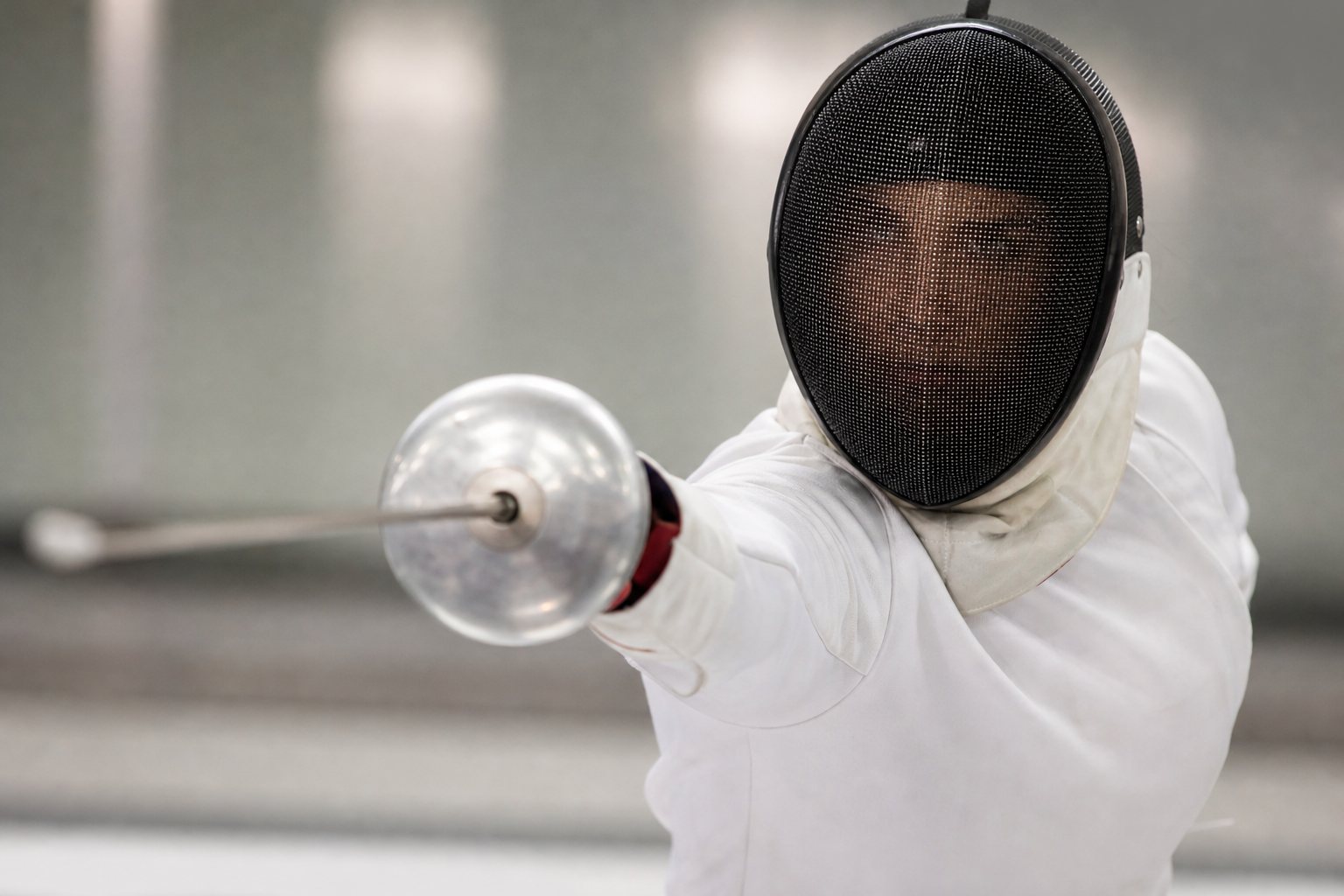
The fencing round went badly. You lost two bouts you expected to win, your seeding slipped, and in twenty minutes you have to dive into a pool as if none of it happened. Then you will start the laser run chasing someone. Modern pentathlon mental training is the set of skills, such as focus, routines, imagery, goal setting and resetting after a mistake, that help an athlete perform their best across five different tasks in one day. It is distinct from mental health, which we cover below and which belongs with qualified professionals.
Quick answer: The one-day format means you must reset between events. Research in pentathletes shows that shooting accuracy held up as heart rate rose (Dadswell and colleagues, 2016) and that missed shots came at higher heart rates (Ünver and colleagues, 2025), so a repeatable routine and practice under fatigue are the practical tools. Mental skills may help, but nothing guarantees performance. Anxiety, depression, disordered eating or burnout are health matters to take to a qualified professional, and in the US you can call or text 988.
What is different about this sport mentally
Most sports ask you to stay in one task. Modern pentathlon asks you to change task four times, with short gaps between events, and where you finish in the final event depends on points from the first three. A 2024 commentary (Rappelt and Donath) says the condensed one-day format makes individual routines before, during and after competition essential. The mental load includes both resetting and the unusual scoring: a handicap start means you can see exactly who is ahead of you when you begin the laser run.
Confidence and motivation
Confidence usually comes from preparation you can point to: sessions completed, skills rehearsed under pressure, race rehearsals. Motivation is easier to sustain in a sport with several disciplines if you track progress in each one, because a weak event can drag a good day down. Many athletes keep a short training log with one thing that went well. This is general coaching practice, not a pentathlon finding.
Goal setting
Set goals you control: process goals (a start routine in the pool, a shooting rhythm, a lunge distance plan) alongside outcome goals (a points total). Because the rules convert times to points, for example 1:10 in the 100 m swim equals 250 points and 13:20 in the laser run equals 500 points (UIPM), a time goal in each event turns the day into small, trainable targets. Check the current UIPM tables before building goals on them.
Focus, shooting and heart rate
Shooting is where mind and body meet. In 17 pentathletes (Dadswell and colleagues, 2016), heart rate and blood lactate rose through the combined event, yet aiming time, shot score and pistol movement did not change. In seven national-team athletes (Ünver and colleagues, 2025), shooting accuracy did not differ significantly between lab and field, heart rate was higher in the field, and heart rate was higher in missed shots than in hits. The authors recommend running-and-shooting practice in varied weather and field conditions. A 2019 study of 25 young pentathletes (Sadowska and colleagues) showed that the first running phase disturbed the shooting stance. The practical idea is to have a fixed shooting routine, for example stance, breath, aim, squeeze, and to rehearse it when breathless. Whether a given routine works for you is individual.
Imagery and pre-competition routines
Imagery means rehearsing a skill in your mind in detail. It is widely used in sport psychology, but we did not find pentathlon-specific studies of it, so treat it as an option to try with a coach or sport psychologist. A pre-competition routine works the same way across the day: a plan for each transition (what to drink, what to focus on, one cue word for the next event), tried out in training so it is familiar. The UIPM 2026 rules, in a summary we read, list breaks of 5, 5 and 10 minutes at the top-level semi-finals and finals, which suits short routines, not long ones.
Handling pressure and setbacks
- Before the event: breathing, a familiar warm-up and a plan for the first 30 seconds.
- After a bad event: name it, one sentence, then move to the next task; the points are already banked.
- When behind in the laser run: your start time already reflects your points, so your job is to run and shoot your own race one shoot at a time.
- After the day: review what happened with a coach once you have eaten and rested, not at the finish line.
These steps are general coaching practice. The research above does not test them in pentathletes.
Decisions and tactics
In fencing, a one-minute bout leaves little time to think; coaches often teach simple plans, such as an opening action and a back-up. In the obstacle lane, deciding to slow slightly to avoid a fall can matter. In the laser run, pace against the athlete in front is a tactical choice. Learn these with your coach in controlled practice. See fencing and shooting for the individual skills, and skills, rules and getting started for the format.
Mental health is not the same as mental performance
Mental skills help you compete. They are not treatment. The International Olympic Committee consensus statement on mental health in elite athletes (Reardon and colleagues, 2026) says mental health symptoms and disorders are common among elite athletes, can have sport-related causes and can affect performance, and that treatment may include psychotherapy, medication and other approaches. If you notice constant anxiety, low mood, a loss of enjoyment, burnout, or worries and habits around food and weight, talk to a doctor, a licensed mental health professional or a sport psychologist. In the US, call or text 988 (Suicide and Crisis Lifeline). The ANAD helpline (1-888-375-7767) supports people with eating concerns. The Association for Applied Sport Psychology has a resource page for finding a consultant. See also nutrition and athlete health.
Mental training FAQs
How do I stay calm before the laser run?
There is no single method. A familiar breathing and shooting routine, practised when tired, is the approach supported by the shooting studies, and a sport psychologist can tailor it.
Does heart rate ruin shooting accuracy?
In the pentathlon studies we found, accuracy did not change significantly as heart rate rose, though heart rate was higher on missed shots in one study. Individuals vary.
Can imagery improve performance?
It is widely used, but we found no pentathlon-specific evidence. Try it with a coach and judge for yourself.
How do I recover mentally from a bad event?
Use a short reset routine and focus on the next task. If bad days leave you low or anxious for weeks, speak to a professional.
Is it normal to feel burnt out?
It is common enough in demanding sports to be taken seriously. Speak to a doctor or mental health professional, not just a coach.
Sources
- Rappelt and Donath 2024 (PubMed 39168463)
- Dadswell et al. 2016, J Sports Sci (PubMed 26375196)
- Ünver et al. 2025, BMC Sports Sci Med Rehabil
- Sadowska et al. 2019 (PubMed 31726785)
- Reardon et al. 2026, IOC consensus statement on mental health in elite athletes
- UIPM, 2026 format
- 988 Suicide and Crisis Lifeline
- ANAD Eating Disorders Helpline
- AASP resources
General information for education only, not medical advice. It does not replace a sports medicine doctor, physical therapist, athletic trainer or registered dietitian who knows you. Read how we work in our editorial policy.