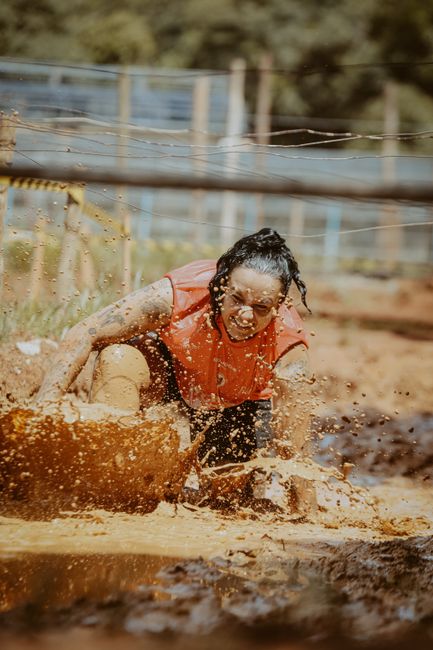
You are standing at the base of an 8-foot wall with a wave of racers piling up behind you. Your lungs are burning, the last water crossing left your hands numb, and a voice in your head is arguing about whether to try the rig or just take the burpees. Every obstacle course racer meets some version of that moment, from a first-timer at a Sprint to an age-grouper chasing a podium. Obstacle course racing mental training means practicing the skills between your ears (staying calm at a height or in cold water, pacing yourself, resetting after a failed obstacle) the way you practice your carries. This page is for racers, parents and coaches. It is about mental performance, which is different from mental health; there is a clear section on that difference below.
Quick answer: Mental skills are habits you can practice: a short routine at the start line and before each obstacle, small goals you control, a pacing plan, and a reset for when an obstacle goes wrong. Research on these tools is promising but not settled, and none of them guarantees a better finish. If fear is so strong that it stops you doing everyday things, or worry, low mood or trouble eating or sleeping lasts more than a couple of weeks, see a doctor, licensed psychologist or other qualified professional, and in a crisis call or text 988 (US).
Confidence: built from reps, not slogans
Sport psychologists often call confidence self-efficacy: your belief that you can do one specific thing, such as get over a 7-foot wall or finish the monkey bars. It grows mostly from evidence you can point to, such as wall climbs you practiced, hangs you held and long trail runs you finished. A 2015 group-randomized trial of 2,432 soldiers in basic combat training (Adler and colleagues, Journal of Applied Psychology) found that those taught mental skills reported more confidence and used more mental skills than a comparison group, and did somewhat better on obstacle course events, but the authors describe the effects as small and they varied with gender and experience.
A practical habit: after every training session or race, write down two obstacles or moments that went well, even on a day with failed obstacles. It gives your confidence something real to stand on at the next start line.
Fear of heights, water and obstacles
Many racers feel real fear at some obstacle: walls from 4 to 8 feet, a 16-foot rope climb, hanging rigs, the barbed-wire crawl, or a swim through a murky pond (heights are from Spartan’s obstacle guide). A little fear is normal and can keep you careful. What helps is not pushing through blindly but approaching the fear in small, planned steps, with the safety facts clear.
- Heights: practice at a lower version first. Climb a fence or low wall with a spotter, then a taller one, and work up over weeks.
- Cold water: the National Weather Service says that in water of 70 degrees F or lower you can lose muscle control within 10 minutes, and a published review on cold shock describes the gasp reflex as peaking within about 30 seconds and settling over roughly 3 minutes. Tough Mudder lists its ice pit at 34 degrees F. Knowing that the first breath is the worst part, and that it passes, is a useful mental tool. Enter feet first and breathe slowly.
- Skipping is allowed: Tough Mudder lists its electrified obstacle as optional, and at a Spartan race you can take the 30-burpee penalty instead of an obstacle. Deciding in advance which obstacles you will skip if you feel unsafe is a plan, not a failure.
Fear that is extreme, shows up in everyday life, or makes you avoid things is a health matter, not a mindset problem. A 2020 review of 69 trials (van Dis and colleagues, JAMA Psychiatry) found that cognitive behavioral therapy helped adults with specific phobias in the short term, though the trials were mainly of low quality.
Motivation and goal setting
Racers stay motivated through long training blocks when the goals feel like their own. A common approach is to split goals into three kinds: outcome (finish a Beast, place in an age group), performance (finish a 5K trail loop with ten minutes of carries) and process (hug the bucket high, breathe out on the way over each wall). Process goals are fully in your control, so they still count on a day when the course is muddier than expected. Write down one process goal per session and tick it off.
Pushing through discomfort, and when to stop pushing
Obstacle racing rewards toughness, and discomfort is part of it: burning forearms, cold hands, tired legs. Learning to stay with that feeling in training is a real mental skill. But discomfort is not the same as warning. Sharp joint pain, a hand that will not close, dizziness, confusion, or shivering that will not stop are reasons to stop, not to be brave; our OCR injuries guide and race day guide cover the signs and the medical team.
The same applies across a season. The joint consensus statement of the European College of Sport Science and the American College of Sports Medicine (Meeusen and colleagues, 2013) says that good training needs overload but must avoid excessive overload with too little recovery. It describes a short-term dip in performance followed by improvement after rest (functional overreaching) and a more serious state when balance is not respected (nonfunctional overreaching and the overtraining syndrome), with fatigue, performance decline and mood disturbance. In plain words: if your performance, mood and sleep keep sliding for weeks despite rest, pushing harder is the wrong answer. Talk to a doctor or sports medicine professional, and see our OCR recovery guide.
Visualization and imagery
Imagery means rehearsing a race in your mind with as many senses as you can: the shock of the ice water, the weight of the sandbag, the feel of the rope between your feet, the sound of the bell. A 2023 systematic review and meta-analysis of psychological interventions across sports (Reinebo and colleagues, Sports Medicine) found moderate effects for imagery, multimodal psychological skills training and mindfulness-based approaches compared with controls. The authors also report that the effects were not stable: when non-randomized trials and subjective outcomes were removed, they were no longer significant. Imagery is best seen as a low-cost add-on to real practice, not a replacement for it.
- Try 3 to 5 minutes before bed: see and feel yourself moving through the course, obstacle by obstacle, staying calm.
- Rehearse the hard moments too: the missed monkey bar, the burpees that follow, the cold plunge, and then your calm response.
Pacing and decisions on course
An obstacle race mixes running with bursts of hard effort, and the pace that suits a 5K Sprint does not suit a 21K Beast (race lengths are from Spartan’s race types guide). The mental job is deciding, again and again, how hard to go. Common coaching advice, not a research finding, is to start a little easier than feels necessary, save grip for the hanging obstacles, and treat each obstacle as a short task with its own plan. Decide ahead which obstacles you will attempt and which you will skip, so you are not bargaining with yourself while your heart rate is high. For fuel and fluids that also affect clear thinking late in a race, see our race day guide, and for how obstacles are judged, our OCR rules guide.
Event-day routines and nerves
Watch experienced racers in the start corral: the same stretch, the same shoelace check, the same breath. A pre-performance routine is a short, fixed sequence that gets you ready and shuts out noise. A 2026 position statement from Exercise and Sports Science Australia on performance under pressure (Schweickle and colleagues, Sports Medicine) lists pre-performance routines among the evidence-based strategies, along with psychological skills training and mindfulness-based approaches. It also says pressure can have both helpful and harmful effects on performance.
- At the start line: two or three steps you can repeat, for example check laces, one slow breath, one cue word such as “steady”.
- Before each obstacle: one breath and one cue (grip, feet, go). Use it in training too, so it feels automatic.
- After a failed obstacle: acknowledge it, do the burpees (or take the lap, depending on the event), and move on with a simple cue. Dwelling on it costs more time than the penalty.
Nerves before an event are normal.
Preparing for the event
Put the mental pieces into the final week: one or two imagery sessions, a rehearsal of your start-line and obstacle routines, a clear plan for which obstacles you will attempt and one or two process goals, plus enough sleep. Logistics such as food, clothing, heat and cold are in our race day guide; physical preparation is in the training guide. If an injury is making you anxious about racing, talk to a sports medicine doctor, physical therapist or athletic trainer.
Young racers
Spartan Kids races run from half a mile to 2 miles for ages 4 to 14. For children, keep it playful: effort goals, praise for trying, and the freedom to skip an obstacle that scares them. See our youth OCR guide for age-based guidance.
Mental performance is not the same as mental health
Everything above is about performance skills. Anxiety disorders, depression, disordered eating and burnout are health matters, not mindset problems, and they are not fixed by a better routine. The 2026 International Olympic Committee consensus statement on mental health in elite athletes (Reardon and colleagues, British Journal of Sports Medicine) treats them as medical and psychological care issues. Signs to take seriously include worry or low mood lasting weeks, panic before training, withdrawing from friends, big changes in eating or sleep, or dreading training you used to enjoy.
Start with your doctor, a licensed psychologist or other qualified mental health professional. In the US, you can call or text 988 (Suicide & Crisis Lifeline) at any time. For disordered eating, the nutrition side is in our nutrition and supplements guide, but a clinician should lead care.
Frequently asked questions
How do I get over my fear of obstacles?
Practice a lower or easier version with a spotter, build up in small steps, and decide in advance what you will skip. If the fear is extreme or affects daily life, see a licensed mental health professional; a 2020 review found CBT helped specific phobias in the short term.
Does visualization really help obstacle racers?
A 2023 review across sports found moderate benefits for imagery, but the effects were not stable once weaker studies were removed. We found no OCR-specific trial, so use it alongside real practice.
How do I know if I am overreaching or just tired?
A short dip after a hard block that recovers with rest is common. If fatigue, worse performance and low mood last for weeks despite rest, the ECSS and ACSM consensus statement describes this as a sign of too little recovery. See a doctor or sports medicine professional rather than training harder.
Are start-line nerves normal?
Some nerves are common, and the ESSA statement says pressure can have helpful as well as harmful effects. If worry is constant, causes panic, or disrupts sleep or eating, talk to a doctor or licensed mental health professional.
Is it okay to skip an obstacle?
Yes, when it feels unsafe. At a Spartan race the penalty is 30 burpees, and Tough Mudder lists its electrified obstacle as optional. Check the rules for your event and for any elite or age-group wave.
Sources
- Adler AB et al. Mental skills training with basic combat training soldiers: A group-randomized trial. Journal of Applied Psychology, 2015. PMID 26011718
- Meeusen R et al. Prevention, diagnosis, and treatment of the overtraining syndrome: joint consensus statement of the ECSS and ACSM. Medicine & Science in Sports & Exercise, 2013. PMID 23247672
- van Dis EAM et al. Long-term Outcomes of Cognitive Behavioral Therapy for Anxiety-Related Disorders. JAMA Psychiatry, 2020. PMID 31758858
- Reinebo G et al. Effects of Psychological Interventions to Enhance Athletic Performance: A Systematic Review and Meta-Analysis. Sports Medicine, 2023. PMID 37812334
- Schweickle MJ et al. Performance Under Pressure in Sport: A Position Statement from Exercise and Sports Science Australia. Sports Medicine, 2026. PMID 42271117
- Reardon CL et al. Mental health in elite athletes: International Olympic Committee consensus statement (2026). British Journal of Sports Medicine. PMID 42580854
- Spartan, race types guide and obstacle guide
- Tough Mudder, obstacles
- National Weather Service, Hazards of Cold Water Activities
- Cold shock response review (PMC4580772)
- 988 Suicide & Crisis Lifeline
General information for education only, not medical advice. It does not replace a doctor, psychologist or other qualified professional. See how we work in our editorial policy. Back to the obstacle course racing hub.