This article contains affiliate links: if you buy through them we may earn a commission, at no extra cost to you. Read our affiliate disclosure.
The rental racket is a little heavy, the court-shoe soles are worn smooth, and your friend swears by a racket that looks very different from yours. Padel gear is simple compared with many sports: a racket, balls, court shoes, a wrist cord and clothes you can move in. The details that matter are fit, a racket that suits your body, shoes for your club’s surface, protection for your eyes if you want it, and a quick inspection before every session. This page separates what the rules and standards say from what makers say, and it is general information, not a recommendation for any one body.
Quick answer: The FIP rulebook sets the racket (up to 45.5 cm long, 38 mm thick, with a compulsory wrist cord up to 35 cm) and the ball (6.35 to 6.77 cm, 56.0 to 59.4 g). Beyond that, choose a racket weight you can swing comfortably, court shoes that fit and suit your surface, and consider eye protection. Maker claims such as “ASTM F803” are not the same as independent testing. If you have pain, see a sports medicine doctor, physical therapist or athletic trainer before relying on a brace or strap.
The racket
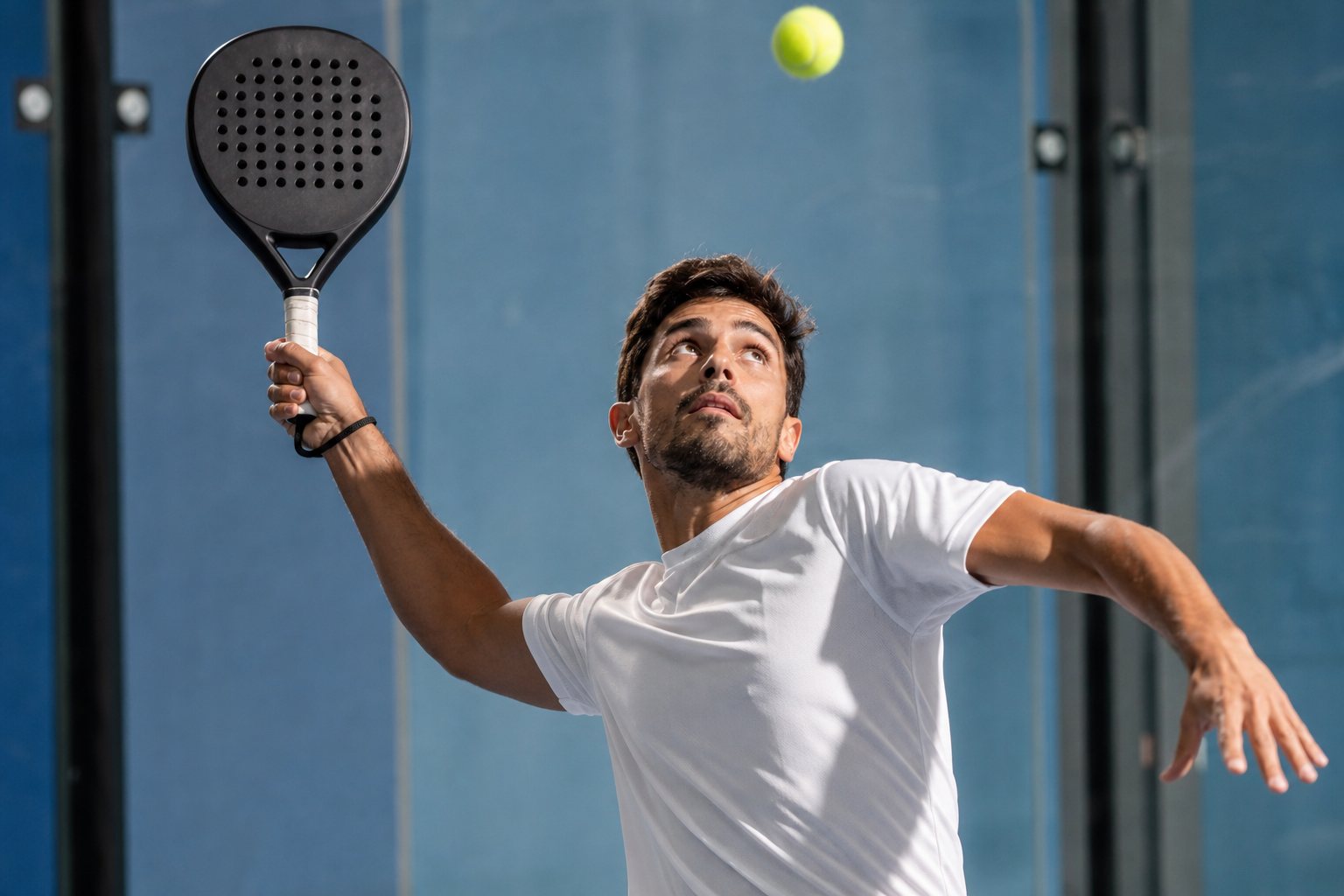
- What the rules say. The FIP rulebook allows a solid, perforated racket no longer than 45.5 cm and no thicker than 38 mm, with holes of 9 to 13 mm in the centre, flat faces and no devices that communicate with the player. It must carry a non-elastic wrist cord up to 35 cm long.
- Weight and shape. In the women’s upper-body injury study (PMID 42543029), amateurs used lighter rackets (350 g or less) and racket shape was linked with injury. In a survey of 216 players (PMID 40711113), muscle and ligament injuries were reported more often with 350 to 370 g rackets, and a Saudi survey linked racket hardness with injury location (PMID 43012253). These are associations in surveys, not proof, so ask a coach or a good shop to let you demo a few rackets.
- Grip and handle. A handle that is comfortable in your hand and an overgrip you replace when it wears are common advice from racket-sport coaches; no padel study tests them.
- Inspect. Look for cracks in the frame or face, loose grommets and a frayed wrist cord. A broken cord or a dropped racket loses the point in FIP competition (Rule 13).
Balls
The FIP specifies a rubber ball 6.35 to 6.77 cm across weighing 56.0 to 59.4 g, and competitions announce the brand, number of balls and any change policy in advance (Rule 17). For practice, buy balls marked for padel. Check with your club, because some use specific brands. We did not find a source on how long padel balls keep their bounce, so we do not give a number.
Shoes
The American Academy of Orthopaedic Surgeons (AAOS) says to buy a sport-specific shoe if you play one sport more than twice a week, try shoes on at the end of the day with your usual socks, leave at least half an inch between your longest toe and the shoe tip, make sure the heel counter grips, and check that the shoes have not sat on a shelf for long. For padel, a survey of 216 players (PMID 40711113) reported muscle, tendon and ligament injuries more often with herringbone soles and muscle and ligament injuries more often on sand courts, though it cannot show cause. Ask your club what its courts use and pick a sole made for that surface. Replace shoes when the tread is worn smooth or the cushioning feels dead.
Eye protection
In an Italian survey of 583 padel players (PMID 42010296), 10.3% had had an eye injury and 92% of those came from the ball. Protective eyewear is your choice. Racket-sport eyeguards are often sold as meeting ASTM F803; that comes from the maker, not from independent testing we have seen, so look for the marking, check the fit and ask an eye doctor about prescription lenses. An eyeguard should not block your side vision.
Braces, straps and comfort gear
A strap or brace is support, not treatment. The AAOS describes a brace as one option in managing tennis elbow, along with rest and therapy, and the NATA position statement supports bracing or taping after a previous ankle sprain. Neither promises prevention. Get lasting pain checked before relying on any support.

Tourna Clear Eye Protection
- Polycarbonate lens
- ASTM F803 (maker)
- Anti-fog, anti-scratch
$16.99 at Amazon, as of Nov 17, 2026 01:07 UTC
Check price on Amazon
Unique Sports RX Specs
- Polycarbonate frame
- Adult and youth sizes
- Removable lenses
$16.95 at Amazon, as of Nov 17, 2026 01:07 UTC
Check price on Amazon

ASO EVO Ankle Stabilizer
- Lace-up design
- Fits inside court shoes
- Ankle support
These four are examples of the kind of product described, not endorsements of the best choice for you. Details are the makers’ own; we did not test them. Amazon links are affiliate links.
Standards versus maker claims
- Verified by a rulebook. Racket size and holes, ball size and weight, the wrist cord, glass and fence requirements on courts: the FIP Rules of Padel.
- Maker claims. “ASTM F803” on eyewear, “dual Sorbothane pads” on a strap, “lightweight” or “power” on a racket: all come from the seller. Check the label and the standard text.
- Not covered. We could not find an independent test of padel rackets or padel shoes, so we do not rank them.
Padel gear FAQs
What racket should a beginner buy?
Try before you buy. Surveys link racket weight, shape and hardness with injury patterns, so a coach or demo racket is better than guessing. Ask your club what you can borrow.
Do I really need padel shoes?
The AAOS says a sport-specific shoe is worth it if you play one sport more than two times a week. For padel, choose a sole suited to your court surface.
Is eye protection necessary?
It is a personal choice. The Italian survey shows ball-to-eye injuries happen. A fitted, impact-rated eyeguard is one option; an eye doctor can advise.
Do I have to wear the wrist cord?
In FIP competition, yes. For social play, follow your club’s policy; it is cheap protection against a flying racket.
How often should I replace my gear?
There is no sourced schedule for padel. Replace shoes when the tread is worn or cushioning feels flat, replace grips when slick, and retire a racket with cracks.
Sources
- FIP Rules of Padel, review of application 1 January 2026 (PDF)
- Upper-body injury epidemiology in women’s padel, J Sports Sci 2026, PMID 42543029 (PubMed)
- Injuries in padel players by sport-specific factors, Sports 2025, PMID 40711113 (PubMed)
- Musculoskeletal injury patterns among padel players in Saudi Arabia, PMID 43012253 (PubMed)
- Ocular injuries in padel, Eye 2026, PMID 42010296 (PubMed)
- AAOS OrthoInfo, Athletic Shoes (orthoinfo.org) and Tennis Elbow (orthoinfo.org)
- NATA position statement on ankle sprains (PMC)
- Product pages on Amazon for the four items shown (see the cards above)
General information for education only, not medical advice. It does not replace a visit with a doctor, physical therapist or athletic trainer. See how we write and check our pages in our editorial policy.