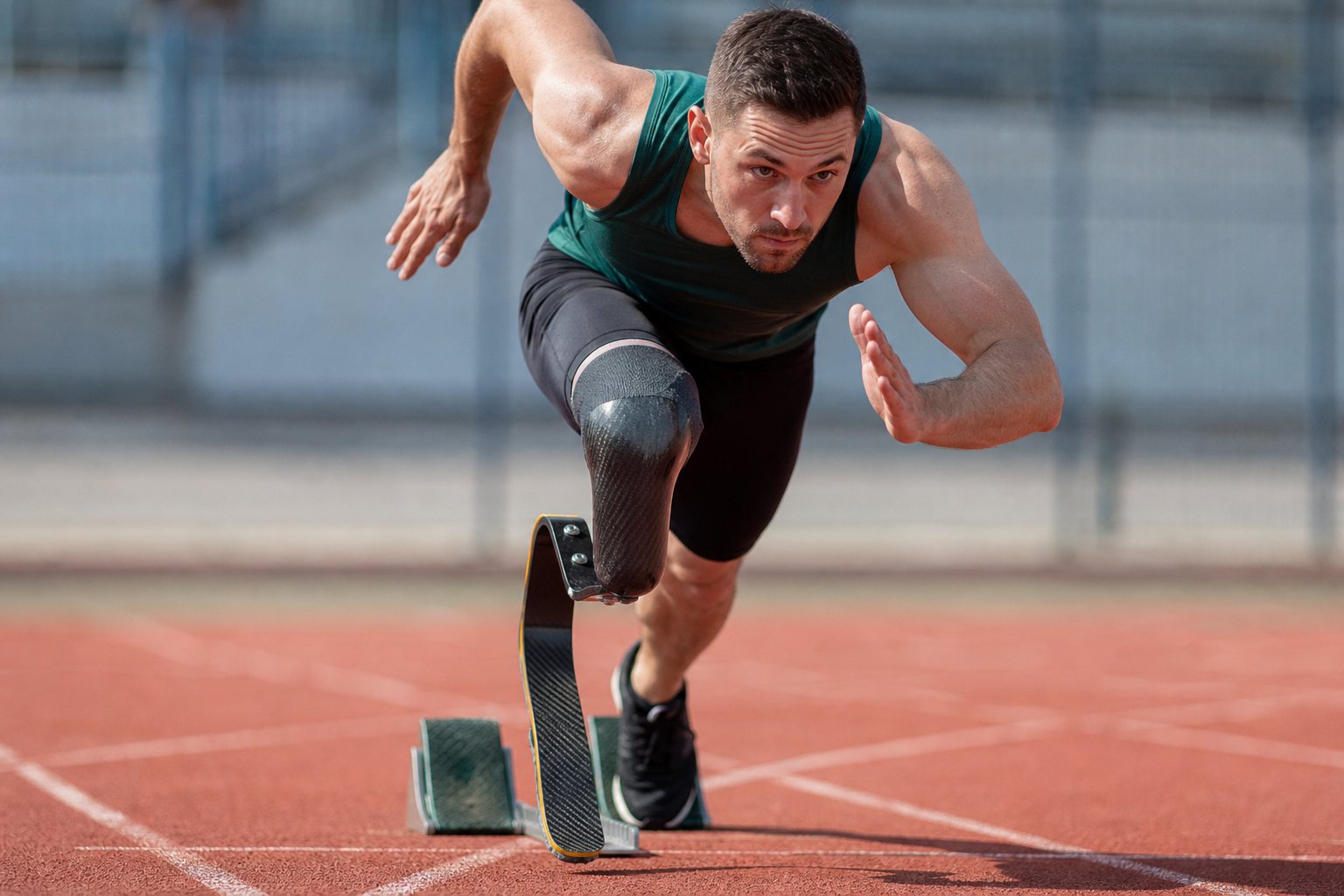
At a Paralympic athletics meet the medical tent sees a thrower with a sore shoulder, a sprinter holding a hamstring and a distance runner who got too hot. Para athletics injuries follow the athlete’s event and impairment: the shoulder dominates for athletes who push a chair or throw seated, and the thigh for many ambulant runners. This page summarises the surveillance numbers, concussion, heat and general rehab principles. It does not diagnose anything.
Quick answer: At the London 2012 Paralympic athletics competition the overall injury rate was 22.1 per 1,000 athlete-days, with thigh injuries most common in ambulant athletes and shoulder and collarbone injuries in wheelchair and seated athletes (Blauwet and colleagues, 2016). See a sports medicine doctor, physical therapist or athletic trainer for any injury that lingers, and seek care right away after a head injury or if you have a danger sign.
What the surveillance numbers show
The best large study is Blauwet and colleagues in the American Journal of Sports Medicine (2016), which followed 977 athletes over the 10-day London 2012 athletics competition. The overall rate was 22.1 per 1,000 athlete-days. Ambulant athletes had the most injuries to the thigh (16.4 percent of their injuries), mostly in track events, while wheelchair and seated athletes had the most to the shoulder and collarbone region (19.3 percent), mostly in field events. Seated throwing had a higher rate (23.7) than wheelchair racing (10.6), and most injuries did not cause time loss.
Across all Paralympic sports, BJSM surveillance studies recorded 386 injuries in 66,045 athlete-days at Tokyo 2020 (5.8 per 1,000 athlete-days) and 535 injuries at Paris 2024 (8.6 per 1,000). These cover every sport, and the summaries we read did not break them down for athletics. Madaleno and colleagues (2025) followed 102 Para athletes over a year in swimming, athletics, powerlifting and taekwondo and found the shoulder complex had the greatest burden, followed by the ankle and knee.
The shoulder
A review of shoulder complaints in wheelchair athletes (PubMed 29161335) reports prevalence from 16 to 76 percent, with low study quality. The University of Kentucky review on wheelchair racers links impingement and rotator cuff problems to muscle imbalance and weakness and discusses non-surgical care. Pain with overhead movement, pain at night and loss of strength are reasons to be examined. A clinician who knows wheelchair users should assess, since chair use in daily life adds to the load. Prevention steps are on our injury-prevention page.
Thigh, ankle, knee and stress injuries
For ambulant athletes, the London 2012 data put the thigh first, and Madaleno and colleagues put the ankle and knee after the shoulder. Bone stress injuries come from repeated load; AAOS OrthoInfo describes stress fractures as tiny cracks in bone from repeated stress and says to see a doctor if pain continues. Athletes with prostheses or a leg length difference may load joints differently, and a prosthetist should check fit when pain starts.
Concussion
A 2024 narrative review (Teodoro and colleagues) found athletes with a vision impairment may be more likely to have a concussion than other athletes, though the evidence is limited and incidence is poorly measured. The CDC HEADS UP program lists headache, dizziness, confusion and balance problems as signs. Anyone who hits their head should stop and see a healthcare provider before returning, and a provider decides when it is safe to return. Call 911 for danger signs such as repeated vomiting or a seizure. This applies to falls from a racing chair and to collisions with guides or equipment.
Heat illness
Heat illness is a medical issue as well as a comfort issue. Grobler and colleagues (2019) found temperatures at the 2015 Para Athletics World Championships regularly exceeded cancellation guidelines, and a survey of Paralympians around Tokyo 2020 found 9 percent had a medical diagnosis of exertional heat illness (Alkemade and colleagues, 2023). Confusion, collapse or a very high body temperature is an emergency: stop and get medical help.
Spinal cord injury and autonomic dysreflexia
Athletes with a high spinal cord injury can have a sudden rise in blood pressure called autonomic dysreflexia, set off by something painful or irritating below the injury level. USADA lists seizure, heart attack and brain bleeding among its possible complications, and the IPC prohibits causing it on purpose (“boosting”). Athletes with spinal cord injuries and their coaches should learn the warning signs from their own medical team.
General rehabilitation principles
We do not give return-to-play dates or protocols; a clinician does. In general terms, sports medicine sources describe rehab as settling the pain, restoring movement, rebuilding strength, then adding sport load in steps. For a chair user, exercises must account for the shoulders they need every day, so a clinician who knows wheelchair users should choose them. Recovery habits are on our recovery page.
When to see a professional
- Pain that lasts more than a few days, wakes you at night or limits what you can do.
- Swelling, a pop, instability or a joint that gives way.
- Numbness, weakness or skin problems where equipment presses.
- A head injury, or heat illness signs such as confusion.
Frequently asked questions
What injuries are most common in Para athletics?
In the London 2012 study, thigh injuries in ambulant athletes and shoulder and collarbone injuries in wheelchair and seated athletes (Blauwet and colleagues, 2016).
How long does a shoulder injury take to heal?
There is no universal time. It depends on the injury and the person, and a clinician who knows wheelchair users can advise.
Do blind runners get more concussions?
A 2024 narrative review suggests they may, but the evidence is limited. Any head injury needs a provider before returning.
Is heat a bigger risk in Para sport?
It is a recognised risk for some impairments. Ask your clinician about your own temperature control.
What is boosting?
Deliberately causing autonomic dysreflexia to try to improve performance. The IPC bans it and USADA warns it can be dangerous.
Sources
- Blauwet et al. 2016, injuries in Paralympic track and field, London 2012 (PubMed)
- Madaleno et al. 2025, injuries in Para athletes across four sports (PubMed)
- BJSM 2023: incidence and burden of injury at the Tokyo 2020 Paralympic Games
- Lund University record: injury and illness at the Paris 2024 Paralympic Games (BJSM)
- PubMed: shoulder complaints in wheelchair athletes, review (PMID 29161335)
- University of Kentucky: shoulder function and rehabilitation for the wheelchair racing athlete
- Teodoro et al. 2024, concussion in Para athletes with vision impairment (PubMed)
- CDC HEADS UP: signs and symptoms
- Grobler et al. 2019, illness and heat at a Para athletics World Championships (PubMed)
- Alkemade et al. 2023, heat and Paralympians, Tokyo 2020 (PubMed)
- OrthoInfo (AAOS): stress fractures
- USADA: What is boosting and why is it dangerous?
General information for education only, not medical advice. It does not replace a visit with a doctor, physical therapist or athletic trainer who knows Para sport. See how we write and check our pages in our editorial policy. Back to the Para athletics hub or the sports hub.