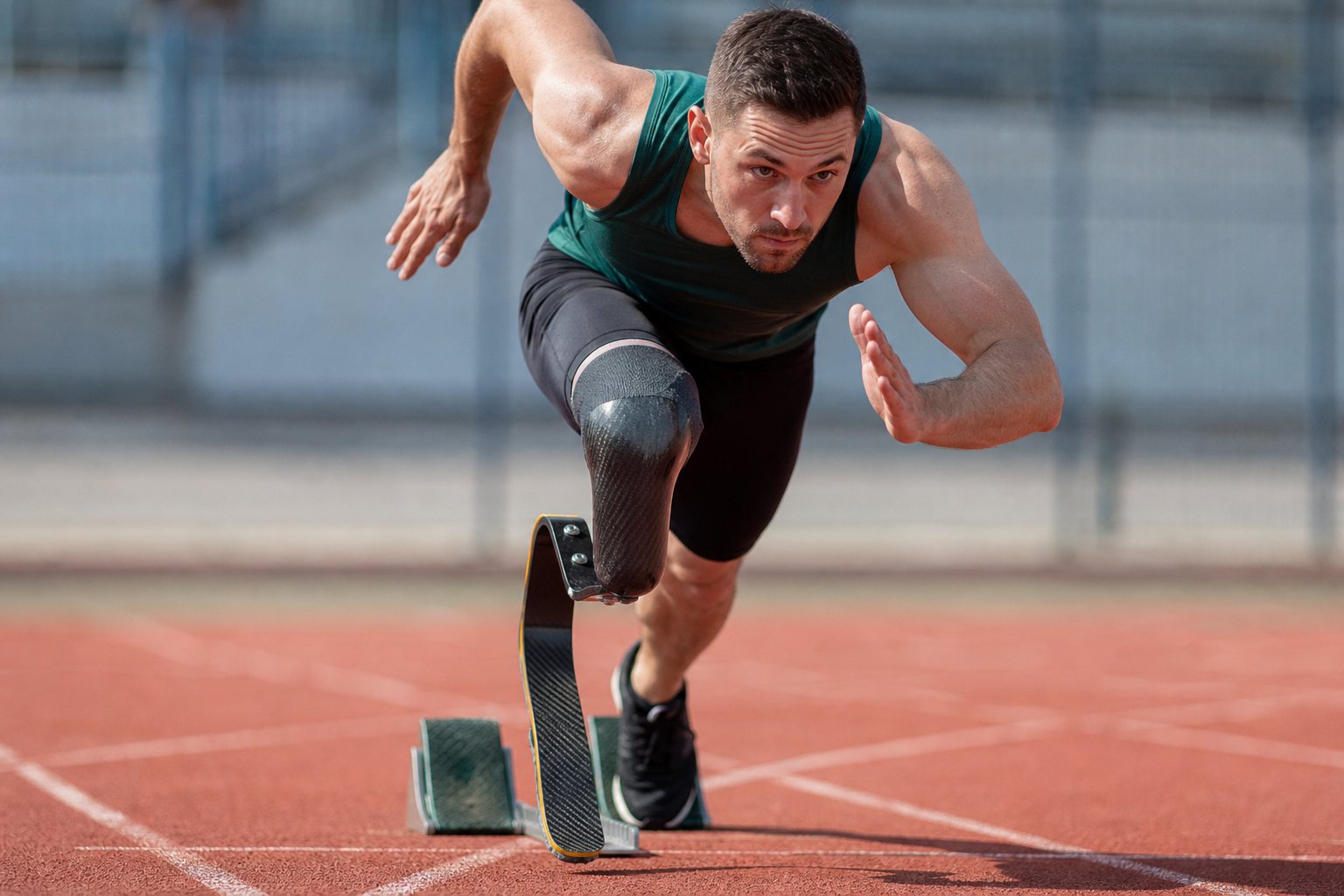
The track is empty, the chair is parked by the fence, and the evening after a hard session is where a Para athlete’s next week is decided. Para athletics recovery is sleep, easing load, mobility work and food after training, so the body can adapt and the athlete can train again. Much of the evidence comes from athletes without disabilities, and this page says where it is weak.
Quick answer: Sleep, steady load and enough food are the recovery basics with the best support. Mobility work, massage, foam rolling and compression are mostly about comfort, and the evidence is mixed. Normal soreness fades in a day or two and eases with movement; pain that is sharp, stays in one spot or gets worse is a reason to see a sports medicine doctor, physical therapist or athletic trainer.
Sleep
The CDC recommends at least 7 hours of sleep for adults and 8 to 10 for teens. Practical points are a regular bedtime, a cool dark room and caffeine early in the day. Pain, spasms, bladder routines and travel can all disturb sleep for some athletes, and a clinician can help. A 2023 PM&R study (Meidl and colleagues) followed 78 Para athletes with screening questionnaires; we did not read its sleep findings in full, so we do not quote numbers.
Load management
Recovery starts in the plan. Easy days, rest days and lighter weeks let load build without breakdown. The American Academy of Pediatrics (Brenner, 2016) advises one to two days off a week from the main sport for young athletes. For athletes who push a chair every day, rest for the shoulders is hard to find because the chair is also transport. A coach and clinician can help plan sessions that spread the load, for example following a hard push session with work that is easier on the shoulders. Our training page has the weekly shape.
Mobility and flexibility
Mobility work keeps joints moving through the range an athlete needs. The University of Kentucky review on wheelchair racers ties shoulder problems to muscle imbalance and weakness, and a narrative review on wheelchair basketball (Fari and colleagues, 2023) recommends a combination of strengthening, endurance and stretching, while noting that few trials exist. For athletes with spasticity or reduced range of movement, stretching should be set up by a clinician.
What recovery methods have evidence?
Honestly, little is proven for Para athletes. We found no trials of foam rollers, massage guns, compression or cold water in Para athletics, and we did not review the general evidence for this page. These tools are widely used for comfort and the feeling of recovery; do not expect them to treat an injury. People with reduced sensation, poor circulation, pressure injuries or spasticity should talk with a clinician first, since heat and cold can hurt skin that cannot feel them. Our recovery tools guide compares products and is not medical advice.
Soreness or injury?
- Usually soreness: a dull, spread-out ache that appears a day after unfamiliar work and eases with gentle movement within a few days.
- Get it checked: sharp pain, pain in one spot, pain that is worse each session or at night, swelling, numbness or weakness. See our injuries page.
- Emergency: a head injury with danger signs, or confusion in the heat. Call 911.
Recovery around meets and in the heat
Para athletics meets can mean several events over a few days, often outdoors. Paralympic.org notes the Paris 2024 athletics program ran from 30 August to 8 September, so elite athletes plan rest, food and sleep around a long schedule. The same applies at a weekend club meet: eat and drink between events, keep warm layers or shade handy, and avoid starting a hard session on little sleep. Heat adds to the recovery bill. At the 2015 Para Athletics World Championships temperatures regularly exceeded cancellation guidelines (Grobler and colleagues, 2019), and 57 percent of 107 Paralympians surveyed around Tokyo 2020 had earlier had heat-stress symptoms (Alkemade and colleagues, 2023). Cooling down in the shade, drinking and resting afterwards are sensible steps, and your clinician can advise on how your impairment affects temperature control.
A quick check after sessions
Recovery is also a short routine of looking after the body and the equipment. After a session, many athletes check hands, skin and any place a chair, strap, socket or tether presses, and note any new soreness in a training log. If a prosthesis, chair or frame feels different, or skin is red, broken or numb, tell your prosthetist, coach or clinician rather than training through it. A log also gives a clinician something concrete to look at. These are common-sense habits, not a published protocol.
Food and fluids after training
Fuel and fluids are part of recovery. Review authors in Frontiers in Nutrition (2025) say knowledge of para-athletes’ specific nutrient needs is limited, so a registered dietitian who knows sport is the best guide. See the nutrition and athlete health page.
Frequently asked questions
How much sleep do Para athletes need?
The CDC recommends at least 7 hours for adults and 8 to 10 for teens. Individual needs vary, and pain or spasms can disturb sleep, so ask a clinician.
Do foam rollers and massage guns work?
They are mostly used for comfort. We found no trials in Para athletics. Check with a clinician if you have reduced sensation or spasticity.
How do I rest shoulders I use every day?
A coach or clinician can help plan easier days and balance the work. There is no simple fix because the chair is also your transport.
Is soreness a sign of injury?
Dull soreness that fades in a few days is common after hard work. Sharp or one-spot pain, swelling, numbness or weakness should be checked.
Can I use ice or heat where I have little feeling?
Ask a clinician first. Skin that cannot feel can be damaged by extreme cold or heat.
Sources
- Grobler et al. 2019, illness and heat at a Para athletics World Championships (PubMed)
- Alkemade et al. 2023, heat and Paralympians, Tokyo 2020 (PubMed)
- Paralympic.org: Paris 2024 introduction to Para athletics
- CDC: about sleep
- AAP, Brenner 2016, sports specialization and intensive training (PubMed)
- University of Kentucky: shoulder function and rehabilitation for the wheelchair racing athlete
- Wheelchair basketball shoulder narrative review (Fari et al., Biomechanics 2023)
- Frontiers in Nutrition 2025: tailored nutrition strategies for Paralympic athletes
- PM&R 2023: prospective screening in Para athletes (Meidl et al.)
- Blauwet et al. 2016, injuries in Paralympic track and field, London 2012 (PubMed)
General information for education only, not medical advice. It does not replace a visit with a doctor, physical therapist or athletic trainer who knows Para sport. See how we write and check our pages in our editorial policy. Back to the Para athletics hub or the sports hub.