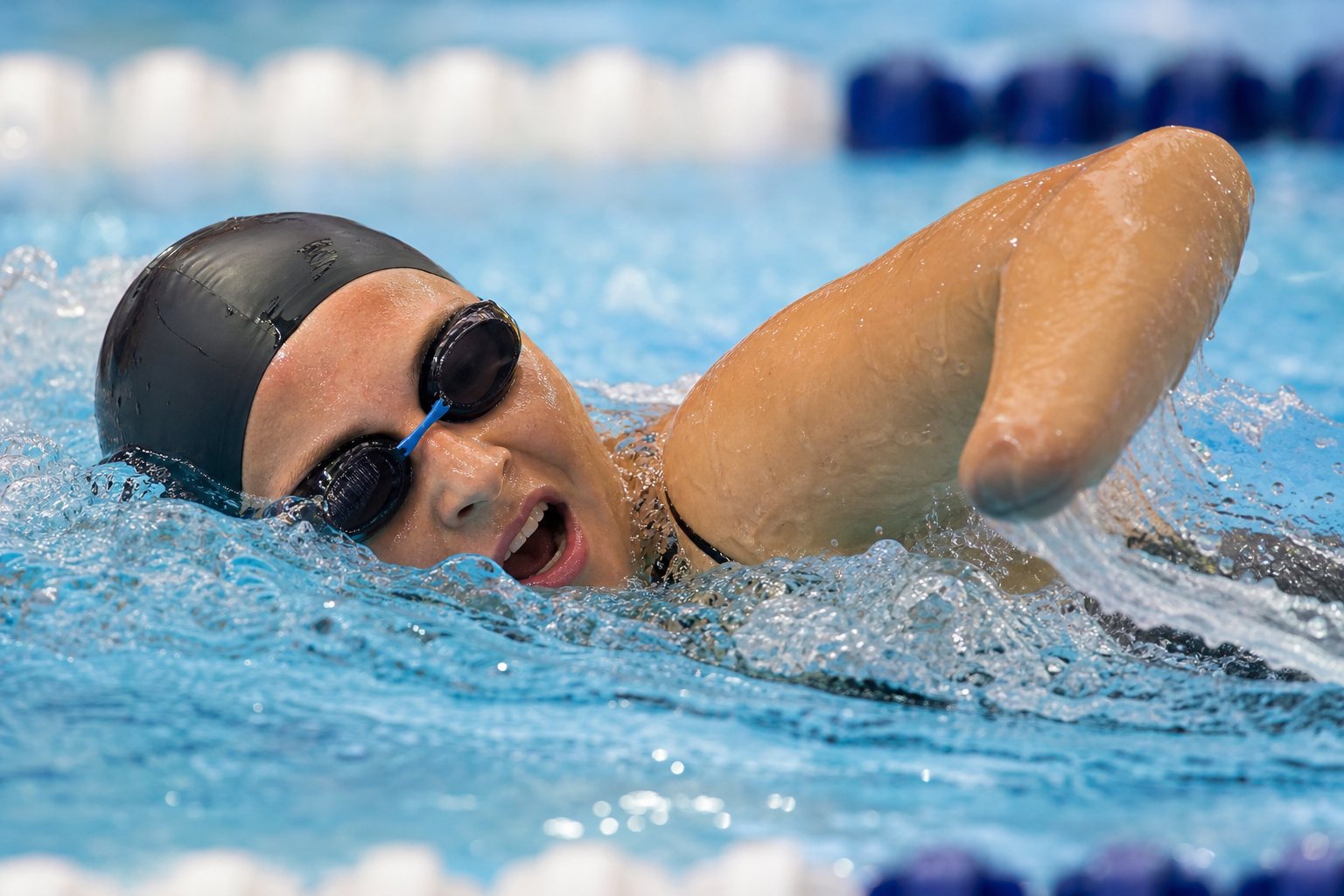
Four a.m. alarm, a banana in the car, and a swimmer with a spinal cord injury checking whether she has enough water in the bag for a warm pool deck. Para swimming nutrition and athlete health is about eating and drinking enough to train, recover and stay well, and it differs from advice for swimmers without impairments, because impairment can change energy needs, thirst, sweating and the way medicines interact with food and fluid. Published research on Para swimmers specifically is thin, so this page draws on reviews of Para athletes and of swimmers in general, and says which is which.
Quick answer: There is no single Para swimming diet. A 2025 review of 56 studies concluded that Paralympic athletes need individually planned energy, nutrient and fluid intakes, and the Gatorade Sports Science Institute says needs vary by impairment. Food comes first; supplements are optional extras with real risks, and only a registered dietitian or doctor can tailor advice. Persistent tiredness, repeated injuries, missed periods, rapid weight change or worry about food are health matters to take to a professional.
General information, not medical advice. It is not a diet plan.
Energy: what a pool session asks for
In a study of five elite female swimmers training about 17.5 km a day, energy expenditure averaged 5,593 kcal a day and intake 3,136 kcal, a deficit of about 43% (Trappe and colleagues, 1997, Medicine and Science in Sports and Exercise). That was high-volume training in swimmers without impairments. An expert review of swimming nutrition (Shaw and colleagues, International Journal of Sport Nutrition and Exercise Metabolism, 2014) gave carbohydrate ranges of 3 to 10 g per kg of body mass per day depending on training, recommended mixed diets, and said to avoid rapid weight swings. Para swimmers’ needs differ: the Gatorade Sports Science Institute’s 2025 review (Goosey-Tolfrey and Perret) says athletes with spinal cord injury have less active muscle mass and lower metabolic rate, which can lower total energy expenditure, and that athletes with cerebral palsy can have a higher energy cost of movement but highly variable needs. For athletes with amputations it says rapid body-mass changes should be avoided because they can affect prosthesis fit. It says swimmers with a vision impairment have energy needs similar to athletes without impairment but may find menu planning, portions and judging hydration harder. A registered dietitian who works with Para athletes can estimate your needs; online equations may be off.
Fluids, heat and the pool
A pool does not feel hot, but a swimmer still sweats. The same Gatorade review (Goosey-Tolfrey and O’Brien, 2024) says athletes with spinal cord injury can sweat less below the lesion and have a dulled sense of thirst, that low sweating plus high fluid intake can lead to weight gain and low blood sodium, and that medicines such as antispasmodics or diuretics can change sweating or fluid balance. It recommends frequent small sips and long-straw bottles for limited hand function. A 2022 working group (Hosokawa and colleagues, British Journal of Sports Medicine) adapted prehospital heat stroke care for Paralympic athletes. Swimmers with a vision impairment may find it hard to judge urine colour, which the energy-expenditure review flags as a challenge. Ask your doctor for a personal fluid and cooling plan, especially for warm decks and long meets.
Relative energy deficiency (REDs): awareness
Relative Energy Deficiency in Sport (REDs) is the term for health and performance problems caused by not eating enough for the training done. The 2023 IOC consensus statement (Mountjoy and colleagues, British Journal of Sports Medicine) links low energy availability with effects on bone, hormones, immunity, mood and performance, and reports that estimates of low energy availability or REDs indicators ranged from 23% to 79.5% in female and 15% to 70% in male athletes. Among 30 collegiate swimmers in a 2023 study in Nutrients, 43% showed low energy availability. The Goosey-Tolfrey and Perret review notes that female wheelchair athletes and athletes with cerebral palsy may be at risk of low energy availability. We did not find a swimming-specific figure for Para swimmers. Warning signs include recurring injuries, illness, loss of periods, lasting tiredness and an unhealthy focus on weight; these deserve a doctor’s visit, and eating disorders are medical issues, not training issues. Coaches and parents should avoid comments on weight and shape.
Food before, during and after
General practice, supported by the swimming nutrition review, is a carbohydrate-based meal a few hours before hard sessions, a snack and drink for early starts, and a recovery meal with carbohydrate and protein afterwards (Shaw and colleagues suggest about 0.3 g of high-quality protein per kg after key sessions). If you use a feeding tube, special diet or medication timing, follow your care team’s plan. See recovery for timing and training for load.
Supplements: food first, testing matters
The IOC consensus on dietary supplements (Maughan and colleagues, 2018) says a food-first approach should come before supplements, and that few supplements have good evidence. Some, such as caffeine and creatine, are among the better studied in athletes generally. Contamination is a risk: a study of 634 supplements found about 15% contained undeclared substances, as summarised in a 2021 expert statement (Collins and colleagues, British Journal of Sports Medicine), and in anti-doping the athlete is responsible for what is in their body. Third-party certification such as NSF Certified for Sport or Informed Sport lowers the risk but does not remove it or prove a product works. Do not take banned substances, and ask a doctor or sport dietitian before using any supplement, especially if you take prescription medicines or have a spinal cord injury, high blood pressure or a heart condition. Youth swimmers should avoid supplements unless a doctor says otherwise. We give no doses.
Anti-doping for Para athletes
A 2025 survey of 109 elite Para athletes from 25 countries (Qvarfordt and colleagues, BMJ Open Sport & Exercise Medicine) found 27% had never received anti-doping education, and 25% could not provide a urine sample without help. If you compete at a sanctioned level, ask your national anti-doping organization and federation about education, assistance at testing and Therapeutic Use Exemptions for medicines you need. A 2025 review (Benitez-Albiter and colleagues, American Journal of Physical Medicine & Rehabilitation) discusses “boosting”, deliberately triggering autonomic dysreflexia to improve performance, as a method with serious health risks; ask your federation about its status and never attempt it.
Weight classes and weigh-ins
Swimming has no weight classes, so no weigh-in cut. If anyone pressures you to lose weight for performance, ask for a conversation with a doctor or dietitian.
When to see a professional
- A registered dietitian who works with athletes, for an individual plan.
- A sports medicine doctor for missed periods, repeated injuries, fainting, lasting fatigue or sudden weight change.
- A mental health professional for distress about food or body image; US readers can call or text 988.
Para swimming nutrition: FAQs
What should a Para swimmer eat?
A dietitian can tailor it. General swimming guidance is a carbohydrate-based diet matched to training with protein after hard sessions, and the Gatorade reviews say energy and fluid needs vary by impairment.
Do Para swimmers need more fluids?
Needs vary. Swimmers with spinal cord injury may sweat less and feel thirst less, and fluid mistakes can go both ways. Ask your doctor for a plan.
Are supplements safe for Para swimmers?
Food comes first. Supplements can be contaminated and may interact with medicines. Check with a doctor or sport dietitian and use third-party tested products only.
What is REDs?
Relative Energy Deficiency in Sport: health and performance problems from not eating enough for training. It affects both women and men.
Is boosting allowed?
We could not confirm the official rule here and it is risky; ask your federation or anti-doping agency and never attempt it.
Sources
- Ghazzawi et al. 2025, tailored nutrition for Paralympic athletes, Front Nutr
- Goosey-Tolfrey and Perret 2025, how impairments affect energy expenditure (GSSI SSE 261)
- Goosey-Tolfrey and O’Brien 2024, thermoregulatory challenges in Para sport (GSSI SSE 259)
- Hosokawa et al. 2022, heat stroke management for Paralympic athletes
- Shaw et al. 2014, Nutrition for swimming
- Trappe et al. 1997, energy expenditure of swimmers
- Mountjoy et al. 2023, IOC consensus on REDs
- Low energy availability in NCAA Division III swimmers, Nutrients 2023
- Maughan et al. 2018, IOC consensus on dietary supplements
- Collins et al. 2021, UEFA expert group statement on nutrition
- Qvarfordt et al. 2025, Para athletes’ perspectives on anti-doping
- Benitez-Albiter et al. 2025, performance enhancement in Paralympic athletes
- 988 Suicide and Crisis Lifeline
General information for education only, not medical advice. It does not replace a visit with a sports medicine doctor, physical therapist or athletic trainer who knows you and your impairment. See how we write and check our pages in our editorial policy, and return to the Para swimming hub.