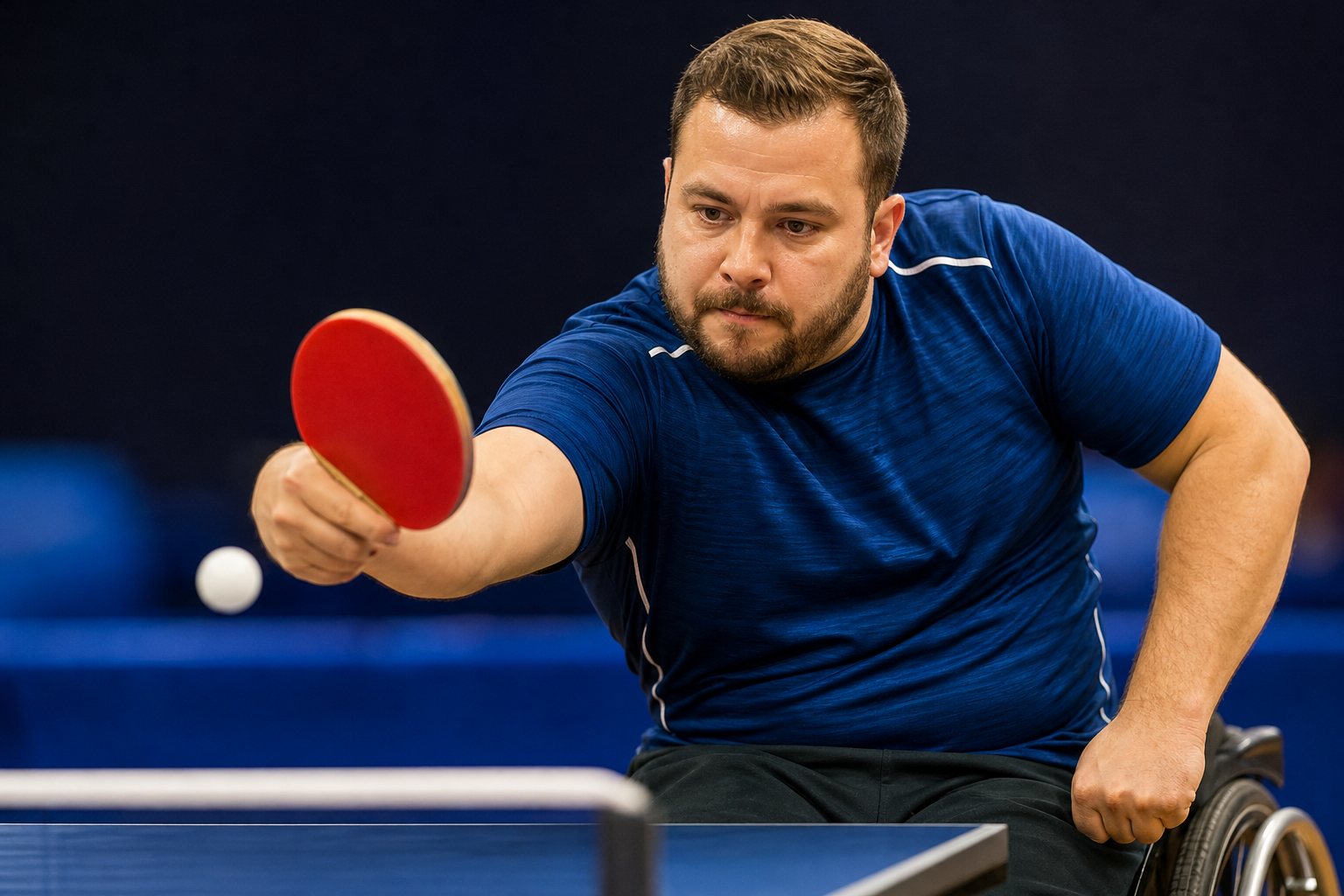
The draw has you playing at 9 a.m., again at noon and, if things go well, in a final at 5. Between rounds there is a hall, a bag of snacks and a long wait. Para table tennis nutrition is simply eating and drinking so that your body and attention hold up through all of it, while allowing for your own impairment, medicines and medical needs. This page gives practical, sourced pointers and a cautious look at supplements. It is general information; a sports dietitian or doctor who knows your situation should guide your plan. For after-play recovery see our recovery page.
Quick answer: Eat regular meals with carbohydrate, protein and fruit or vegetables, and bring familiar snacks and drinks for tournament days. Energy needs are hard to estimate for some para athletes, so a sports dietitian helps. Supplements are optional, can carry anti-doping risk, and should be third-party tested; ask a doctor or dietitian first.
What the sport asks of the body
A 2026 mini-review of nutrition in table tennis (Wang, Shen and Gao, Frontiers in Nutrition) reports that table tennis costs roughly 4.6 kilocalories a minute, based on its sources, and that in a simulation about 97 percent of the energy came from the aerobic system, with carbohydrate as the main fuel. It also stresses that water loss of about 1 percent of body weight can affect attention. Those figures describe standing players. Para energy needs depend on the class, body size, muscle mass and impairment, which makes them harder to predict.
Everyday eating
For the season, the same review gives ranges for table tennis athletes in general: carbohydrate of 5 to 7 grams per kilogram of body weight per day and protein of 1.4 to 1.7 grams per kilogram, spread over meals and snacks. A review of nutrition for Paralympic athletes (Ghazzawi and colleagues, Frontiers in Nutrition, 2025, 56 studies) describes a dearth of studies on para athletes and calls for individualised planning and close monitoring of intake. Use ranges as a conversation starter with a sports dietitian, not a prescription. A plate with some carbohydrate, some protein and colour from fruit and vegetables is a sound everyday pattern, and iron and vitamin D checks, which the table tennis review mentions, are a matter for a blood test and a doctor.
Tournament-day fuel and fluids
The position stand from the American College of Sports Medicine with the Academy of Nutrition and Dietetics and Dietitians of Canada (2016) advises a carbohydrate-containing meal 1 to 4 hours before long events, with limited fat, protein and fibre. For a day of matches, general practice is to eat what you already know suits you, sip fluids between matches and carry small carbohydrate snacks such as fruit or a sandwich. Do not try new foods on the day.
Heat, fluids and impairment
A Sports Science Exchange review on para sport reports that athletes with spinal cord injury may sweat less below the level of injury and may not notice heat in affected areas, that cool fluids can reduce discomfort, and that frequent small sips are recommended. It adds that some medicines, such as antispasmodics, can impair sweating and diuretics can disturb fluid and electrolyte balance, and that hydration plans should be individual and based on sweat rate. Long-straw bottles can help if hand function is limited. Talk to your doctor about your medicines and the plan for hot venues.
Energy availability and RED-S awareness
Relative energy deficiency in sport (RED-S) happens when an athlete does not take in enough energy for training and basic body needs, with possible effects on bones, hormones, mood and immunity. A 2022 narrative review (Jonvik and colleagues, Nutrients) says how often it affects para athletes is relatively unknown, that there are legitimate concerns they may be at higher risk, and that the usual assessment tools are hard to apply because energy expenditure data for various impairments are limited. It also notes that some signs may come from the impairment or its history rather than low energy. Table tennis has no weight classes, but young players or those with changing appetites should be watched. If you feel constantly tired, lose weight without meaning to, miss periods or get repeated injuries, see a doctor or sports dietitian. Do not diet to “improve” ability to play on your own.
Supplements: a cautious guide
Most athletes who eat well do not need supplements. The IOC consensus statement on supplements (Maughan and colleagues, 2018) says that only a few have good evidence for performance, and that all carry some risk of contamination. The ITTF anti-doping rules in its statutes place the responsibility on the athlete: a positive test from a mislabelled or contaminated supplement does not qualify as no fault, and athletes take supplements at their own risk. If you choose one:
- Ask a doctor or sports dietitian first, especially if you take prescription medicines or have a spinal cord injury, kidney, heart or other health condition.
- Prefer products tested by a third party for sport, such as NSF Certified for Sport or Informed Sport, and check the registry yourself.
- Avoid products with proprietary blends, big promises or stimulants you cannot identify. Caffeine is common; a table tennis review says it may enhance performance in simulated competition, but people differ and some should not use it, including those with heart conditions or sensitivity.
- Creatine is among the most studied supplements, but it can add some body weight, and the American Academy of Pediatrics does not advise it for under 18s.
- Never use anything banned. Check substances and medicines with your national anti-doping organisation, and ask about therapeutic use exemptions if you need a prescribed medicine.
The IPC bans boosting, deliberately causing autonomic dysreflexia to gain an advantage. It can be life-threatening and is not a nutrition matter at all; we mention it because it sits among health warnings in para sport.
Para table tennis Nutrition and Athlete Health FAQs
What should I eat on tournament day?
Foods you already know: a carbohydrate-rich meal a few hours before, then small snacks and sips between matches. Avoid trying anything new.
Do para athletes need different nutrition?
Often, yes, in details such as energy needs, fluid planning and heat. Research is limited, so a sports dietitian who knows your impairment is helpful.
Is RED-S a risk for para athletes?
It can be. A 2022 review says the rate is relatively unknown and assessment is difficult, so see a doctor if you notice persistent fatigue, unplanned weight loss or repeated injuries.
Are supplements safe for athletes?
Some have good evidence, but all carry risks, including contamination. Choose third-party tested products, ask your doctor, and remember you are responsible under anti-doping rules.
Should teenagers take creatine or protein powders?
The AAP does not advise creatine for under 18s. Teens are best served by regular meals; speak to a doctor or dietitian first.
Sources
- Wang, Shen and Gao, Front Nutr 2026 (PMID 42434404)
- Ghazzawi et al., Front Nutr 2025: tailored nutrition strategies for Paralympic athletes
- Jonvik et al., Nutrients 2022: assessing energy availability and RED-S risk in para athletes (PMC8912472)
- Gatorade Sports Science Institute: thermoregulatory challenges in para sport
- ACSM, AND and DC position stand, 2016 (PMID 26891166)
- IOC consensus statement: dietary supplements and the high-performance athlete (2018)
- ITTF Statutes 2026 (anti-doping chapter)
- AAP: creatine use by adolescents not recommended
- IPC: the IPC tightens rules to clamp down on boosting
- Paralympics Australia: position statement on boosting (2024)
General information for education only, not medical advice. See our editorial policy. More: the para table tennis hub, recovery, rules and getting started, the table tennis hub and the sports hub.