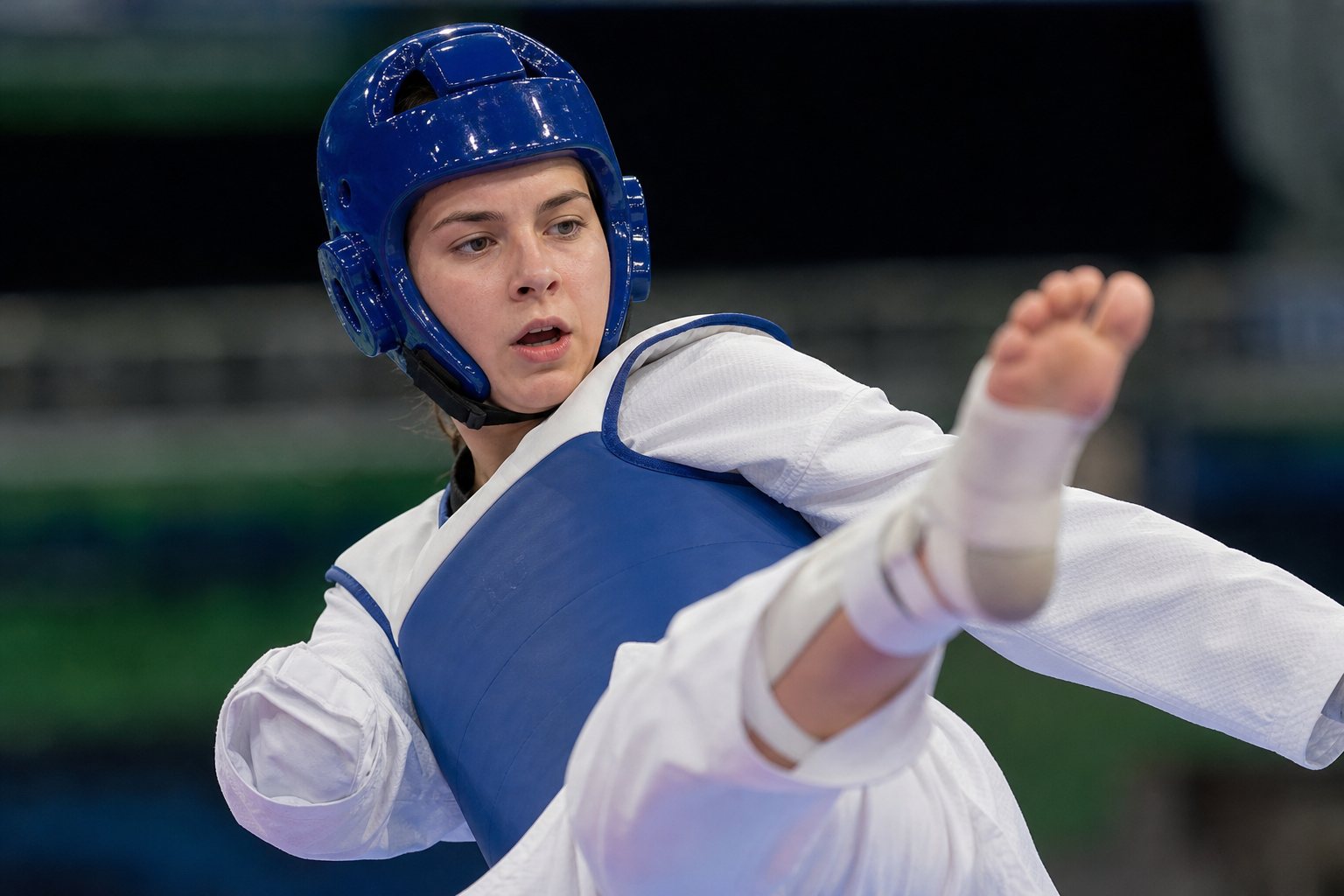
Friday sparring night. The headgear strap is a notch loose, the mouth guard is still in the bag, and a tired fighter throws one more turning kick after the coach called time. Para taekwondo injury prevention is the set of habits around that moment: a proper warm-up, protective gear that fits, a training load that grows gradually, strength and balance work, enough sleep and honest reporting of pain. These habits lower the odds of getting hurt. They cannot promise anything.
Quick answer: The best-supported steps for a Para taekwondo athlete are a neuromuscular warm-up (tested in one small trial), correctly fitted approved protective gear, a gradual build-up of sparring, and watching stress and fatigue. The sport has a high injury rate: the Paris 2024 Paralympic study found 27.3 injuries per 1,000 athlete days in taekwondo against 8.6 across all sports. See a sports medicine doctor, physical therapist or athletic trainer if pain stays in one spot, shows up at rest or follows a head knock; call 911 for danger signs after a head injury.
General information, not medical advice. This page is about lowering risk. What each injury looks like is on our Para taekwondo injuries page, so we do not repeat it here. For the sport itself, start at the hub.
Why prevention matters in this sport
The Paris 2024 Paralympic surveillance study (Derman and colleagues, British Journal of Sports Medicine, 2026) followed 4,450 athletes over 14 days. Taekwondo had the highest injury incidence, 27.3 per 1,000 athlete days (95 percent confidence interval 20.7 to 35.8), compared with 8.6 for all sports together. At Tokyo 2020 taekwondo was second, at 16.0 per 1,000 athlete days, behind 5-a-side football (Derman and colleagues, 2022). Those are Games-time numbers from elite fighters, but they explain why coaches take prevention seriously.
Warm-up
We did not find a general-purpose injury-prevention program built for Para taekwondo, but we did find one trial. In a 2026 randomized trial of 24 elite K44 athletes (Rouhi and Barati, Adapted Physical Activity Quarterly), an 8-week neuromuscular warm-up called MASS-12, done three times a week for 20 minutes, improved dynamic balance, reaction time and knee position sense compared with a routine warm-up. The authors suggest it may reduce injury risk, but the trial did not measure injuries, and it is small. Ask your coach whether something similar fits your impairment.
General practice, not a Para-specific rule: warm up with easy movement that builds in intensity (jogging, leg swings, light kicks), then rehearse the kicks you will use. Leave long static stretching for after training.
Technique and rules that protect you
The WT rules are partly safety rules. Head contact is prohibited, kicks below the waist and attacks after the referee says “Kal-yeo” are penalized, and so are dangerous and unsafe play. Learning to kick cleanly, keep your guard and turn away without exposing your back are skills that also reduce risk. Falling is itself a penalty, so landing balance counts. Coaches also teach how to take a fall without putting a hand or an elbow out to catch it, which matters most for athletes with a shorter arm or a sensitive residual limb. That is general coaching practice rather than a studied method.
Progressive training load
We did not find a sourced rule of thumb for weekly increases in Para taekwondo, so we will not make one up. The sensible principle is gradual change: add sparring rounds, hard sessions or heavy lifting a little at a time. A 50-week study of 61 Para athletes in swimming, athletics, powerlifting and taekwondo (Madaleno and colleagues, BMJ Open Sport and Exercise Medicine, 2026) found that high self-reported stress was linked to higher odds of a gradual-onset injury in the next week (odds ratio 1.73), and high fatigue to higher odds of a substantial gradual-onset injury (odds ratio 1.99). The authors suggest monitoring stress and fatigue. It is an association, not proof that reducing stress prevents injury. See recovery for sleep and rest.
Conditioning and strength
Leg and trunk strength, balance and hip mobility are the base of kicking. Our training page covers a general week. A 2024 expert position statement on periodic health evaluations for Para athletes (Pinheiro and colleagues, BMJ Open Sport and Exercise Medicine) notes that Para athletes often under-report health problems and recommends regular check-ups that consider the sport and the impairment. A pre-season visit with a sports medicine doctor is a reasonable idea.
Surfaces, environment and weight
WT rules require a WT-recognized, elastic, non-slip mat, with a flat surface and no obstructing projections. Train on a proper mat, not a hard floor, and check it for gaps. Weight categories add a risk of their own: rapid weight loss before weigh-in is a health issue, and our nutrition page explains why.
Protective equipment and fit
The rules require a WT-approved uniform and protective set at WT calendar events: trunk protector, head protector with face guard, groin guard, forearm and shin guards, sensing socks and a mouth guard. They also allow Para athletes to use extra, personalized protective equipment with prior WT approval, and an amputee may cover the end of the residual limb with padding no thicker than 2 cm. Those are the standards. Product pages that say “WT approved” are the maker’s claim, so check with your coach or federation. See our gear page.
What prevention cannot do
It does not remove risk. This is a full-contact sport, and many injuries come from direct contact with an opponent. A reviewed set of eight elite studies (García Blanco and colleagues, Cureus, 2025) found direct contact was the leading cause. Youth-specific prevention advice for Para taekwondo is not something we found, and WT-promoted Para championships require athletes to be 16 or older.
When to see a professional
- Pain that is sharp, stays in one spot, wakes you at night or shows up at rest.
- A joint that swells, locks or gives way.
- Skin breakdown, pressure sores or numbness where a prosthesis, sleeve or pad rubs.
- Any blow to the head or a fall on your head, even if you feel fine. The CDC HEADS UP danger signs include repeated vomiting, a seizure, a worsening headache or one pupil larger than the other: call 911.
Frequently asked questions
Is there a warm-up proven to prevent injuries in Para taekwondo?
No. One small 2026 trial of an 8-week neuromuscular warm-up in 24 elite K44 athletes found better balance, reaction time and position sense, but it did not measure injuries.
Do head kicks cause concussions in Para taekwondo?
Head contact is prohibited in Para kyorugi, but falls and accidental contact can still happen. WT rules have doctor checks after head injuries; see a clinician after any blow to the head.
Can I use my own protective padding if I have an amputation?
WT rules allow additional personalized protective equipment with prior WT approval, and a residual limb cover no thicker than 2 cm. Ask your federation and the event Technical Delegate first.
Does stress really affect injury risk?
One 2026 study of 61 Para athletes (including taekwondo) linked high stress and fatigue to higher odds of gradual-onset injury, but it shows an association, not cause.
Should I get a medical check before I start?
It is a reasonable step. An expert statement on Para athlete health checks recommends regular evaluations that consider both sport and impairment. A sports medicine doctor can advise you.
Sources
- Derman et al., injury and illness at the Paris 2024 Paralympic Games, Br J Sports Med 2026 (Europe PMC)
- Derman et al., injury incidence and burden at the Tokyo 2020 Paralympic Games, Br J Sports Med 2022 (PubMed)
- Rouhi and Barati, 8-week neuromuscular warm-up in Iranian national Para taekwondo team, Adapt Phys Activ Q 2026 (Europe PMC)
- Madaleno et al., daily stress, sleep, fatigue and soreness and injury in Para athletes, BMJ Open Sport Exerc Med 2026 (Europe PMC)
- Pinheiro et al., periodic health evaluation in Para athletes: expert position statement, BMJ Open Sport Exerc Med 2024 (Europe PMC)
- Garcia Blanco et al., epidemiology of injuries in high-performance taekwondo: systematic review, Cureus 2025 (Europe PMC)
- World Taekwondo, Para Taekwondo Competition Rules in force as of 23 October 2025
- CDC HEADS UP: signs and symptoms
General information for education only, not medical advice. It does not replace a visit with a doctor, physical therapist or athletic trainer. See how we write and check our pages in our editorial policy.