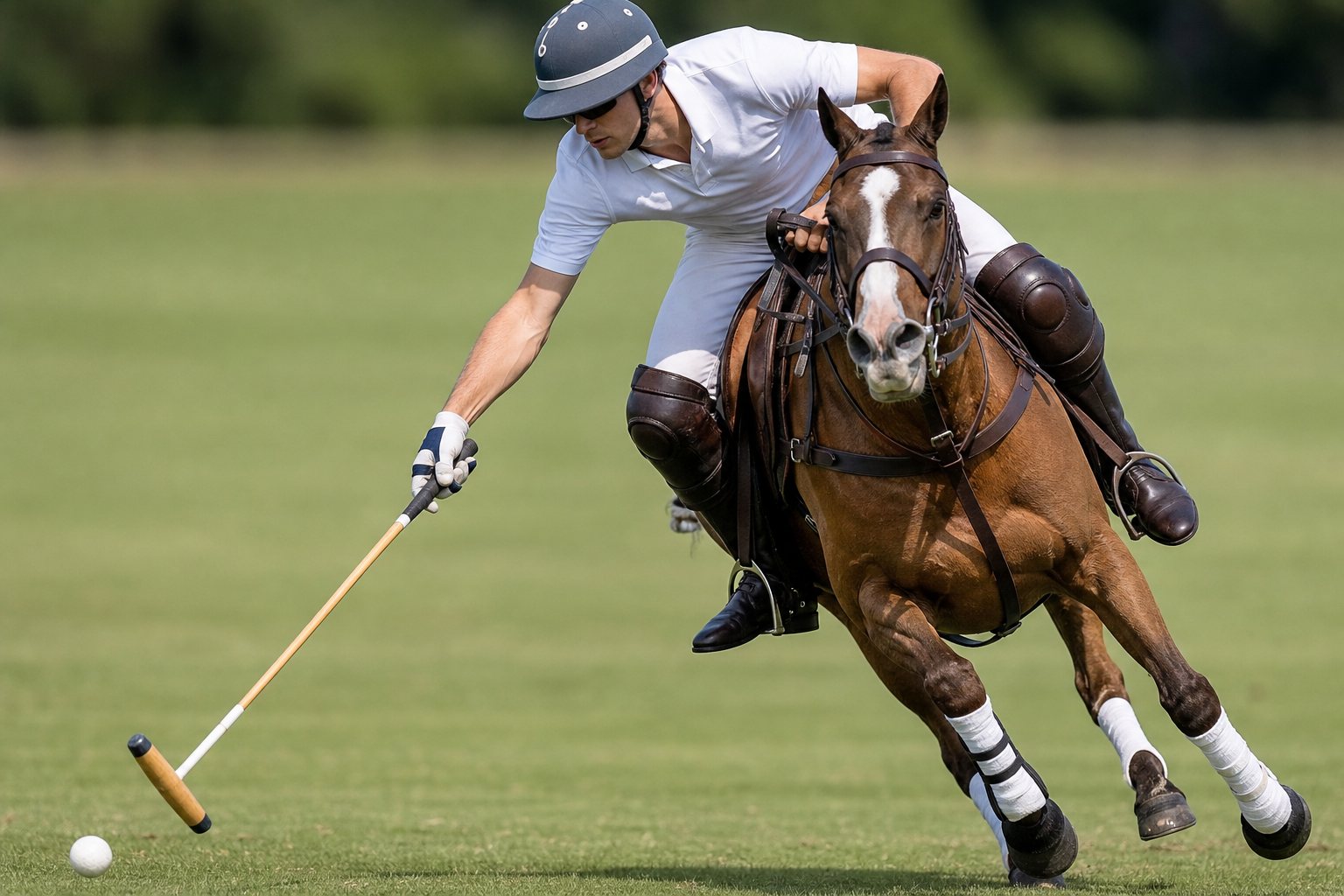
Second chukker, and the number 3 rider gathers the ball just inside midfield. Two opponents close in, a whistle sounds, and the umpires confer: one rider crossed the line of the ball. That single idea, a path that belongs to whoever hit the ball last, explains most of what you see in polo, the mounted team sport in which riders use a long mallet to drive a small ball through the other team’s goal. This page explains the rules in plain words, the basic skills, and how a beginner can start.
Quick answer: Polo is won by scoring more goals. Almost every foul comes from the line of the ball, the path the ball travels, which gives right of way to the last player who hit it. To start, find a club through the United States Polo Association (USPA) club finder (or your national association), take lessons on school horses, and ask about membership and insurance. Rules differ slightly between associations and tournaments, so read the current rulebook before you play. See a doctor before starting if you have a health concern.
General information, not medical advice. For the sport overview, start at the polo hub. This page covers rules, skills and getting started. Not to be confused with water polo.
How a match works
The Museum of Polo and Hall of Fame says an outdoor match is played on a field 300 by 160 yards, with goal posts eight yards apart and wooden sideboards no more than 11 inches high. Teams have four players outdoors and three indoors. A match is divided into periods called chukkers: six of seven minutes outdoors (four in arena polo), with a bell at 6 1/2 minutes and a horn at the end. The USPA’s international rules, which apply to bigger tournaments, allow periods of up to 7 1/2 minutes, so the tournament conditions always decide.
A goal counts when the ball crosses the line between the goal posts, whoever or whatever hit it, including a horse. Teams switch ends after every goal, which evens out wind and turf. If the score is tied after the last chukker, the museum says there is a five-minute break and then sudden death: the first team to score in an extra chukker wins.
The line of the ball and right of way
USPA rule explainers describe the line of the ball as the imaginary path the ball is travelling. The last player to strike it holds the right of way along that line, and crossing it at a dangerous angle or distance is the foul behind most whistles. A helpful picture from the USPA’s rule-of-the-week series is a highway: the line of the ball is its centre line, and you may not cut into the lane unsafely in front of someone who has right of way. Players carry the mallet in the right hand. The museum notes the USPA banned left-handed play in 1974 for safety, after an earlier ban in the 1930s.
Fouls and contact you will hear about
- Bump: riding into an opponent to spoil his shot or move him off the line. The angle must be 45 degrees or less, and the faster the horses, the smaller the angle must be.
- Ride-off: two riders push each other off the line, horse against horse. Riders may use their bodies but not their elbows.
- Hooking: putting your mallet in the way of an opponent’s mallet to spoil the shot.
- Crossing: entering the line of the ball in front of the player who has right of way.
- Penalty: a free hit toward goal from a set distance. The severity of the foul decides which penalty is given.
Two mounted umpires watch the play, one on each side of the field. When they agree on a foul, they penalize it; if they disagree, they consult the referee. Time-out is called by the umpires for fouls or accidents. Players may call it only for broken tack or injury, not to change horses or mallets.
The positions
The museum describes four roles, which players may swap during play. Number 1 is the forward attacker. Number 2 supports number 1 and marks the opposing number 3. Number 3 is the field general, who turns the ball upfield with long hits and marks the opposing number 2. Number 4, the back, defends the goal and sends the ball back toward the opponent’s goal.
Basic skills
The museum lists hitting methods that every player works toward: the near-side (left) and off-side (right) swings, the backshot (a backhand that sends the ball the other way), the neck shot (under the horse’s neck) and the tailshot (across the horse’s rump). The mallet is 48 to 54 inches long with a bamboo shaft, and the ball is plastic, about 3 1/2 inches across. The museum adds that the ball can travel about three times as fast as the horse that last hit it, which is why fouls are judged on safety.
General coaching practice, not a study finding, usually builds the skills in this order: a secure, balanced seat at all gaits first, then mallet handling at a walk and trot (often on a wooden practice horse or on foot), then hitting the ball while riding, and only then match play with its right-of-way rules. Your own coach will set the pace.
Levels and handicaps
Each player has a handicap in goals. The museum gives a range of minus 1 to 10; the USPA scale goes lower, so check your association’s current scale. The museum says ratings reflect horsemanship, hitting, horses, team play, game sense and sportsmanship, and a team’s handicap is the sum of its players’. Tournaments are grouped by team handicap (low, medium, high goal). In handicap matches the higher-rated team gives the difference in goals. The museum also notes that a good pony contributes 50 to 80 percent of the rider-and-pony team’s ability, which is why many beginners start by learning on a club’s schooled horses.
How a beginner starts
- Find a club. The USPA “Learn to Play” page points newcomers to its club finder, where you search by zip code or city and state, then visit the club’s profile and contact it. Ask about beginner lessons; the USPA publishes a “Club Polo 101” guide for newcomers.
- Ask about horses and equipment. Many clubs provide horses and mallets for lessons, but ask. A helmet, boots and kneepads are core gear; see our gear guide.
- Ask about membership. The USPA says you can register for one of four individual membership types through its member portal, and players at USPA clubs are USPA members. Ask your club what is needed before you play a match.
- Build fitness and riding first. See our training guide and the horseback riding hub.
- Learn safety habits early. Start with injury prevention.
Young riders: the USPA runs interscholastic (high school) and intercollegiate programs, according to its program pages; ask your local club about youth routes.
Where to find the official rules
The USPA publishes its outdoor and arena rule books and a “Rules” page; the Federation of International Polo (FIP) publishes international rules and tournament procedures; and other countries have their own, such as the Hurlingham Polo Association in England. They are similar in spirit but differ in detail (chukker length, handicap scale), so read the one that governs your match.
Polo rules FAQs
Can you hit the ball with either hand?
USPA summaries say the mallet is carried in the right hand; the museum says left-handed play was banned for safety.
What is a chukker?
A timed period of play. Outdoors, the museum says a match has six of seven minutes. Some international tournaments use up to 7 1/2 minutes.
Can I play polo without owning a horse?
Many clubs lend horses for lessons, and the museum says horses are central to the sport, so ask the club what it offers. Owning several horses is typical only at higher levels.
Why does the game stop so often?
Umpires stop play for fouls and accidents. The museum says players can call time-out only for broken tack or injury.
Is polo an Olympic sport?
Polo was on the programme in 1900, 1908, 1920, 1924 and 1936, according to Olympedia, and we found no confirmation of it on a current programme. Check olympics.com.
Sources
- Museum of Polo and Hall of Fame, FAQs
- USPA, Learn to Play
- USPA, Rules (line of the ball)
- USPA rule of the week: right of way
- USPA 2016 International Rules
- Federation of International Polo (FIP)
- Olympedia, polo
General information for education only, not medical advice. It does not diagnose, treat or clear anyone to play. For your own situation, see a sports medicine doctor, physical therapist or athletic trainer. How we write and check our pages is in our editorial policy.