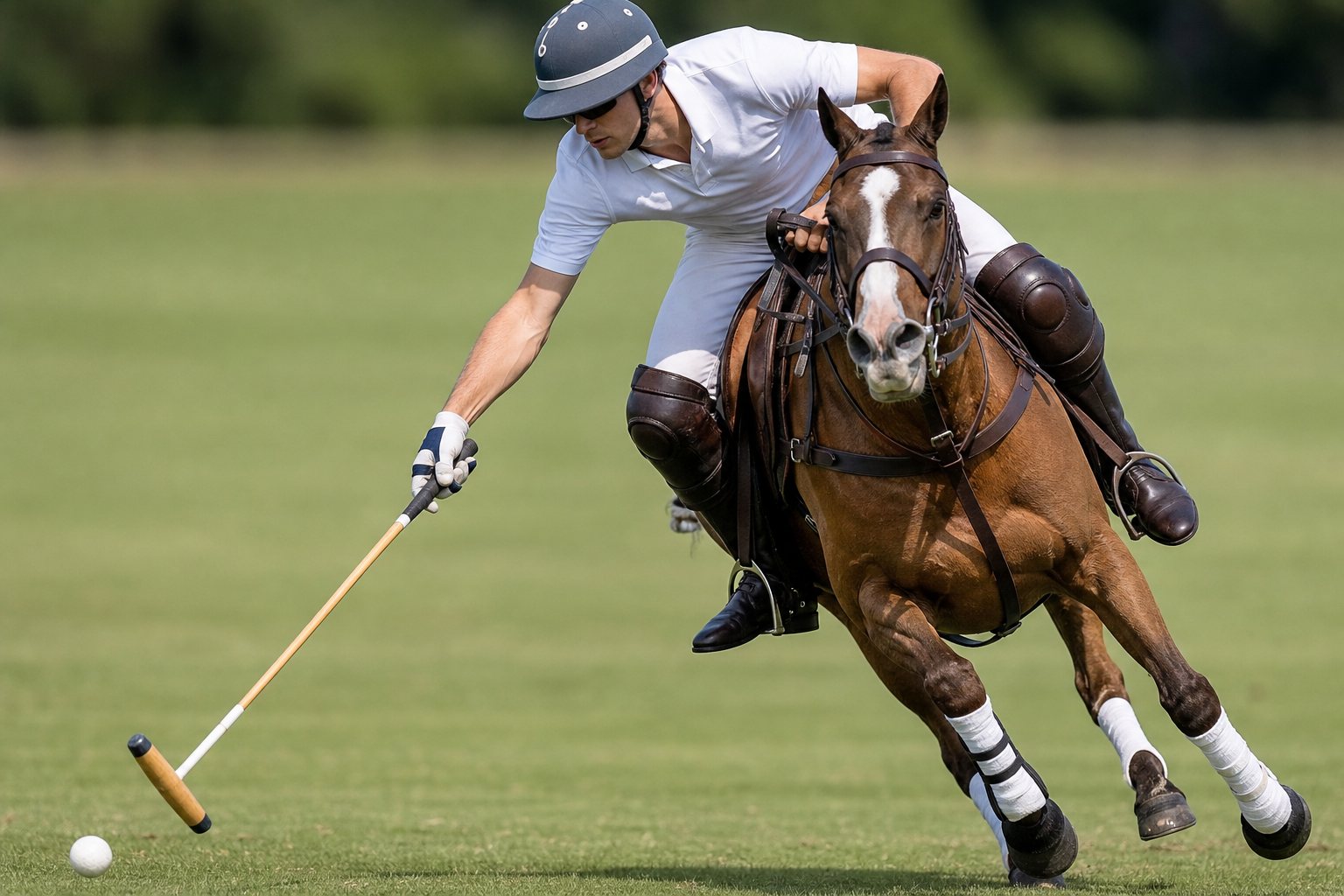
Mid-afternoon in the third chukker, the horses are blowing and the rider’s thighs are burning from holding a deep seat through a hard turn. Nobody needs to explain why polo training matters at that moment. It means preparing your body (and, just as much, your horse) for repeated bursts of riding, hitting and contact over six short but hard periods. This page covers what research says polo asks of a player and a sensible way to organise training. It is general information, not a personal programme.
Quick answer: Studies of polo players found a high heart-rate load: a mean of about 150 beats per minute in two high-goal matches (Wright and Peters 2008), so aerobic fitness matters as well as hitting skill. Build a base of riding time, strength for legs, trunk and shoulders, and aerobic conditioning, add intensity gradually, and keep rest days. Polo-specific training research is thin, so much of the advice below is general coaching practice and is labelled that way. A coach or sports medicine professional can tailor it.
General information, not medical advice. Start at the polo hub. New to the game? See skills, rules and getting started. For injury and safety detail, see injury prevention and injuries.
What polo asks of the body
Two small studies have measured it. Wright and Peters (2008, International Journal of Performance Analysis in Sport) monitored seven professional male players during two high-goal matches: mean heart rate was 150 beats per minute, the third chukker was highest (154), and players spent the largest share of time in what they classified as the hard zone. The authors concluded that polo evokes a high cardiovascular load and recommended aerobic training alongside technical work. A study of five women playing arena polo, summarised in search results (Pritchard and colleagues, 2020), reported the chukker peaked near 89 percent of peak heart rate and 62 percent of peak oxygen uptake. Both samples are tiny and one is arena polo, so treat them as indications, not norms.
A 2023 review in Nutrients (Best and colleagues) says equestrian sport is under-researched in general. Plain-language reading: riders need balance, leg and trunk strength to stay with a turning horse, one-handed mallet control, and enough endurance to do it again in the next chukker.
Riding is the base
Polo skills sit on top of riding skills, and hours in the saddle on varied horses are hard to replace. See our horseback riding hub and its training guide. A survey of 112 UK players (Sports Medicine Open 2015) found that players who exercised in a gym had lower odds of an injury needing a hospital visit (odds ratio 0.1), while a higher handicap goal and falls were linked to more. A survey cannot prove cause, but it fits the idea that off-horse fitness is worth the time.
A sensible weekly shape (general coaching practice)
The following is a general template, not a study result and not a prescription. Adjust it with a coach.
- Two or three riding or stick-and-ball sessions, mixing easy skill sessions with one match-like session.
- Two strength sessions: legs (squat and hinge patterns, single-leg work), trunk (anti-rotation and bracing), shoulders and upper back, and grip.
- One or two aerobic sessions you can talk through at an easy pace, plus, if your coach agrees, one short interval session to mimic chukker bursts.
- One or two real rest days, with sleep protected (see recovery).
Many players balance this around horse availability. If your horse needs a day off, that is a good day for the gym or a run, not a reason to skip rest entirely.
Strength and conditioning
A 2025 systematic review and meta-analysis in the Orthopaedic Journal of Sports Medicine (Chen and colleagues) of randomized trials in contact sports found that injury prevention programmes with strength training reduced total injuries (relative risk 0.70), with specific benefits for groin, hamstring, knee and ankle injuries. Polo was not part of that review, so it supports strength training in general, not a polo-specific claim. Practical aims for a rider: powerful legs that grip without tension, a trunk that resists twisting, healthy shoulders for a high-volume swing, and mobility in the hips and spine.
Aerobic conditioning
Because both polo studies found high heart-rate loads, general fitness guidance applies: build an aerobic base with steady running, cycling or swimming, then add short intervals when your base is solid. Bodyweight management is a health matter for a doctor or dietitian, not something to chase for performance alone; see nutrition and athlete health.
Periodisation basics (general coaching practice)
Periodisation just means planning your year. A common pattern is an off-season or early pre-season of general strength and aerobic work, a build phase where the work becomes more riding- and hitting-specific, a competition phase that keeps fitness while reducing volume, and a short rest. Increase load gradually and avoid piling several hard changes together (more chukkers, new horse, new gym programme) in one week.
Training the horse too
Polo is a partnership, and the horses train as well. The Museum of Polo and Hall of Fame says ponies run about one to two miles per chukker and that high-goal players often use a fresh horse each chukker. A UK survey of players found pre-season rider and horse training were associated with more injuries in that sample, a reminder that sudden early-season intensity can be a risk. A 2025 survey of 145 polo players (Animals) linked lameness risk to horse age and found ground conditions the most commonly cited cause of injury (58.6 percent). Work with your trainer and vet on horse fitness; this site does not give veterinary advice.
Tracking and testing
Simple tracking helps more than a gadget: number of sessions, how hard they felt, sleep, soreness and chukkers played. If you wear a heart-rate monitor, remember that a 2008 study measured about 150 beats per minute on average, but your own numbers depend on your age and fitness.
Polo training FAQs
How fit do I need to be to start polo?
Start with lessons; clubs set the pace. If you are new to exercise or have a health condition, check with a doctor first.
Is polo a good workout?
The two studies we found suggest a high cardiovascular load during chukkers, but samples were small.
What strength exercises help a polo player?
General coaching practice favours leg, trunk, shoulder and grip strength. A coach or physical therapist can choose exercises for your body.
Should I train differently for arena polo?
The only arena data we found came from five players. Arena has shorter, tighter play; ask your coach.
How many days a week should I play?
There is no evidence-based number we can quote. Increase gradually and keep rest days.
Sources
- Wright LR, Peters MD. Heart rate analysis of elite polo (Int J Perform Anal Sport 2008)
- Falls and injuries to polo players (Sports Med Open 2015, PMID 27747839)
- Best R et al. Physiological requirements of equestrian riders (Nutrients 2023, PMID 38068833)
- Chen Z et al. Strength training and sports injury (Orthop J Sports Med 2025, PMID 40416997)
- Schumacher A et al. Lameness in polo horses (Animals 2025, PMID 41227466)
- Museum of Polo and Hall of Fame, FAQs
General information for education only, not medical advice. It does not diagnose, treat or clear anyone to play. For your own situation, see a sports medicine doctor, physical therapist or athletic trainer. How we write and check our pages is in our editorial policy.