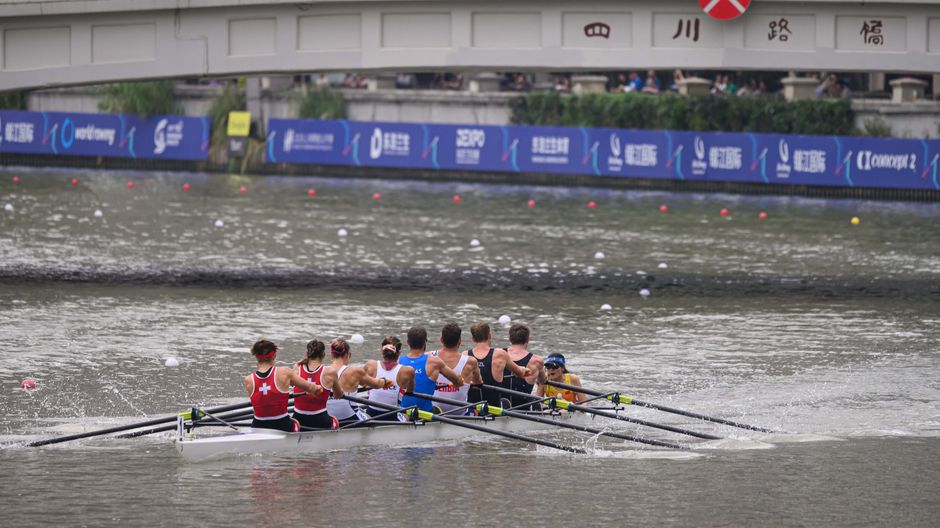
It is the last 500 metres of a 2,000 m piece. Your legs are full of lactic burn, the monitor says you are two seconds down, and the only voice in the boat or on the erg is your own. Every rower knows some version of that moment. Rowing mental training means practicing the skills between your ears (race plans, focus, handling hurt, trust in your crew) the way you practice your catch. This page is for rowers, parents, coxswains and coaches. It is about mental performance, which is different from mental health; there is a clear section on that difference below.
Quick answer: Mental skills are trainable habits: a written race plan you have rehearsed, one or two focus cues for each part of the piece, a simple routine before the start, and a plan for what you do after a bad race. Research on these tools in rowers is small and early, and none of it shows a guaranteed faster time. If worry, low mood, or trouble eating or sleeping lasts more than a couple of weeks or gets in the way of daily life, see a doctor, licensed psychologist or other qualified professional, and in a crisis call or text 988 (US).
Erg tests and pain tolerance
The 2K test is as much a mental exam as a physical one. A few findings are worth knowing, with the limits stated up front. In a 2024 randomized crossover study of 50 experienced male rowers (Applied Physiology, Nutrition, and Metabolism), pressure pain thresholds rose after a 350 m all-out effort but not after 30 minutes of moderate rowing at about 70% of maximum heart rate. In plain words, hard rowing seems to change how sore spots feel right afterward. It did not link this to faster rowing.
Mental toughness is the popular word for pushing through. A 2026 pilot study of 12 Division II women rowers (Papadakis and colleagues, Sports) tracked mental toughness scores before four 2K time trials across a season. The link between a rower’s own mental toughness score and her time was small and uncertain, and the authors say the result is inconclusive, not proof of no effect. Useful habits are more concrete: practice the test in training so the pain is familiar, break the 2,000 m into chunks (for example four 500s with a cue for each), and keep one process goal such as “hold my length at the catch” for when the numbers get ugly.
Nerves matter too. In a 2025 study of 16 highly trained male rowers (Frontiers in Physiology), rowers who scored higher on a pre-test anxiety scale rowed a 2,000 m ergometer test in a similar time to lower-anxiety rowers, but had larger and longer-lasting changes in stress hormones such as cortisol up to 24 hours later. It is a small study of elite men, but a reason to take recovery seriously after tests; see our rowing recovery guide.
Race plans and pacing
A race plan gives you something to do besides panic: a start sequence, a settle, a move at a set point, a sprint. Rehearse the start and the moves at race rate, with the cox or stroke calling them.
One pacing study speaks directly to the fast-start habit. In a 2022 study of 13 national and former international French rowers (Frontiers in Physiology), rowers did simulated 2,000 m ergometer races using a fast-then-fading, a steady, and a slow-then-faster power pattern for the first 1,500 m. Final lactate and effort ratings were similar, but the fast-start pattern pushed blood lactate and perceived effort up sooner, so rowers spent longer at high lactate and high effort, and it was the pattern they liked least. It was a small ergometer study, not a regatta; test starts in practice with your coach. See our training guide and rules guide.
Focus and mindfulness
Rowing is repetitive, so the mind wanders to the clock, the next lane, how much is left. Many coaches use one cue per phase of the piece (long at the catch, relax the shoulders) and return to it each time attention drifts. Drifting is normal; coming back is the skill.
Mindfulness has some rowing-specific research. In a 2020 controlled study of a Division I NCAA women’s rowing team (Frontiers in Psychology), rowers who took an 8-week mindfulness-based stress reduction course alongside normal training improved on psychological well-being, sleep, coping skills and a 6,000 m ergometer test compared with teammates who only trained. It was one team, so it shows an interesting link, not a promise that mindfulness will make a crew faster.
Confidence, motivation and goals
Confidence grows from evidence you can point to: completed erg pieces, race-pace rows, a PB at a time trial. Split goals into three kinds: outcome (make the A final, qualify for a regatta), performance (hold a split for a 2K piece) and process (a clean release, a sharp catch every stroke). Process goals stay in your control when the clock disappoints. Heavy load can drain it: in a 2004 study of 21 male rowers whose training roughly doubled for six days (Journal of Science and Medicine in Sport), 2K erg times worsened and recovery and self-efficacy scores fell; a 2002 junior study found similar results. See our rowing injuries guide for load and overuse.
Imagery and pre-race routines
Imagery means rehearsing a race in your mind, using as many senses as you can: the feel of the first strokes, the rhythm of the blades, the call at the 1,000. A 2023 systematic review and meta-analysis of psychological interventions across sports (Reinebo and colleagues, Sports Medicine) found moderate effects for imagery, multimodal psychological skills training and mindfulness-based approaches compared with controls, but the authors report that the effects were not stable: when non-randomized trials and subjective outcomes were removed, they were no longer significant. We found no rowing-only imagery trial; treat it as an add-on to real rowing.
A 2026 position statement from Exercise and Sports Science Australia on performance under pressure (Schweickle and colleagues, Sports Medicine) lists pre-performance routines among the evidence-based strategies, together with psychological skills training and mindfulness-based approaches. It also says pressure can help as well as harm, and that practice with some pressure, such as a timed piece with the squad watching or a mock heat, can prepare athletes. For a rower, a routine can be as simple as the same warm-up order, the same breathing before the start call and one cue word. For meals, fluids and regatta logistics, see our rowing race day guide.
Crew cohesion and boat feel
Rowing is a team sport where the team has to move as one body. Rowers talk about “swing” and about boat feel: the sense of the hull running between strokes. We found no research that measures boat feel or tests a way to build it, so we leave it to your coach.
There is some research on rowers and bonding. A 2015 paper (Davis and colleagues, PLoS One) reported two experiments. In the first, which used rowers, moderate-intensity exercise led to higher cooperation in an economic game than low-intensity exercise, but rowing in sync versus out of sync made no difference. In the second, a rugby team did better on an anaerobic test after a synchronized warm-up than after a non-synchronized one. These are small studies and do not prove that anything makes a crew faster. Keep roles clear (who calls, who covers) and handle seat racing and lineup changes openly.
After a bad race
Every rower has a race that goes wrong: a crab, a missed start, a boat that never found its rhythm, a time that does not match the work. The useful skill is how fast you come back. Many coaches teach three steps: acknowledge it (a slow breath), learn one thing (“we went out too hard”), and move to the next job (the next heat, the cool-down, the next training week). Talk to yourself the way you would to a crewmate. Review splits and video for lessons, not blame. We found no rowing study on recovering from a bad race, so this is common coaching practice, not a proven method.
Preparing for regatta week
Put the mental pieces into the week before: one or two imagery sessions, a rehearsed start sequence, a written race plan with one or two process goals, and enough sleep. Meals, fluids, weigh-ins and warm-up timing are in the race day guide. If an injury is part of why you feel anxious about racing, talk to a sports medicine doctor, physical therapist or athletic trainer.
Mental performance is not the same as mental health
Everything above is about performance skills. Anxiety disorders, depression, disordered eating and burnout are health matters, not mindset problems, and they are not fixed by a better race plan. The 2026 International Olympic Committee consensus statement on mental health in elite athletes (Reardon and colleagues, British Journal of Sports Medicine) treats them as medical and psychological care issues. Signs to take seriously include worry or low mood lasting weeks, panic before tests, withdrawing from the crew, or big changes in eating or sleep.
Start with your doctor, a licensed psychologist or other qualified mental health professional. In the US, you can call or text 988 (Suicide & Crisis Lifeline) at any time. For eating and weight worries, a clinician should lead care; basics are in our nutrition and supplements guide.
Frequently asked questions
How do I handle the pain in the last 500 m of a 2K?
Practice it. Rehearse the test in training, split it into chunks with one cue each, and hold a process goal for when the numbers get hard. A 2026 pilot study found no clear link between mental toughness scores and 2K times, so rely on rehearsal more than on slogans.
Should I go out fast in a 2,000 m race?
In one small ergometer study, a fast start led to longer time at high lactate and high effort than steadier or slower starts. That is one study; test starts with your coach.
How do I stop dwelling on a bad race?
Pick a reset cue, such as a slow breath, and rehearse it in practice. Then take one lesson from the race and turn to the next heat or training week.
Should my young rower see a sport psychologist?
Most juniors need fun, supportive coaching, not a specialist. If a child shows lasting distress, start with their pediatrician or a licensed mental health professional.
Sources
- Rowing and pain: does rowing lead to exercise-induced hypoalgesia? Applied Physiology, Nutrition, and Metabolism, 2024. PMID 38181400
- Papadakis Z et al. Mental Toughness and 2K Rowing Performance in Division II Female Collegiate Athletes. Sports, 2026. PMID 42506825
- Anxiety level modulates endocrine and neuromodulatory responses to maximal exercise and 24-h recovery in elite rowers. Frontiers in Physiology, 2025. PMID 41425159
- Is the Most Commonly Used Strategy for the First 1,500 m of a 2,000 m Rowing Ergometer Race the Most Appropriate? Frontiers in Physiology, 2022. PMID 35350683
- Mindfulness-Based Stress Reduction Benefits Psychological Well-Being, Sleep Quality, and Athletic Performance in Female Collegiate Rowers. Frontiers in Psychology, 2020. PMID 33071908
- Changes in stress and recovery after heavy training in rowers. Journal of Science and Medicine in Sport, 2004. PMID 15518298
- Relations among heavy training stress, mood state, and performance for male junior rowers. Perceptual and Motor Skills, 2002. PMID 12434845
- Social Bonds and Exercise: Evidence for a Reciprocal Relationship. PLoS One, 2015. PMID 26317514
- Reinebo G et al. Effects of Psychological Interventions to Enhance Athletic Performance: A Systematic Review and Meta-Analysis. Sports Medicine, 2023. PMID 37812334
- Schweickle MJ et al. Performance Under Pressure in Sport: A Position Statement from Exercise and Sports Science Australia. Sports Medicine, 2026. PMID 42271117
- Reardon CL et al. Mental health in elite athletes: International Olympic Committee consensus statement (2026). British Journal of Sports Medicine. PMID 42580854
- 988 Suicide & Crisis Lifeline
General information for education only, not medical advice. It does not replace a doctor, psychologist or other qualified professional. See how we work in our editorial policy. Back to the rowing hub.