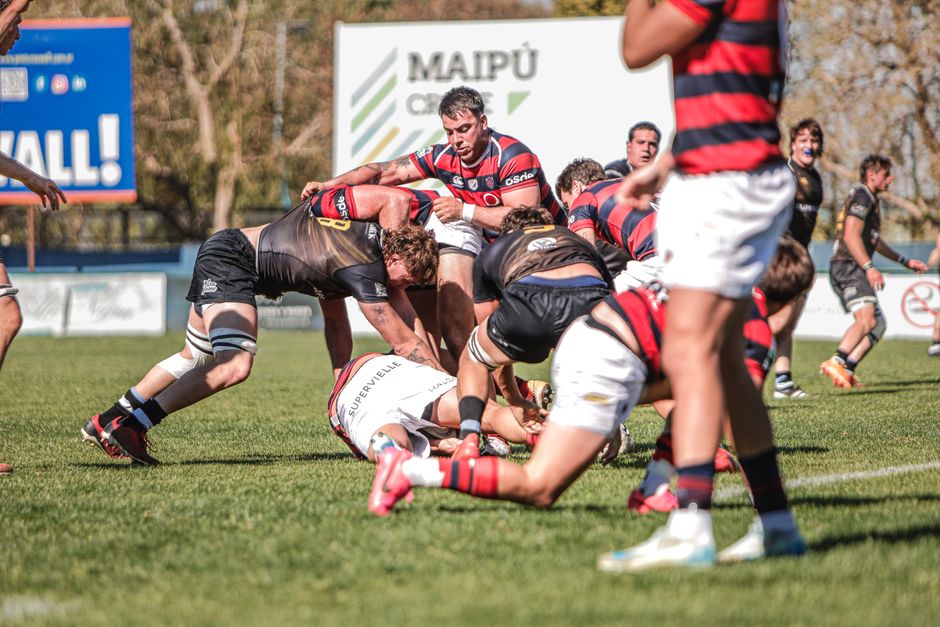
Seventy-eight minutes gone, a one-point lead, and your side has been defending its own line for the last six phases. Lungs burning, you are in the line and the ball-carrier is coming at you. Anyone who has played rugby knows this moment, whether it is a club second-team match in the rain or a final. Rugby mental training means practicing the thinking side of the game (staying composed in contact, deciding when you are tired, steadying yourself over a kick, leading and supporting teammates) the way you practice passing and tackling. This page is about mental performance. Mental health is a different subject, and it has its own section below.
Quick answer: Mental skills in rugby are habits you can practice: a steady routine before a kick, a short reset after a mistake, simple agreed calls with teammates, and mental rehearsal of plays. Studies of rugby players on tools such as imagery are small and mixed, and none of them guarantees a better result. See a doctor, licensed psychologist or other qualified professional if worry, low mood, anger, or problems with sleep or eating last more than a couple of weeks or get in the way of daily life, and call or text 988 in a crisis (US).
Composure in contact
Collision is the part of rugby that other sports do not have, so the mental side of it deserves its own attention. In focus groups with 18 elite rugby league players (Dixon and colleagues, Journal of Sports Sciences, 2023), players described that not all collisions feel the same. Hits they could see coming and brace for felt different from blind-side hits or collisions after a long run-up, and the players described “psychological readiness for collision” as a theme of its own. That was a small interview study of one league, so it describes experiences and does not show what works.
What coaches and players commonly suggest, as practice and not as a studied recipe: build contact skills in progressive steps in training so that technique feels automatic when you are tired, and agree a short cue (a word or a breath) you use just before contact. Safe technique, protective kit and concussion rules are covered on our rugby injuries page, and the physical build-up is on the training page.
Decision-making, including when you are tired
Rugby asks the ball-carrier to choose between running, passing, kicking or offloading in a second or two. A 2025 study of 102 players from elite training centers in France (Hacques and colleagues, Acta Psychologica) used a three-against-three game and found that how the task was framed changed the choice. Priming an individual goal made players take more of the space for themselves, while a team-based goal made them look for the space available to a teammate. It was a staged small-sided game, so it shows that attention to the aims of the moment can shape decisions and does not tell you which choice is better in a real match.
Fatigue is the obvious worry. In a 2021 study (Redman and colleagues, Journal of Strength and Conditioning Research), 20 elite junior rugby league players aged about 16 completed a simulated match. Their jump scores dropped a little, but their decision-making on a reactive agility test and a video task did not change significantly. A separate interview study of 20 elite South African sevens players (Kruyt and Grobbelaar, Frontiers in Psychology, 2019) listed “perform when fatigued” and “perform under pressure” among the psychological demands of tournament sevens. So the evidence is mixed: tired players can still decide well in a lab test, yet players themselves describe fatigue as a real mental challenge. The practical point is to rehearse decisions in training when you are already breathing hard, not only when fresh.
Kicking routines and pressure
A conversion from the touchline to level the scores is the loneliest job in the game. Many kickers use a pre-kick routine, and the Exercise and Sports Science Australia position statement on performance under pressure (Schweickle and colleagues, Sports Medicine, 2026) lists pre-performance routines among the strategies that can help, alongside psychological skills training and mindfulness-based approaches, while also noting that pressure can help or hurt.
The rugby-specific evidence is interesting because it is not what many people expect. Jackson (Journal of Sports Sciences, 2003) timed 572 place kicks at the 1999 Rugby Union World Cup. Harder kicks came with longer concentration time, and when the score was close kickers tended to concentrate for longer and spend less time on the physical preparation. The best and worst kickers of the tournament did not differ in how long or how consistent their routines were. The author concluded that making a routine the same length every time is not what separates good kickers. So treat a routine as a set of steps you know well, and let it flex a little with the situation. This is one World Cup from more than 20 years ago, so it is a useful data point and not a rule.
Visualization and imagery
Mental rehearsal has a small but real rugby research base. In a 2023 randomized crossover pilot (Beaven and colleagues, International Journal of Sports Physiology and Performance), 10 professional players did 15 minutes of video-guided positive imagery, negative video, or self-directed visualization before an exercise stressor and a passing task. Passing accuracy was 91% after positive video, 86% after self-visualization and 79% after the negative video. With only 10 players and a short-term task, this is a pilot and not proof that imagery wins matches.
In a 2026 controlled study of 120 male adolescent rugby players averaging 16.9 years (Di Corrado and colleagues, Children), a personalized imagery program improved imagery vividness and resilience and reduced maladaptive anger expression compared with an education-only group. The researchers reported that resilience helped explain the link to anger. The study measured questionnaires and not match performance.
Confidence, focus and responding to mistakes
Every player drops a ball or misses a tackle. A 2025 study of 76 players in the Italian national squad ahead of the 2024 Six Nations (Robazza and colleagues, Psychology of Sport and Exercise) found that self-confidence and mental toughness were linked to more helpful psychological experiences through problem-focused coping and seeing a challenge as a challenge. It was a one-time questionnaire, so it shows an association and not cause. In the sevens interviews above, players described strategies such as a “back-to-zero” reset, compartmentalizing and cognitive triggers. An older diary study of five professional union players (Nicholls and colleagues, Scandinavian Journal of Medicine & Science in Sports, 2009) found that stronger emotion went with less effective coping, and that “blocking” was the most common coping method on match days. Five players is a very small sample.
- Pick one reset cue (a breath, a word like “next”, resetting your socks) and practice it in training games.
- After the match, note three things you did well before you note what to fix.
- Set goals you control (my tackle line speed, my first pass) rather than only the scoreboard.
- Agree short calls in advance so the forwards and backs mean the same thing by them.
- Give feedback about the next phase, not about who made the last error.
- Let leaders emerge across the pitch (pack, halves, back three), not only the captain.
- Schweickle MJ et al. Performance Under Pressure in Sport: position statement, Exercise and Sports Science Australia. Sports Medicine, 2026. PMID 42271117
- Jackson RC. Pre-performance routine consistency: temporal analysis of goal kicking in the Rugby Union World Cup. Journal of Sports Sciences, 2003. PMID 14620024
- Dixon AJ et al. Elite rugby league players’ experience of collision, contact coaching and player contact psychology: a focus group study. Journal of Sports Sciences, 2023. PMID 38326242
- Hacques G et al. Performance and decision making in rugby union: influence of team-based goals and task complexity. Acta Psychologica, 2025. PMID 40729893
- Redman K et al. Effects of a rugby league match simulation on decision-making in elite junior rugby league. Journal of Strength and Conditioning Research, 2021. PMID 30664109
- Kruyt N, Grobbelaar H. Psychological demands of international rugby sevens and well-being needs of elite South African players. Frontiers in Psychology, 2019. PMID 30984080
- Beaven CM et al. Mental rehearsal improves passing skill and stress resilience in rugby players. International Journal of Sports Physiology and Performance, 2023. PMID 37527821
- Di Corrado D et al. Personalized mental imagery training on anger expression and resilience in adolescent rugby players. Children, 2026. PMID 41749605
- Robazza C et al. Self-confidence, mental toughness and psychobiosocial experiences in elite rugby players. Psychology of Sport and Exercise, 2025. PMID 39674394
- Nicholls AR et al. Acute sport-related stressors, coping, and emotion among professional rugby union players. Scandinavian Journal of Medicine & Science in Sports, 2009. PMID 18282223
- Cammarata IG et al. Sense of belonging, group cohesion and interpersonal closeness in rugby, soccer and basketball. Frontiers in Psychology, 2026. PMID 42839933
- Cotterill S, Cheetham R. Leadership experiences amongst elite female rugby players. Behavioral Sciences, 2026. PMID 42073969
- Reardon CL et al. Mental health in elite athletes: IOC consensus statement (2026). British Journal of Sports Medicine. PMID 42580854
- Nicholls AR et al. Mental health and psychological well-being among professional rugby league players from the UK. BMJ Open Sport & Exercise Medicine, 2020. PMID 32153985
- Iverson GL et al. Worrying about concussions and brain health and psychological distress in former elite rugby league players. Archives of Clinical Neuropsychology, 2026. PMID 41324472
- 988 Suicide & Crisis Lifeline
Teamwork and leadership
A 2026 comparison of 169 adult athletes (Cammarata and colleagues, Frontiers in Psychology) found rugby players reported a stronger sense of belonging, cohesion and closeness than soccer or basketball players. It did not test whether closeness wins matches. The sevens players above named team cohesion, clear purpose and good relationships with coaches as part of their team culture. A 2026 interview study of eight professional women’s rugby captains (Cotterill and Cheetham, Behavioral Sciences) described empathy, empowerment, collaboration and shared leadership as crucial, with leadership spread across several players and not held only by the captain.
Getting ready for the match
A pre-match routine is the same idea as a kicking routine at a larger scale: the same order of things so there is less to think about. Practical logistics (what to eat, what to pack, heat guidance and sevens tournament days) live on our rugby match day page, and the evening after is on recovery.
Young players
The imagery study above included teenage players and found changes in resilience and anger expression on questionnaires. It is the only youth-specific finding used here. For how youth rugby is organized, see the youth rugby page.
Mental performance is not mental health
Mental performance skills help you play. Mental health is about how you are doing as a person. Anxiety, depression, disordered eating, burnout and trouble sleeping are health matters, and a routine or an imagery script is not a treatment for them. The International Olympic Committee consensus statement on mental health in elite athletes (Reardon and colleagues, British Journal of Sports Medicine, 2026) says these symptoms are common among elite athletes, can affect performance and can be treated, and that with support many athletes can keep training and competing.
Rugby studies point the same way. A survey of 233 UK Super League players (Nicholls and colleagues, BMJ Open Sport & Exercise Medicine, 2020) found 13.7% reported moderate or severe anxiety symptoms and 2.6% moderate or severe depressive symptoms. A 2026 study of 235 former elite Australian rugby league players (Iverson and colleagues, Archives of Clinical Neuropsychology) found about three in ten reported moderate to severe distress, and that being very worried about past concussions was one of the factors linked to it. These are questionnaire results, not diagnoses.
If you or a teammate notice symptoms that last, grow worse or affect work, school, relationships, eating, sleep or anger, talk to a doctor, licensed psychologist or other qualified professional, and tell a trusted person at the club. If you are worried about a head knock, see the injuries page and a healthcare provider. In the US, the 988 Suicide & Crisis Lifeline is free, confidential and open 24/7 by call or text to 988. Outside the US, use your local emergency number or crisis line.
Frequently asked questions
Should a goal-kicker use exactly the same routine every time?
Not necessarily. A study of 572 kicks at the 1999 World Cup found routine time varied with kick difficulty and the score, and the best and worst kickers did not differ in routine consistency. Know your steps, but let them flex.
Does tiredness make decisions worse?
Evidence is mixed. Elite junior league players in a simulated match did not show a significant drop in decision tests, but sevens players describe performing when fatigued as a real mental demand. Practice deciding while tired.
Does visualization help rugby players?
Small studies are encouraging: a 10-player pilot saw better passing after positive video imagery, and a 120-player teen study saw gains in resilience and anger control. Neither shows it will improve your match results.
How do I bounce back after a mistake in a match?
Sevens players describe a “back-to-zero” reset. Choose a short cue, use it in training games first, and then bring your attention back to the next phase. If mistakes leave you low or anxious for weeks, speak to a professional.
Is feeling nervous before a big match a sign something is wrong?
Nerves before a big match are common. If worry is constant, comes with low mood, sleep or eating problems, or does not ease, see a doctor or qualified mental health professional. That is a health question, not a performance tip.
Can mental training guarantee I will play better?
No. No technique guarantees results, and rugby studies on these tools are often small, short or based on questionnaires. Treat them as habits to try and keep what works for you.
Sources
General information for education only, not medical advice. It does not replace a doctor, psychologist or other qualified professional. See how we work in our editorial policy. Back to the rugby hub.