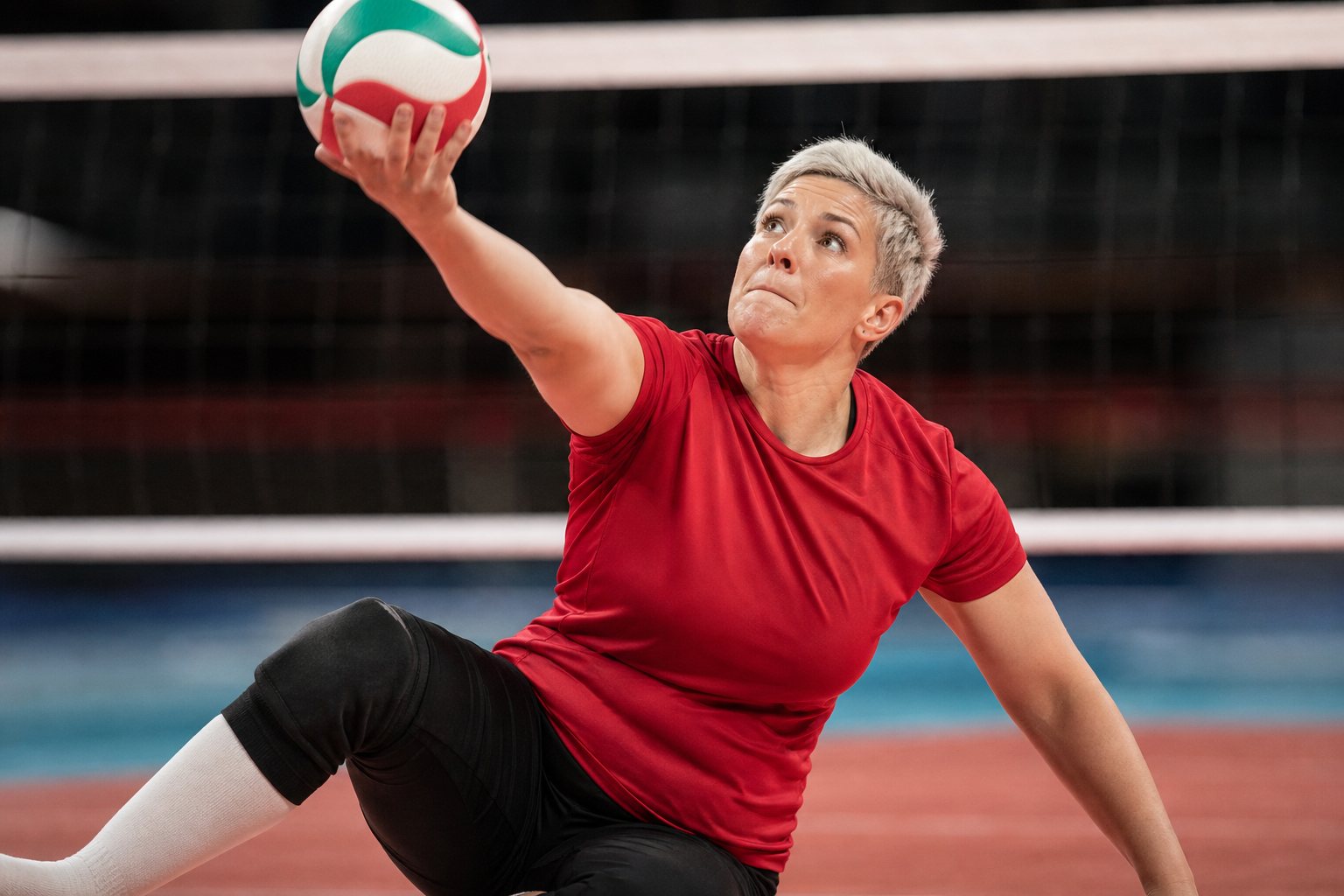
Match point down in the fifth set. The server bounces the ball twice, breathes out, picks a spot over the block and hits. The ball is in; the rally goes on. What happened in those four seconds started long before: a routine practised hundreds of times in training. Sitting volleyball mental training is the set of skills athletes use to keep confidence, attention and composure steady under pressure: goal setting, imagery, routines, ways to reset after a mistake, and teamwork. None of it guarantees a result.
Quick answer: Mental skills are trained like physical ones: short, regular practice with a plan. The sport-psychology sources we read support goals, imagery and pre-performance routines, but we found little research on them in sitting volleyball itself. Keep mental performance separate from mental health: anxiety, depression, disordered eating or burnout are health matters for a qualified professional. In the US you can call or text 988 at any time.
General information, not medical advice. Rules and scoring are on our rules page, and sleep and load are on our recovery page.
Confidence and self-talk
Confidence grows from evidence: reps done, serves landed, matches finished. A simple habit, general sport-psychology practice, is to keep a short log of what went well in each session, in plain words, and to replace “don’t miss” with a clear instruction such as “high toss, full arm”. Confidence is also social: teammates and coaches who name what a player did well build it faster than silence does. The research in para athletes is thin, and a narrative review found only seven publications on Paralympic athletes specifically on the topic of mental health (Swartz and colleagues, British Journal of Sports Medicine 2019), so most advice below is borrowed from sport psychology in general.
Goal setting and motivation
The Association for Applied Sport Psychology (AASP) describes goals that are specific and reviewed often, and recommends setting them weekly or even daily when returning from injury. In sitting volleyball, useful goals are process goals a player controls, such as serve routine every time, first-contact accuracy in a drill or a number of quality shoulder reps, rather than only outcomes like winning. Motivation also comes from enjoyment: in a 16-week sitting light volleyball program, adults with physical disabilities reported higher physical activity enjoyment than a comparison group (Leung and colleagues, 2021).
Imagery
AASP calls imagery, also known as visualisation or mental rehearsal, a skill that improves with practice. It suggests vivid, detailed, positive images using all the senses, run in real time, starting with short sessions and lengthening them, and using them in training, before competition, on tough days and during injury. A sitting volleyball version: rehearse a serve from the back line, the sound of the gym, the reach of the block, the target. AASP says imagery can help with competitive anxiety, confidence and focus. That is a practitioner position, not a sitting-volleyball trial.
Pre-performance routines and focus
An AASP release says the last minutes before competition matter and that successful athletes use a structured set of thoughts and behaviours. In volleyball the serve is the natural place: the same bounces, breath and cue word before every serve, in practice and in matches. Serving matters. In 3,664 serves from the Tokyo 2020 Paralympics and the 2022 World Championship, a more effective serve was associated with a higher chance of winning the match, and the authors recommend that coaches help players manage risk on the serve (Cavedon and colleagues, Frontiers in Sports and Active Living 2024). Between rallies, a reset cue, such as a breath and a look at the floor, can bring attention back to the next ball.
Handling pressure and responding to setbacks
- Name it: nerves before a final are normal. Say what you feel and what you can control.
- Short reset: after an error, use the same few-second routine every time and move on to the next ball.
- Review later, not mid-match: save analysis for the bench or the next day.
- Plan for bad days: have an agreed process for tough sets so you are not inventing one in the moment.
These are general coaching practices, not trial results in sitting volleyball.
Tactics, decisions and teamwork
Sitting volleyball is a six-player game on a small court where reach and reaction decide many rallies. In a study of 100 male players at the 2009 European Championships, seated vertical reach was strongly linked to effectiveness in attacking, blocking and receiving (Molik and colleagues, 2017), so tactical decisions about who blocks whom matter. Teams also combine players from different classes, with no more than one VS2 player on court, so roles must be clear. Calling the ball, agreed signals and honest talk after errors are learned in practice like any other skill.
Classification, selection and identity
Para sport brings stresses most athletes do not face. A 2026 scoping review of 17 studies on classification and reclassification (Aydoğan and Tunç, BMC Sports Science, Medicine and Rehabilitation) found the most disruptive accounts when decisions were poorly explained, seen as inconsistent, or involved unexpected reclassification or loss of eligibility, and it identified themes of uncertainty, identity and belonging. It found that transparent information and respectful communication were linked with trust and acceptance, and that no study had tested a classification-specific support strategy. If classification stress is affecting your sleep, mood or training, talk to your coach, team psychologist or federation about support, and see our rules page for the process in plain words.
Competition preparation
Fuel for a tournament day is on our nutrition page. On the mental side, rehearse the routine you will use, know your plan for a bad set, and agree roles with teammates before the first whistle. We found no youth-specific sitting volleyball sport psychology research, so we make no claims for young players.
Mental health is not the same as mental performance
Mental training aims at performance. Anxiety, depression, disordered eating, burnout, sleep problems and substance use are health matters that need a qualified professional such as a doctor or licensed mental health clinician. The 2019 IOC consensus statement on mental health in elite athletes (Reardon and colleagues, British Journal of Sports Medicine) emphasised routine screening and monitoring, and an updated IOC consensus statement was published in 2026, whose release recommends mental health emergency action plans in elite sport settings. Evidence for para athletes is limited: an Australian survey of 749 elite athletes found most mental health symptoms were similar between para and non-para athletes, with alcohol use the exception (Olive and colleagues, Sports Medicine Open 2021), and a prospective study of 122 German Paralympic athletes found mood and stress, not training load, were the main predictors of later distress scores (Busch and colleagues, Frontiers in Psychology 2025). If you are struggling, tell your doctor or a trusted professional. In the US, the 988 Suicide and Crisis Lifeline is free, open 24 hours a day, and reachable by call, text or chat at 988lifeline.org; text and chat are available in Spanish. In an emergency, call 911.
Sitting volleyball mental training: FAQs
Does mental training work for sitting volleyball?
Sport-psychology bodies such as AASP support goals, imagery and routines, but we found no sitting volleyball trials. Treat the skills as practice that may help, not a guarantee.
How do I build a serve routine?
Pick a short sequence you can repeat the same way every time: bounces, a breath, a cue word and a target. Practise it in training until it is automatic.
How can a team handle pressure at a tournament?
Agree roles and a plan for bad sets before the match, use a short reset after errors and save analysis for later. These are general coaching practices.
Is classification stressful for athletes?
A 2026 scoping review found it can be, especially when decisions are unexplained or unexpected. Clear information and respectful communication were linked with trust. Ask your federation for support.
When is it more than nerves?
If worry, low mood, eating concerns or burnout last, or interfere with sleep, school, work or training, see a doctor or qualified mental health professional. In the US you can call or text 988 at any time.
Sources
- Swartz et al., mental health symptoms and disorders in Paralympic athletes, Br J Sports Med 2019
- Reardon et al., IOC consensus statement on mental health in elite athletes, Br J Sports Med 2019
- BMJ Group news release: IOC consensus statement on mental health in elite athletes (2026)
- Olive et al., mental health symptoms in Paralympic sport athletes vs non-para athletes, Sports Med Open 2021
- Busch et al., mental health in Para athletes and physical health problems, Front Psychol 2025
- Aydoğan and Tunç, classification and reclassification in Para sport: scoping review, BMC Sports Sci Med Rehabil 2026
- AASP: Sport Imagery Training
- AASP: Mentally preparing athletes to return to play following injury (goal setting)
- AASP: The last five minutes before competition (press release)
- Cavedon et al., serve reception effectiveness at Tokyo 2020 and the 2022 Worlds, Front Sports Act Living 2024
- Molik et al., game performance in elite male sitting volleyball, APAQ 2017
- Leung et al., sitting light volleyball program, BMC Sports Sci Med Rehabil 2021
- 988 Suicide and Crisis Lifeline
General information for education only, not medical advice. It does not replace a visit with a doctor, physical therapist or athletic trainer. See how we write and check our pages in our editorial policy.