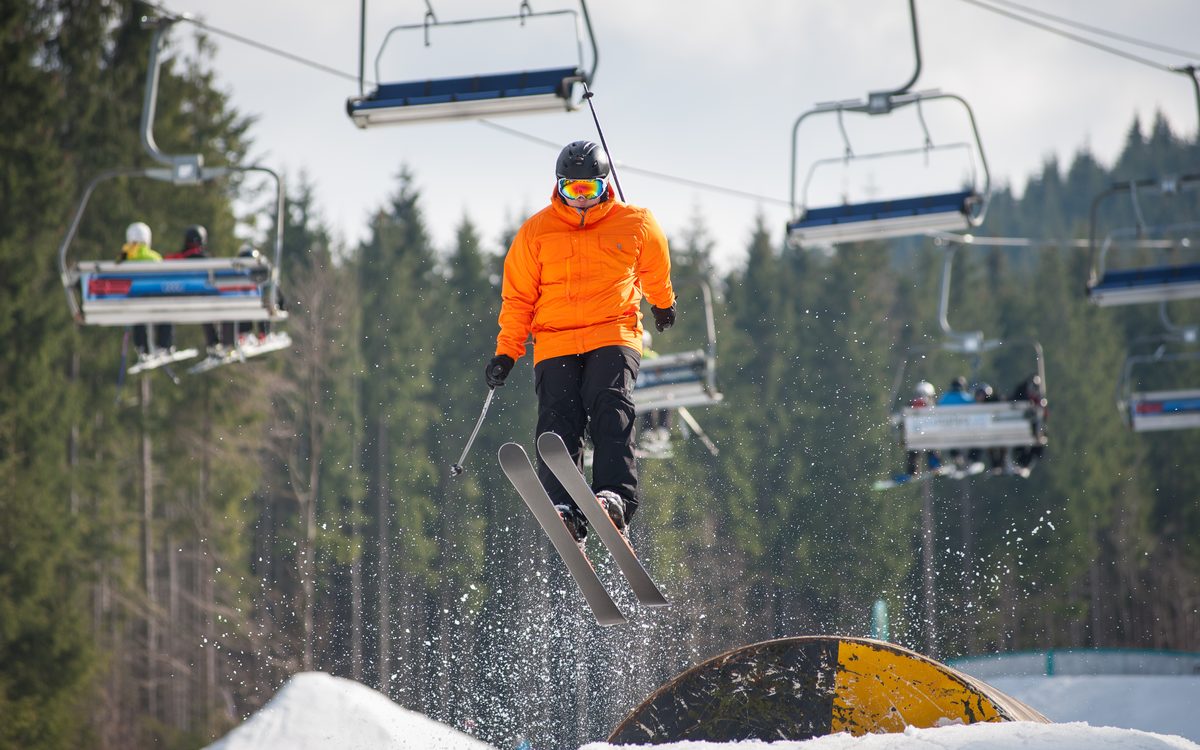
The take-off looks fine, the rotation is a little late, and the landing is a little short. Everyone on the hill has seen that moment, and the difference between a shaky landing and a trip to ski patrol is often a few inches and a few degrees. Freestyle skiing injury prevention means the habits, training, setup and equipment choices that lower the chance and seriousness of injury in moguls, aerials, ski cross and the park. It does not mean eliminating risk. This page covers prevention; what each injury looks like is on our freestyle skiing injuries guide, and the sport itself starts at the freestyle skiing hub.
Quick answer: The best-supported steps are a short warm-up, a helmet made for snow sports, building skills on smaller features before bigger ones, a plan for each jump, stopping when tired, and equipment checked by a ski shop. Elite freestyle skiers still get hurt at high rates, so no step is a guarantee. See a sports medicine doctor, physical therapist or athletic trainer if pain lingers or changes how you ski, and call emergency services after a head injury with danger signs.
Know the risk first
The Oslo Sports Trauma Research Center followed World Cup freestyle skiers from 20 nations for three seasons (Flørenes and colleagues, British Journal of Sports Medicine 2010). It recorded 291 acute injuries in 662 skiers, or 14 injuries per 100 athletes per season, and about one in three was severe, meaning more than 28 days away. The knee was the most commonly injured body part, with 27% of injuries. At the Beijing 2022 Games, the IOC injury study reported injury incidence of 30% in ski halfpipe, 28% in ski big air and 22% in ski slopestyle (Soligard and colleagues). Those are elite numbers and not what a weekend skier should expect, but they show where care matters most: landings, knees and heads.
Warm-up
FIS published a consensus statement on warm-up and cool-down for competitive alpine and freestyle skiers and snowboarders in 2025 (Spörri and colleagues). Its authors say warm-up and cool-down can improve performance-related factors and reduce injury risk in many sports when applied systematically, but that scientific evidence in snow sports is widely lacking, and that aerials and moguls were under-represented on the panel. So treat the details as expert consensus. The American Academy of Orthopaedic Surgeons (AAOS) suggests a few minutes of easy movement before the first run, and general coaching practice adds light jumps, hip and ankle mobility and a couple of easy practice runs before you try anything hard.
Technique and a plan for every jump
The National Ski Areas Association (NSAA) built its Park SMART program for terrain parks around five habits: start small, make a plan, always look before you drop, respect the features and other users, and take it easy. Practical translations, labelled as general advice: watch a feature before you hit it, ride the smaller version first, know your speed and where you will land, and move out of the landing zone right away. For moguls and aerials, technique is coached: lessons teach the posture, the line and how to fall. The AAOS lists lessons and learning to fall among its skiing safety steps.
Training load
We found no published freestyle-skiing rule of thumb for how fast to raise jump counts or training hours, so we will not invent one. The Kellmann consensus statement on recovery and performance says balancing stress and recovery matters for continuous high-level performance and for avoiding under-recovery, injuries and illness. Practical, general advice: add new tricks or features before adding more volume, cut back after travel or illness, and treat fatigue as a reason to stop. AAOS notes that many ski injuries happen late in the day, when people are tired.
Strength and conditioning
Strong legs and a stable trunk make sense for a sport with big landings, and the Zoppirolli review calls freestyle a power and technique sport. Evidence that conditioning prevents ski injuries is modest. A 2009 review of recreational skiing injuries (Johnson and colleagues, Sports Health) said there was no convincing evidence that fitness conditioning reduces injury risk. A study of more than 1,400 knee ligament injuries in recreational alpine skiers (Ettlinger and colleagues, 1995) found about 62% fewer injuries after ski patrollers and instructors were taught awareness training. That was alpine and recreational, not freestyle. Our training page covers strength work for performance.
Snow, features and weather
- Features change. Park jumps and mogul lines change with weather and use; the Park SMART message is to look before every drop.
- Freestyle terrain signs. NSAA trail signage uses an orange oval for freestyle terrain.
- Cold. The CDC lists frostbite and hypothermia as winter-weather risks and tells people to dress in layers; AAP says fingers, toes, ears and noses frostbite first.
- Altitude. The CDC Yellow Book describes altitude illness; go up gradually and ask a doctor if you have heart or lung disease.
- Trees and deep snow. If your freestyle day includes off-piste, the NSAA warns about tree wells and deep snow: stay with a partner.
Helmets, protectors and fit
A meta-analysis in the Canadian Medical Association Journal (Russell and colleagues, 2010) found helmet users had about 35% lower odds of head injury, without more neck injuries. For children under 13, the same analysis gave odds about 59% lower. Look for ASTM F2040 or EN 1077 on the label. ASTM states that protection is limited and mainly at lower speeds, and the NSAA says to wear a helmet but ski as if you are not. A 2025 hospital study of 1,160 patients identified (232 followed up) found back protectors did not significantly reduce spinal injuries (Tinner and colleagues), so we cannot call them a proven safeguard. Have a ski shop set and test bindings and boots; AAOS recommends this. More on the gear page.
Young skiers
The AAP’s winter safety guidance for children says to use helmets, supervision, instruction and well-maintained equipment, with bindings checked yearly. Freestyle-specific youth injury data were not part of our sources.
What prevention cannot do
A helmet does not stop a concussion; a warm-up does not make a bad landing safe. Many injuries, such as knee ligament tears in a crash, are partly random. If you are hurt, stop. The CDC HEADS UP program says anyone with a suspected concussion should stop activity and see a healthcare provider, who decides when to return.
When to see a professional
- After a head injury with headache, dizziness, confusion or balance problems, or any danger sign (repeated vomiting, seizure, one pupil larger): emergency care.
- A knee that swells, gives way or locks, or a joint that cannot bear weight.
- Pain that is in one spot, comes at rest or at night, or changes how you ski.
- Neck or back pain, numbness or tingling after a fall.
Freestyle skiing injury prevention FAQs
Does a helmet prevent concussions?
No helmet can promise that. A CMAJ meta-analysis found about 35% lower odds of head injury in helmet users, and ASTM notes protection is limited at higher speeds.
Do back protectors work?
A 2025 hospital study found no significant reduction in spinal injuries among users. Evidence is limited, so do not treat one as a guarantee.
How should I warm up for freestyle skiing?
FIS has a consensus statement, though it says snow-sport evidence is lacking. AAOS suggests easy movement for a few minutes before the first run.
How do I make park jumps safer?
Use the NSAA Park SMART habits: start small, make a plan, look before you drop, respect the features and others, and take it easy.
Should kids wear helmets?
Yes, the AAP recommends them, and the CMAJ analysis found larger reductions in head injury odds for children under 13.
Sources
- Flørenes et al. 2010, Injuries among World Cup freestyle skiers (Br J Sports Med)
- Soligard et al. 2023, injuries and illnesses at the Beijing 2022 Winter Olympics
- Spörri et al. 2025, FIS consensus statement on warm-up and cool-down
- Kellmann et al. 2018, recovery and performance consensus
- Zoppirolli et al. 2026, Olympic snow sports review
- Johnson, Ettlinger, Shealy 2009, Sports Health
- Ettlinger et al. 1995, Am J Sports Med
- Russell et al. 2010, helmets and head injury (CMAJ)
- Tinner et al. 2025, back protectors and spinal injuries
- NSAA, Park SMART
- NSAA, helmet safety
- ASTM F2040
- AAOS OrthoInfo, skiing injury prevention
- AAP HealthyChildren, winter safety
- CDC HEADS UP, signs and symptoms
- CDC, winter weather prevention
- CDC Yellow Book, high-altitude travel
General information for education only, not medical advice. It cannot replace a sports medicine doctor, physical therapist or athletic trainer who knows you. Read how we work in our editorial policy.