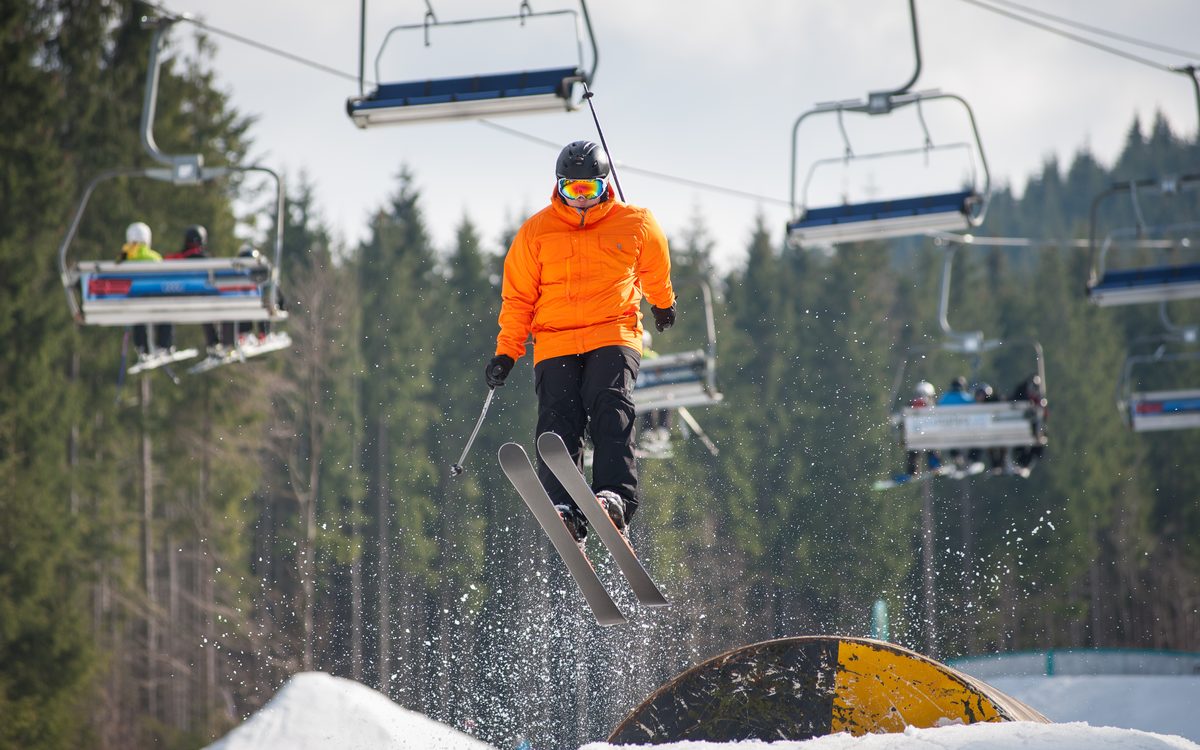
At the top of the kicker the world gets very quiet. Skis tick over the snow, someone below shouts a number, and the only thing left is the decision to go or not to go. Every freestyle skier knows that moment, whether it is a first small park jump or a final run in a mogul field. Mental training for freestyle skiing means the skills that help an athlete stay focused, confident and calm enough to do what they have practised, and make good decisions about risk. This page covers those skills. The physical side is on our training page; the rules are on the rules page.
Quick answer: Mental skills such as goal setting, imagery, routines and a clear plan for each run are widely taught in sport and can help athletes feel prepared, but research specific to freestyle skiing is thin and no technique guarantees results. Fear that keeps you safe is useful; fear that stops you from sleeping, eating or enjoying the sport is a health matter. Talk to a coach, a sports psychologist or your doctor, and in the US call or text 988 in a crisis.
Fear, risk and the plan for each run
Freestyle events ask skiers to commit to jumps, speed and rotation, so fear is normal and often useful. Research on risk in snow sports is mostly in alpine and freeride skiing, but its ideas carry over. A 2022 study of junior freeriders, adolescent alpine skiers and adult freeriders (Frühauf and colleagues) found that accidents and close calls did not differ between the groups, while deliberate risk-taking was lower in adult freeriders, and the authors suggested risk education for adolescents. A 2025 paper on competitive alpine skiing (Bonell Monsonís and colleagues) proposed a risk management framework of identify, assess and mitigate. In a park, that is the NSAA Park SMART habit of making a plan for every feature, every time, in action. General coaching practice: check the take-off and landing, decide your speed and trick before you start, and decide in advance what you will do if it feels wrong, including skiing away.
Confidence
Confidence in freestyle skiing comes from skills you have actually done, in small steps, not from forcing a bigger trick. A survey of 4,792 backcountry skiers and snowboarders (Shonnard and colleagues, 2026) found confidence correlated with willingness to take risk, training and experience, and that more than 30% of those without level 1 avalanche training still reported being confident, a reminder that confidence is not the same as competence. Coaches often use progressions, video of good attempts and written reminders of past successes to build confidence honestly (general practice).
Focus and routines
- Pre-run routine. A short, repeatable sequence at the top: a breath, a look at the line, one focus word, go. Coaches teach it because routines reduce last-second doubt (general practice).
- One focus. Pick one cue for the run, such as hips forward on the take-off or quiet upper body in the bumps, instead of five.
- Reset cue. After a mistake, use a physical cue such as a pole tap or a deep breath, then return to the next feature.
- Psychological warm-up. The 2025 FIS consensus statement on warm-up and cool-down covers physical and psychological warm-up for competitive freestyle and alpine athletes (Spörri and colleagues); we only read its abstract, so check the full text for details.
Goal setting and motivation
A common coaching split is outcome goals (a podium), performance goals (a score or a personal best) and process goals (what you do on each run); process goals are the most controllable (general practice). A 2025 study of 332 college skiers from four skiing events (Wu and colleagues) found that a task-involving climate, one that rewards effort and learning, was positively linked with basic psychological needs and mental toughness, while an ego-involving climate was negatively linked. It was a questionnaire study, so it shows association, not cause. Ask your coach what the climate is like on your team.
Imagery and visualization
Imagery means rehearsing a run in your mind: the line, the take-off, the sound of the snow. A 2025 mixed-methods study (Volgemute and colleagues) surveyed 500 athletes and then followed nine alpine skiers through a six-month guided imagery program alongside their regular training. Nine skiers is a very small group, so it is a pointer, not proof. General coaching advice: use imagery in a calm place for three to five minutes, see the run from your own eyes and feel the movements, and do it after course inspection so the picture is accurate. Do not imagine tricks you cannot yet safely do on snow.
Handling pressure
The 2026 position statement from Exercise and Sports Science Australia (Schweickle and colleagues) says pressure can have both helpful and harmful effects on performance, and that training that practises pressure can prepare athletes. Its list of evidence-based strategies includes pre-performance routines, implicit attentional strategies, psychological skills training and mindfulness-based approaches. It is written for sport-science practitioners and was not freestyle-specific, so use it as a starting point for a conversation with a qualified sport psychologist. General advice: reframe nerves as readiness, breathe slowly and stick to the routine.
After a fall or a setback
Falling is part of the sport. After a crash or injury, confidence can drop. A systematic review of 14 studies (Rajpoot and colleagues, 2026) found that a measure of psychological readiness after ACL reconstruction predicted return to sport in seven cohorts. A scoping review of return to performance after ACL injury in competitive alpine skiing (Spörri and colleagues, 2026) found little evidence on psychological and social factors and described a stepwise on-snow framework. Practical, general advice: go back to terrain you know, take small steps, and tell your coach and clinician if fear is holding you back. The FIS return-to-performance consensus statement is aimed at competitive athletes with medical teams. See our injuries page.
Decisions and tactics
In ski cross, tactics matter: choosing a line, starting position and when to pass (NBC Olympics notes starting gates are chosen in seed order). Judged events involve choosing a trick list that fits your skills on the day. General coaching practice: pick the run you can land, not the run you hope to.
Mental health is not the same as mental performance
Mental skills are for performance. Anxiety that does not settle, low mood, trouble sleeping or eating, panic, burnout or thoughts of self-harm are health matters. The IOC consensus statement on mental health in elite athletes (Reardon and colleagues, 2019) says mental health symptoms and disorders are common among elite athletes, impair performance, and increase the risk of physical injury and delay recovery. Talk to your doctor or a qualified mental health professional. In the US, you can call or text 988, the 988 Suicide & Crisis Lifeline. Outside the US, use your local emergency number. For eating concerns, see our nutrition page.
Youth skiers
Our sources did not include youth-specific freestyle mental training research. For young athletes, the Frühauf study above suggests risk education, and the best help is usually a coach who values effort and a family that watches for signs of stress.
Mental training for freestyle skiing FAQs
Is it normal to be scared of jumps?
Yes. Fear is a normal response to a risky skill. Use a plan, small steps and a coach’s eye, and never force a trick you are not ready for.
Does visualization work?
Imagery is widely used and a 2025 study followed skiers using it, but freestyle-specific evidence is limited, so treat it as one tool, not a guarantee.
How do I get my confidence back after a crash?
Return to known terrain, build back in small steps, and talk to your coach or clinician. A 2026 review found psychological readiness measures predicted return to sport after ACL surgery in several studies.
What is a pre-run routine?
A short repeatable sequence at the start, such as a breath, a look at the line and one cue word. It is a general coaching tool.
Where do I go for help with anxiety?
A doctor or qualified mental health professional. In the US you can call or text 988.
Sources
- Frühauf et al. 2022, risk-taking in junior freeriders, adolescent alpine skiers and adult freeriders
- Bonell Monsonís et al. 2025, risk management framework for competitive alpine skiing
- Shonnard et al. 2026, backcountry skiers and snowboarders survey
- Spörri et al. 2025, FIS consensus on warm-up and cool-down
- Wu et al. 2025, motivational climate and mental toughness in college skiers
- Volgemute et al. 2025, guided imagery
- Schweickle et al. 2026, ESSA position statement: performance under pressure
- Rajpoot et al. 2026, psychological readiness after ACL reconstruction, systematic review
- Spörri et al. 2026, return to performance after ACL injury in alpine skiing
- Spörri et al. 2026, FIS consensus on return-to-performance
- Reardon et al. 2019, IOC consensus statement on mental health in elite athletes
- NBC Olympics, ski cross 101
- NSAA, Park SMART
- 988 Suicide & Crisis Lifeline
General information for education only, not medical advice. It cannot replace a sports medicine doctor, physical therapist or athletic trainer who knows you. Read how we work in our editorial policy.