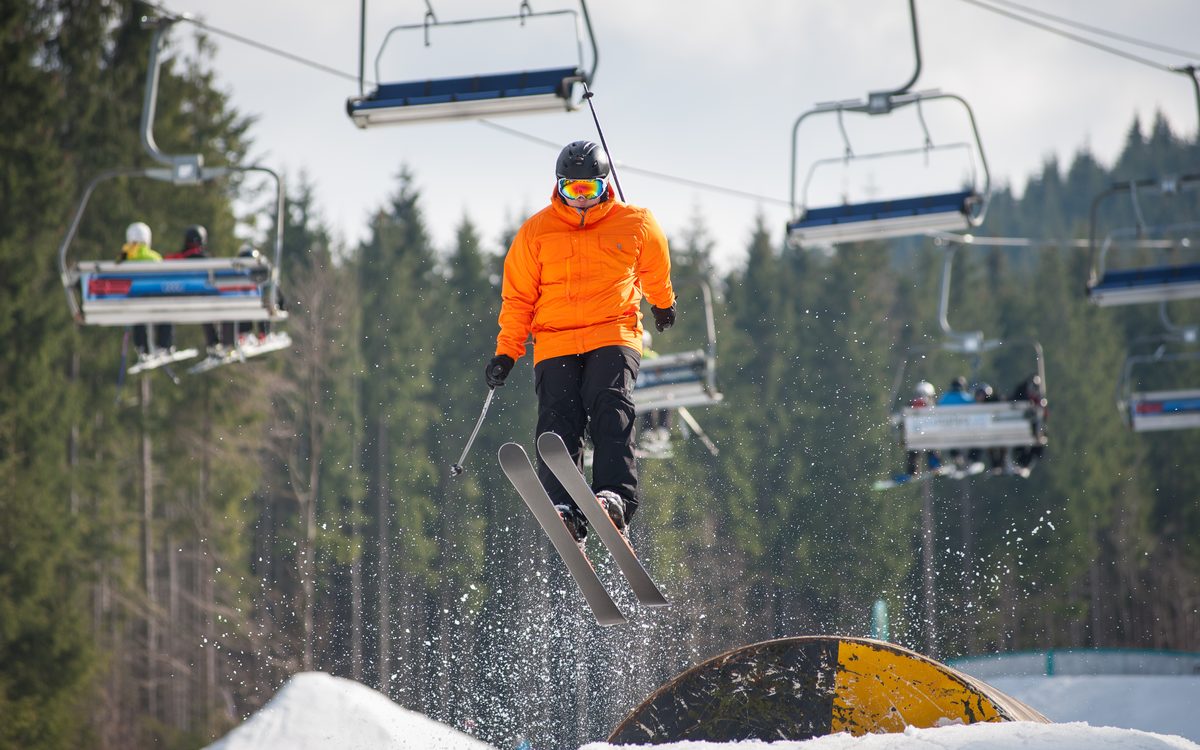
After a long day on the bumps or in the park, the legs feel like they belong to someone else. Quads are tight, boots have left their marks, and the idea of one more run feels very far away. Freestyle skiing recovery is how an athlete gets from that feeling back to being ready: sleep, enough food and fluid, planned easy days, and some tools that help comfort more than they help performance. This page also helps you tell ordinary soreness from an injury. Training is on our training page.
Quick answer: Sleep, regular days off, eating enough and balancing hard days with easy ones have the strongest backing. Massage and compression show small benefits; foam rolling helps a little with short-term soreness and flexibility; cold-water immersion may ease soreness but can blunt strength gains if used after strength training. Soreness that is on both sides and fades in a few days is common; sharp, one-sided, swelling or night pain is a reason to see a sports medicine doctor, physical therapist or athletic trainer.
Load management: the base of recovery
The 2018 consensus statement on recovery and performance in sport (Kellmann and colleagues) says an adequate balance between stress (training, competition and life demands) and recovery is essential for continuous high-level performance. It adds that systematic monitoring of recovery aims to prevent under-recovery, overreaching, injuries and illness. In practice, that means hard days are followed by easier ones, a heavy block is followed by a lighter week, and travel days count as load. The American Academy of Pediatrics, in its report on overuse injuries and burnout in young athletes, advises 1 to 2 days off per week from organized sport (as cited in our sibling pages).
Sleep
A review of sleep and athletic performance (Charest and Grandner, 2020) describes sleep as a fundamental component of performance optimization that plays a crucial role in physical and cognitive performance, and in reducing injury risk. The American Academy of Sleep Medicine and Sleep Research Society consensus recommends at least seven hours for adults; the pediatric consensus gives 8 to 10 hours for 13- to 18-year-olds (reused from our other sport pages). General tips, labelled as such: regular bed and wake times, a dark cool room, and limited caffeine and alcohol late in the day.
Altitude matters for ski trips. The CDC Yellow Book says that periodic breathing is nearly universal above about 2,700 metres (9,000 feet), sleep stages are altered and wakings are frequent, and it advises avoiding alcohol for the first 48 hours at altitude. People with heart, lung or sleep-apnea conditions should consult a physician.
Food and fluid after training
The joint position of the Academy of Nutrition and Dietetics, Dietitians of Canada and the American College of Sports Medicine (2016) suggests about 15 to 25 grams of protein (0.25 to 0.3 grams per kilogram) after exercise, and says rapid carbohydrate refuelling matters mainly when the next session is within about eight hours. It also advises rehydrating with 1.25 to 1.5 litres per kilogram of body mass lost when quick rehydration is needed. Our nutrition and athlete health page covers fueling in more depth.
Cool-down, mobility and flexibility
The FIS consensus statement on warm-up and cool-down (Spörri and colleagues, 2025) covers cool-down for competitive freestyle and alpine skiers and says evidence in snow sports is lacking. A 2018 review of cool-down in general (Van Hooren and Peake) found small or no effects on most recovery markers, so an easy spin or walk is best seen as a habit and a way to calm down, not a proven recovery shortcut. For mobility, general practice is gentle hip, ankle and thoracic-spine work, done pain-free, a few times a week; no freestyle-specific flexibility standard exists in our sources.
Recovery tools: what the evidence says
- Massage. A 2018 review of 99 studies (Dupuy and colleagues) found massage the most effective method for soreness and perceived fatigue.
- Compression garments. A 2017 review (Brown and colleagues) found small benefits, largest for strength recovery.
- Foam rolling. A 2019 meta-analysis (Wiewelhove and colleagues) examined foam rolling before and after exercise on performance, flexibility and muscle pain; effects are small and short-lived.
- Cold-water immersion. A 2016 meta-analysis (Machado and colleagues) found 10 to 15 minutes at 10 to 15 degrees Celsius slightly better than passive rest for soreness. A 2015 study (Roberts and colleagues) found regular cold-water immersion after strength training reduced strength and muscle gains, so it is not ideal during a strength block.
- Massage guns, boot-dryers, recovery boots and wearables. We did not find freestyle-specific trials; treat them as comfort tools. See the gear page for what to look for.
Soreness or injury?
General guidance, not a diagnosis. Ordinary soreness tends to be dull, spread over muscle groups, on both sides, and to ease within a few days. A possible injury tends to be sharp or pinpoint, on one side, with swelling, bruising, a feeling of instability, pain at rest or at night, or pain that changes how you ski. AAOS notes that many ski injuries happen when people are tired, and says to stop when you are tired or in pain. After a head hit, the CDC HEADS UP rules apply, not a recovery routine. See our injuries page.
A simple recovery day
- Eat a meal with protein and carbohydrate and drink fluids within a couple of hours.
- Walk or do easy cycling for 20 to 30 minutes if it feels good (general practice).
- Do gentle mobility work and, if you like, foam rolling or a massage.
- Go to bed on time; sleep does the most.
Freestyle skiing recovery FAQs
How many rest days does a freestyle skier need?
There is no sport-specific rule. The AAP advises young athletes at least 1 to 2 days off a week from organized sport, and coaches plan lighter days around hard ones.
Does foam rolling help recovery?
A 2019 meta-analysis found small, short-term effects on flexibility and soreness. It is safe for most people, but it is not a substitute for rest.
Are ice baths good after skiing?
Cold-water immersion may ease soreness a little, but a 2015 study found it blunted strength gains when used regularly after strength training. Skip it during strength blocks and check with a doctor if you have a heart condition.
How much sleep do athletes need?
Adults need at least seven hours, according to the AASM and Sleep Research Society consensus, and teens aged 13 to 18 need 8 to 10 hours.
Why do I sleep badly at altitude?
The CDC Yellow Book says altitude changes sleep stages and causes frequent wakings, and periodic breathing is nearly universal above about 2,700 metres.
Sources
- Kellmann et al. 2018, Recovery and Performance in Sport: Consensus Statement
- Charest and Grandner 2020, Sleep and athletic performance
- Watson et al. 2015, AASM and SRS consensus on adult sleep duration
- Paruthi et al. 2016, AASM consensus on pediatric sleep duration
- Brenner, AAP 2016, overuse injuries, overtraining and burnout
- Thomas et al. 2016, ACSM, AND and DC joint position on nutrition and athletic performance
- Spörri et al. 2025, FIS consensus on warm-up and cool-down
- Van Hooren and Peake 2018, cool-down review
- Dupuy et al. 2018, recovery methods review
- Brown et al. 2017, compression garments
- Wiewelhove et al. 2019, foam rolling meta-analysis
- Machado et al. 2016, cold-water immersion
- Roberts et al. 2015, cold-water immersion and training adaptation
- CDC Yellow Book, high-altitude travel
- AAOS OrthoInfo, skiing injury prevention
- CDC HEADS UP, concussion response
General information for education only, not medical advice. It cannot replace a sports medicine doctor, physical therapist or athletic trainer who knows you. Read how we work in our editorial policy.