This article contains affiliate links: if you buy through them we may earn a commission, at no extra cost to you. Learn more.
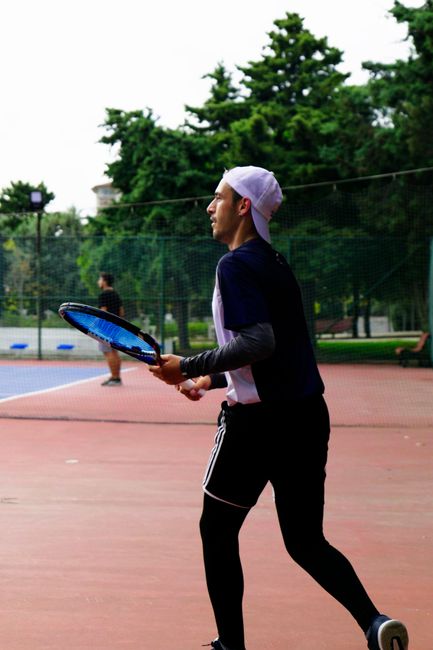
The pop of a fresh can of balls on a cool Saturday morning at the park courts. A high school team match in the spring, six singles courts going at once and teammates yelling “come on!” through the fence. A Tuesday-night league doubles match under the lights, then a cold drink on the bench. And in early September, the night sessions at the US Open, when the whole stadium holds its breath on a second serve. Tennis is a game for a lifetime: in 2024-25, 158,667 boys and 204,721 girls played it for their high schools, according to the National Federation of State High School Associations (NFHS), and adult leagues have divisions for players 55 and over.
Tennis, page by page
- Rules: how the game works at every level
- Leagues & associations: pro, college, high school and youth
- Youth & high school: ages, safety and recruiting, for players and parents
- Injuries & sports health: prevention, concussion, when to see a pro
- Training & conditioning: before: off-season to in-season
- Game day: during: fueling, hydration, heat
- Recovery: after: games, tournaments, sleep
- Nutrition & supplements: what to eat, tested supplements
- Best wearables: trackers and watches for the sport
- Gear: the complete equipment list
Buying guide · Our Tennis buying guide compares the gear we'd pick, with prices and sizing:
This page is tennis for the people who play it and the people who look after them: how the game works, what it looks like at every level from a red ball on a 36-foot court to the Grand Slams and the Olympics, and, most of all, how to stay healthy playing it. Sports health is the heart of it: the tennis injuries players get most, what to know about tennis elbow, how to handle long matches in the heat and when to see a professional. Then training, recovery and the gear you really need, with links to every page in our tennis section.
Tennis at a glance
| Players | 1 against 1 (singles) or 2 against 2 (doubles, including mixed doubles). |
|---|---|
| Court | 78 feet (23.77 m) long; 27 feet wide for singles and 36 feet wide for doubles. The net is 3 feet high in the center and 3½ feet at the posts. |
| Scoring | Points go love, 15, 30, 40, game, with deuce and advantage at 40-40. Six games (by two) win a set, with a tiebreak at 6-6. Matches are best of three or best of five sets. |
| Surfaces | Hard courts, clay and grass (plus carpet and indoor courts). The four Grand Slams cover all three main surfaces. |
| Governing bodies | The ITF writes the Rules of Tennis worldwide; the USTA in the US; the ATP and WTA run the pro tours; the ITA, NCAA, NAIA and NJCAA run college tennis; state associations run high school tennis. |
| Most common injuries | Ankle sprains and other leg injuries, muscle strains, wrist and shoulder problems, tennis elbow, low-back pain and, in the heat, heat illness. |
How tennis works
The idea is simple: hit the ball over the net and into the court so your opponent can’t return it before it bounces twice. A point starts with a serve from behind the baseline, diagonally into the service box. You get two tries; if the serve clips the net and still lands in, it’s a “let” and you serve again. A ball that touches any part of a line is in. Under the ITF Rules of Tennis, players get up to 25 seconds between points and 90 seconds when they change ends, and they switch ends after the first, third and every other odd game of a set (with no rest after the first game).
Scoring is the part that confuses newcomers. Points in a game go love, 15, 30, 40, game. At 40-40 it’s “deuce,” and a player has to win two points in a row to take the game. Six games win a set, but you have to be two games ahead; at 6-6 most events play a tiebreak, first to 7 points by two. Many events use ITF-approved shortcuts: no-ad scoring (one deciding point at deuce) and a 10-point match tiebreak instead of a third set. The four Grand Slams settle the final set with a 10-point tiebreak at 6-6. Our tennis rules page walks through all of it, including doubles and the college and high school formats.
In most recreational, high school and junior matches there’s no umpire: players call the lines on their own side, and under the USTA’s “The Code,” any doubt goes to the opponent.
Tennis at every level
Kids and youth
Kids learn tennis on smaller courts with slower balls. The ITF rules for 10-and-under tennis use a red ball on a court 36 to 42 feet long for players up to about 8, an orange ball on a 58- to 60-foot court for ages 8 to 10, and a green ball on the full court for advanced 9- and 10-year-olds, each with a shorter racquet. In the US this runs through USTA Net Generation, the USTA’s youth tennis brand for ages 5 to 18, with team events and non-elimination tournaments before kids move on to the yellow ball and ranking tournaments. Our youth tennis guide covers the ball colors, junior rankings, parents’ questions and college recruiting.
High school
High school tennis is one of the bigger school sports: the NFHS counted 10,373 boys’ programs and 12,175 girls’ programs in 2024-25, and girls’ tennis grew by more than 15,000 players since 2018-19. There’s no NFHS tennis rulebook: matches follow the USTA’s rules, and each state association sets its own season and team format, for example three singles and two doubles in Georgia.
College
College tennis is a team sport. Under the Intercollegiate Tennis Association (ITA) rules used by the NCAA and NAIA, a dual match starts with three doubles matches (one set to six games) for one “doubles point,” then six singles matches worth a point each; the first team to four points wins. The NCAA Division I team championships take 64 men’s and 64 women’s teams each spring. The NAIA and the NJCAA (two-year colleges) hold their own national championships each May. More on our leagues and associations page.
Pro
Men play on the ATP Tour, founded in 1972; women on the WTA Tour, founded in 1973 by Billie Jean King. The 2026 ATP calendar has 59 tournaments in 29 countries besides the four Grand Slams; the WTA runs events on six continents. The top of the sport is the four Grand Slams: the Australian Open and US Open on hard courts, Roland Garros on clay and Wimbledon on grass.
International, Olympic and wheelchair tennis
The International Tennis Federation (ITF) governs the game worldwide and runs the big national-team events: the Davis Cup for men, played since 1900, and the Billie Jean King Cup for women, launched in 1963 as the Federation Cup and renamed in 2020. At the Los Angeles 2028 Olympics, tennis runs July 19–28 at the Carson Courts in Carson, California, with men’s and women’s singles and doubles plus mixed doubles. In wheelchair tennis, also at the Paralympics, the ball may bounce twice.
Adult and recreational
This is where most tennis is played. USTA League, with more than 300,000 players a year, is the country’s largest adult competitive tennis league. Players are grouped by their NTRP rating (2.5 for developing players up to 5.0 and above for advanced) and by age: 18 & Over, 40 & Over, 55 & Over and mixed divisions. If you’re coming back after years off, the American Academy of Orthopaedic Surgeons (AAOS) recommends a 3- to 5-minute warm-up and gentle stretching before you play.
Sports health for tennis players
Tennis has no tackles, but sprints, sudden stops, lunges and hundreds of serves, often on hard courts in the sun, add up. AAOS reported that more than 21,000 people were treated in hospitals, doctors’ offices and clinics for tennis injuries in 2007. This section is general information, not medical advice. If you’re hurt, see a professional.
The most common tennis injuries
Research reviews find most tennis injuries happen in the legs, then the arms, then the trunk. In US high school tennis (2014–2018), 25.6% of injuries were to the ankle, 12.5% to the knee and 9.7% to the wrist; sprains (35.2%) and muscle strains (17.6%) were the most common types, and 97.6% didn’t need surgery. A second national study of high school players (2011–2014) found girls were about 1.5 times as likely to be injured as boys and had twice the rate of ankle injuries.
- Ankle sprains and leg injuries: rolling an ankle on a quick change of direction is the classic one. Nearly 3 in 10 high school injuries came from twisting on a planted foot.
- Tennis elbow: pain on the outside of the elbow from overuse of a forearm muscle. Most people who get it are 30 to 50, and many aren’t tennis players at all.
- Shoulder and wrist: overuse from serving and heavy topspin, especially in juniors who play a lot.
- Back, Achilles and feet: AAOS lists low-back injuries, Achilles tendinitis, plantar fasciitis and blisters. It suggests bending your knees on the serve instead of arching your back.
Tennis elbow: what helps
AAOS says tennis elbow often comes from technique or equipment in racquet sports, and that stiffer racquets and looser string tension often reduce the stress on the forearm. About 80 to 95% of patients do well without surgery. Doctors’ options include rest, physical therapy and a counterforce brace (an elbow strap). The research on straps is mixed: in a small placebo-controlled trial, both the real strap and a placebo strap helped, with the real one doing better on pain at rest in the first weeks, and a 2020 review of 17 trials called the effects inconclusive. If your elbow keeps hurting, see a sports medicine doctor or physical therapist. Our tennis gear page covers grip size, strings and straps.
Heat and hydration
Tennis is a summer sport played on courts that soak up heat, and matches have no clock. The EPA notes that about 9,000 US high school athletes are treated for heat-related illness each year, and the National Athletic Trainers’ Association (NATA) recommends easing into hot-weather training over 7–14 days. Drink before you’re thirsty, use every changeover to sip and sit in the shade, and add electrolytes on long, sweaty days (see our electrolyte powder guide). Call 911 for confusion, collapse, hot dry skin, a racing pulse or seizures. Our tennis game-day page covers tournament days in the heat.
Concussion: recognize and remove
Concussions aren’t common in tennis, but a ball to the head, a fall or a collision with a doubles partner can cause one. The CDC’s HEADS UP advice applies: if a player seems dazed, confused, slow to react or complains of headache, dizziness or blurry vision after a blow to the head, stop play for the day and see a healthcare provider before returning. Call 911 for seizures, passing out, a worsening headache or one pupil larger than the other.
Overuse and young players
Junior tennis can turn into year-round lessons and weekend tournaments early. The American Academy of Pediatrics warns that specializing in one sport too young can hurt young athletes physically and mentally, and a 2025 review of high-performance players found sudden jumps in training load were the strongest outside predictor of injury. Build in rest days and other sports.
When to see a doctor, physical therapist or athletic trainer
Don’t play through pain. See a professional for an ankle you can’t put weight on, swelling, an elbow or shoulder that hurts on every serve, wrist pain that keeps coming back, a knee that gives way, or any concussion signs. A sports medicine physician manages most sports injuries without surgery and refers on when needed. A physical therapist guides rehab and the return to play. Athletic trainers are licensed or regulated health care professionals in all 50 states; if your school has one, start there. Our tennis injuries page goes deeper.
Training and conditioning for tennis
Off-season and preseason: tennis is short bursts again and again. Build footwork and agility (see our speed training equipment guide), leg strength for the lunges, and core and shoulder strength for the serve; bands are a cheap way to train the rotator cuff (see resistance bands for athletes). The 2025 review linked core and rotator-cuff work with fewer overuse injuries.
In season: warm up before every match and increase hours slowly before summer tournaments. Many players watch sleep and recovery with a wearable (see Whoop vs Oura vs Garmin and HRV for athletes), and tennis is famously mental: see mental training tools for athletes. More on our tennis training page.
Match day: the sports-nutrition position statement from the American College of Sports Medicine and two dietitians’ groups recommends a pre-exercise meal that is high in carbohydrate, moderate in protein, low in fat and fiber, made of familiar foods and eaten roughly 1–4 hours before. Pack snacks and fluids for long matches and tournament days with more than one match. See tennis game day and nutrition and supplements.
Recovery after tennis matches
Recovery starts with the basics. Sleep comes first: the CDC, citing the American Academy of Sleep Medicine, recommends 9–12 hours a night for children 6–12, 8–10 hours for teens and 7 or more for adults. Then a real meal and fluids, or a protein shake when dinner is hours away (see our protein powder guide).
Simple tools help many players feel better between matches: a foam roller or massage gun for calves, quads and the forearm, an ankle brace after a past sprain, and soft recovery shoes after a long day on hard courts. They’re about comfort, not treatment; pain that doesn’t go away needs a professional. More on our tennis recovery page.
Gear for tennis
- Racquet and grip: adult racquets can be up to 29 inches long under ITF rules; most are about 27. The grip size matters for comfort and for your elbow, so measure your hand before you buy.
- Shoes: tennis shoes, not running shoes. They’re built for side-to-side movement, and the outsole should match your court: modified herringbone for hard courts, full herringbone for clay.
- Balls: extra-duty felt for hard courts; red, orange and green balls for kids.
Three picks for a tennis bag: the HEAD Ti.S6, a long-time beginner and recreational racquet with a big 115-square-inch head, pre-strung with synthetic gut and sold in several grip sizes (about $55 to $100 on Amazon in October 2026, depending on the listing); a case of Penn Championship Extra Duty balls, made for hard courts and the official ball of USTA League (about $19 for six cans); and the Mueller Tennis Elbow Support, a simple strap with a gel pad (about $15). The OOFOS OOahh Slide is for after. Our tennis gear page and best wearables for tennis go further.
HEAD Ti.S6 Tennis Racquet
- 115 sq in head
- Pre-strung, synthetic gut
- Several grip sizes
Penn Championship Extra Duty Balls (6 cans)
- Extra-duty felt for hard courts
- USTA and ITF approved
- 18 balls
Mueller Tennis Elbow Support
- Counterforce strap
- Gel pad
- One size fits most
OOFOS OOahh Slide
- OOfoam slide
- APMA Seal of Acceptance
- Machine washable
Tennis FAQs
How does tennis scoring work?
Points go love, 15, 30, 40, game; at 40-40 (deuce) you need two points in a row. Six games win a set if you’re two ahead, with a tiebreak to 7 points at 6-6. Most matches are best of three sets; men’s singles at the Grand Slams are best of five.
What is the most common tennis injury?
Most tennis injuries happen in the legs, and in US high school tennis the ankle was the most common site (about a quarter of injuries), mostly sprains. Tennis elbow, shoulder, wrist and low-back problems are the common overuse injuries, especially in adults and players who train a lot.
Does an elbow strap help tennis elbow?
Many players find a counterforce strap comfortable, and AAOS lists it among nonsurgical options, but research results are mixed. Checking your grip size, string tension and technique matters too. Elbow pain that lasts needs a sports medicine doctor or physical therapist.
What age should kids start tennis?
USTA Net Generation programs start at age 5 with red balls on a 36-foot court. Kids move to orange balls, then green, then the regular yellow ball as they grow and improve, usually around age 11 for yellow-ball competition.
What is an NTRP rating?
The National Tennis Rating Program describes playing levels from 2.5 (developing beginner) up through 5.0 and higher. The USTA uses it to place adults in USTA League; new players start by self-rating online. UTR and the ITF World Tennis Number are other rating systems.
How do tennis players stay safe in the heat?
Get used to the heat gradually over one to two weeks, drink before and during play, and use changeovers for shade and fluids. Get help for confusion or collapse.
Tennis gives back a lot: friends, fitness and a sport you can play at 8 or 80. The players who last warm up well, sleep, eat, pick the right gear and listen to pain. Keep exploring: our recovery tools guide, Nutrition & Supplements for long match days, our basketball guide if you play in winter too, and every other sport on our sports hub.