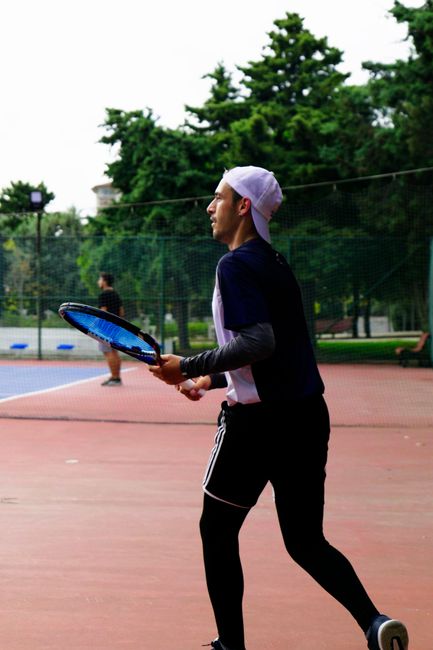
Five-all in the third, you’re serving at 30-40, and the last double fault is still ringing in your head. Nobody can walk over and help: in most tennis matches you sort it out alone, in the 25 seconds before the next serve. That is why tennis mental training matters to club players, juniors, college players and pros alike. It means practicing the skills between your ears (routines, self-talk, focus, imagery, a plan for pressure points and bad days) the same way you practice a backhand.
Quick answer: Build a short, repeatable routine for between points and use it every time, even in practice. Keep self-talk simple and about the next action, not the score. Try a few minutes of serve imagery away from the court, and decide in advance how you’ll reset after an error. Studies on these tools are encouraging but mostly small, and none can promise a win. If worry, low mood, trouble sleeping or eating, or loss of enjoyment lasts more than a couple of weeks, talk to a doctor or licensed mental health professional.
Why tennis puts so much on the player’s mind
Tennis is a sport of many short pauses. Under the ITF Rules of Tennis (2026) you get up to 25 seconds between points, up to 90 seconds when players change ends and up to 120 seconds at a set break (details on our tennis game day page). Those gaps are where a match is often won or lost mentally, because the next point starts whether or not your head is ready. A 2026 interview study of eight Czech professional players found they valued mental preparation but often did it informally and inconsistently, and named confidence, emotion control and pre-match routines as important. It is small and qualitative, so treat it as a window into players’ experience, not a prescription.
Between-point routines
A routine is a short set of steps you do the same way every time. The Exercise and Sports Science Australia (ESSA) position statement on performance under pressure (Sports Medicine, 2026) lists pre-performance routines among four strategies backed by evidence, alongside implicit attentional strategies, psychological skills training and mindfulness-based approaches. It also notes that pressure can help or hurt performance. The statement is not tennis-specific, so the exact steps below are a common coaching template, not a tested formula:
- Release: the point is over. Turn away from the net, walk to the back fence or fix your strings, whatever marks “that one’s gone.”
- Reset the body: one slow breath out, shoulders down, a drink or towel when you need it.
- Plan: choose one simple intention for the next point, such as “first serve to the body” or “deep crosscourt, then move forward.”
- Ready: your usual serve or return ritual (bounces, stance, a look at the target), then play.
- Use one or two short cues per stroke, such as “turn” or “reach,” chosen with your coach.
- Talk about the next action rather than the score or what the opponent thinks of you.
- Swap harsh labels for a corrective cue, such as “toss higher, finish the swing.”
- In 38 competitive players, six weeks of Functional Imagery Training (multisensory and goal-focused) improved serve accuracy more than single-sense visual imagery. Both beat no imagery (Rhodes and Leach, Journal of Sport and Exercise Psychology, 2026).
- In 20 skilled players, imagining the serve before hitting it improved accuracy and success rate in match-like conditions, and adding a planned breathing pattern (breathe in on the toss, forced breath out at contact) helped speed as well (Robin and colleagues, Sports Health, 2026). It was a non-randomized study.
- During the match: shrink the goal. Win this game, then this point. Use the changeover (up to 90 seconds, per the ITF rules) to breathe, drink and pick one tactic or one technical cue, not three.
- Right after: give yourself a short cooling-off period before any review. Eat, drink and sleep first; see our tennis recovery page.
- Next day: write down two things that worked, one thing to improve and one practice drill for it. Then move on.
- ITF Rules of Tennis 2026 (Rule 29, time between points, changeovers and set breaks)
- Schweickle MJ et al. Performance Under Pressure in Sport: A Position Statement from Exercise and Sports Science Australia. Sports Medicine, 2026. PMID 42271117
- Redlichová V, Novotná J, Komarc M. Mental Preparation in Professional Tennis: A Qualitative Study of Czech Players’ Experiences. Sports, 2026. PMID 42931566
- Galanis E et al. Strategic Instructional Self-Talk Intervention on Performance in a Complex Tennis Rally. Behavioral Sciences, 2026. PMID 41595028
- Rhodes J, Leach A. Functional Imagery Training and Internal Visual Imagery on Tennis Serve Performance. Journal of Sport and Exercise Psychology, 2026. PMID 41713449
- Robin N et al. Motor Imagery and Breathing and the Serve in Skilled Tennis Players. Sports Health, 2026. PMID 41263400
- Su X, Shangguan R, Chen M. Competitive trait anxiety and attentional bias in adolescent tennis players. Frontiers in Psychology, 2026. PMID 41982361
- Gao Z et al. Resilience under pressure: systematic review of coping among collegiate tennis athletes. Frontiers in Psychology, 2025. PMID 41736971
- Kazama S, Tanabe H. Pair cohesion, tactical communication and performance in doubles tennis. Frontiers in Sports and Active Living, 2026. PMID 43005256
- Harwood C, Porter K. Applying the 5Cs Framework to Elite Youth Tennis. Behavioral Sciences, 2026. PMID 41749975
- Konstantinou GN et al. The Mental Game of Tennis: A Scoping Review. Sports, 2025. PMID 40423266
- Reardon CL et al. Mental health in elite athletes: International Olympic Committee consensus statement (2026). British Journal of Sports Medicine. PMID 42580854
- 988 Suicide & Crisis Lifeline
Practice it in drills and practice sets, not only in matches. A routine you only use when you’re nervous is not yet a habit.
Self-talk: simple, instructional, in your own words
Self-talk is the running commentary in your head. In a 2026 study of 50 young beginner players from two academies, a group that used a narrow instructional self-talk plan for five weeks improved more than a control group on a multi-stroke rally test (Galanis and colleagues, Behavioral Sciences). A few ideas for your own plan:
The result applies to beginners and a specific task; it does not show that self-talk wins matches for everyone.
Focus, confidence and goals
Confidence is your belief that you can do a specific thing, such as hold serve or return a kick serve. It grows mostly from honest evidence: well-run practice, match play at the right level, and a habit of noting what worked after every match, win or lose. Goals help when you control them. A common way to split them is outcome (win the tournament), performance (get 60% of first serves in during practice sets) and process (use my routine on every point; take my full time on big points). Process goals are the ones nobody else can take from you on a bad day. This split is standard coaching practice rather than the finding of one tennis study.
Visualization and imagery for the serve
The serve is the one stroke you start yourself, which is why it is the most studied for imagery. Two recent studies, both small:
Practical version: a few minutes before bed or on the drive to the club, picture yourself serving with as many senses as you can (the sound of the ball, the feel of the grip), including a tight moment where you stay calm. Keep it short and regular. Imagery supports practice; it does not replace it.
Pressure points
Break points, set points and tiebreaks feel bigger, and the body reacts: faster heartbeat, tight arms, rushing. The ESSA statement says pressure can have both helpful and harmful effects, and that training under pressure can prepare athletes for it. In practice that can mean playing practice sets where the loser carries a small penalty, starting games at 30-40 or deuce, or finishing a drill session with a “must win” tiebreak. These are our ideas for applying pressure training, not drills the statement names.
Use your routine, especially on big points. Take the full time the rules allow (never more), choose your target, and commit to the plan rather than to the result. A 2026 study of 120 adolescent tennis players found that those with high competitive anxiety had more difficulty looking away from negative faces than low-anxiety players, a lab finding about attention, not a match-day tool. It hints that anxious thinking can pull attention toward what is going wrong, one reason to give yourself a specific task for the next point.
Handling a bad match or a bad game
Every player has days when the ball won’t go in. A 2025 systematic review of 15 studies of collegiate tennis players found that resilience and coping skills were linked to better handling of stress, anxiety and mental fatigue, and to steadier performance. (Most of the studies measure associations, so it does not prove that building resilience causes better results.) A practical approach, from general coaching practice:
The Czech professionals also described real psychological strain and said social support helped. Talking with a coach, a parent or a friend is part of the toolkit.
Tactics and doubles teamwork, only where we have a source
Which patterns to play (where to serve, when to attack the net) is a coaching question we do not cover here without a source. One related finding: in a small exploratory 2026 study of 29 collegiate doubles pairs (16 men), pairs whose members rated their social closeness quite differently had less tactical talk between points. Pairs with more tactical talk had a lower point rate, but the study said the link between the two was not statistically significant and called its models exploratory. The gentle lesson: partners should agree in advance on how they will communicate. See our tennis rules page for the basics of doubles and singles.
Match preparation
Mental preparation starts before the first ball. Write your two or three process goals on a card for your bag. For food, drink, heat and changeover logistics, use our game day page; for building the fitness that lets you think clearly in the third set, see tennis training. Pain or concussion symptoms are physical matters, not a mindset problem; start with our tennis injuries page and a medical professional.
Young players
A 2026 case study of a 30-week “5Cs” program at a British youth development center (five players, parents and two coaches) reported positive views when it was tailored to tennis and involved coaches and parents. It is small and does not mean every child needs a sport psychologist. For most juniors, fun, praise for effort and a calm car ride home do more than any technique. See our youth tennis page for ages, stages and formats.
Mental performance is not the same as mental health
Routines, imagery and self-talk are performance skills. Anxiety disorders, depression, disordered eating, burnout and thoughts of self-harm are health matters, and a routine will not treat them. The International Olympic Committee’s 2026 consensus statement on mental health in elite athletes (British Journal of Sports Medicine) describes mental health conditions as common in athletes, able to affect performance, and treatable, with many athletes continuing to compete. A 2025 scoping review of tennis research found that playing is linked to fewer depressive and anxiety symptoms, but that competitive tennis also brings high stress.
Talk to a doctor or a licensed mental health professional if you notice persistent low mood or worry, constant dread before matches, changes in sleep or eating, losing interest in a sport you loved, or exhaustion that rest doesn’t fix. In the United States, you can call or text 988 (or chat at 988lifeline.org) for the free, confidential 988 Suicide & Crisis Lifeline, 24 hours a day. If you are in immediate danger, call your local emergency number. Outside the US, use your country’s crisis line.
FAQs
How do I stop choking on big points?
No method removes nerves completely. The ESSA position statement suggests pre-performance routines, pressure training, attention strategies and mindfulness. Build a routine, practice it under mild pressure in practice sets, and give yourself a task for the point, such as a target for the serve.
What should I say to myself during a match?
Short, specific cues about the next action usually serve you better than judgments about yourself. In one study of young beginners, a five-week plan of narrow instructional self-talk improved rally performance, but it was a small study and results for other levels are unknown.
Does visualization actually help my serve?
Several small 2026 studies found better serve accuracy after imagery training. It is a reasonable, low-cost addition to practice, not a guarantee.
How do I recover mentally after a bad loss?
Rest and eat first, review with a cool head, write down what worked and one thing to fix, then return to practice. Support from a coach, family or friends helps. If the low mood or dread stays for weeks, see a professional.
Is match anxiety normal for young players?
Competitive anxiety is common among adolescent athletes. In one study of 120 players aged 14 to 18, it tended to be lower with age and experience. If it is intense or constant, talk to a pediatrician or licensed mental health professional.
Should I hire a sport psychologist?
It can help, especially if you are competing at a high level or stuck on one problem, but it is optional. For distress or illness, start with a doctor or licensed clinician.
Sources
General information for education only, not medical advice. It does not replace a doctor, psychologist or other qualified professional. See how we work in our editorial policy. Back to the tennis hub.