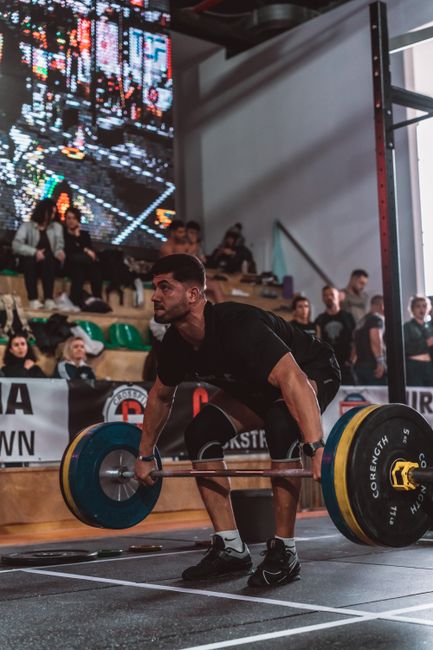
You are in the warm-up room, two lifts from your third snatch. The bar on the platform has just gone up to a weight you have only made once in training, your coach is counting attempts on the board, and your hands feel colder than they did ten minutes ago. Nothing about your technique changed in the last hour. What you do with your attention now is a skill, and it can be practiced. Mental training for weightlifters is the deliberate use of routines, cues, imagery, attempt planning and recovery habits to lift your own lift under meet pressure. It supports good lifting. It cannot promise a total.
Quick answer: Research on competitive weightlifters points to a few useful habits: a short set of cues you rehearse in training, imagery aimed at readiness rather than at thinking through technique, and attempts chosen in advance with your coach. None of these guarantees a lift. See a doctor or a licensed mental health professional, not only a coach, if worry, low mood, disordered eating or exhaustion are affecting daily life, including around a weight cut.
General information for Olympic weightlifters. Back to the weightlifting hub. How to train and peak is on our training page, and weigh-in, warm-up timing and fueling are on the meet day page. This page covers the thinking side and does not repeat them.
What lifters actually do before a meet
Weightlifting asks for complex technique under high physical and psychological demands. Researchers surveyed athletes at the 2025 USA Weightlifting American Finals before the competition began (Huebner and colleagues, Sports 2026). Of 122 lifters who used verbal cues, 39% mostly used external cues and 35% control cues, and more than half used several kinds. Confidence in that group split into three parts: performance goals, mental resilience and physical readiness. Control cues were linked with higher mental resilience and physical readiness, and promotion-focused cues with higher physical readiness. This was a one-time survey, so it shows what lifters report and how it lines up, not that any cue causes a better lift.
Attempt selection under pressure
Choosing attempts is a mental task as much as a numbers task, because the board changes, the clock runs and nerves push you toward a bigger number than you planned. A study of medalists at the IWF Senior World Championships from 2011 to 2023 looked at 3,144 individual results from 528 athletes (Erdagi and colleagues, Scientific Reports 2024). It found that success rates fell from the first attempt to the third in both lifts, that gold medalists missed a lower share of their lifts than silver or bronze medalists, and that the second and third attempts were the ones that decided medal order. That was a study of top-three finishers at a world championship, so read it as context, not as a rule for a first local meet.
What that can mean in practice, as common coaching habits rather than tested methods:
- Write the plan before the meet. Opener, second and third for each lift, with a “go up, stay, or go down” rule agreed with your coach, so the choice in the moment is a rule, not a debate with yourself.
- Let the coach own the number. Under the clock your job is the lift. Many lifters hand the call to their coach so their attention stays on the bar.
- Know the rules that shape the choice. Weight can’t be lowered once loaded, and a lifter has one minute to start, or two when following themselves. See the weightlifting rules page and the meet day page for the clock and the opener advice.
- Practice it. Run a mock meet in the gym with six planned attempts and a timer, and change a number mid-way to rehearse adapting.
When the bar feels heavy: fear of big weights
Hesitating under a weight you have missed before, or flinching on a heavy jerk, is something many lifters talk about. We did not find a weightlifting study on fear of heavy weights that we can cite, so what follows is general coaching practice, not a research result. Common approaches are to build exposure slowly with small, planned steps up in training, to keep technique drills at lighter loads so you can still feel the lift is yours, and to learn how to bail safely so a miss is not frightening. Our training page and injuries page cover practicing misses on a platform with bumper plates. A coach you trust is the best guide here. Fear that stops you from training or comes with panic is a different matter; see the health section below.
Focus and arousal control before a lift
Lifts last about a second, so the mental work happens before the bar leaves the floor. A few approaches that fit that setting:
- A short, fixed routine. Chalk, breath, one cue, go. The point is the same sequence every time, in training and at the meet.
- One or two short cues. A 2011 meta-analysis of 32 studies by Hatzigeorgiadis and colleagues found self-talk helped most on fine or novel tasks and had a smaller benefit on strength and power tasks, so treat cue words as a tool for focus, not a power-up.
- Slow breathing before the approach. A review of slow breathing (Zaccaro and colleagues, Frontiers in Human Neuroscience 2018) linked breathing under about ten breaths a minute with feeling calmer and more alert. It supports a slow breath in a routine; it does not show better lifts.
- Match your arousal to the lift. Some lifters like to be fired up and others calm. In a small 2026 study of 17 elite Vietnamese weightlifters before the 2019 Asian Championships, pre-competition anxiety and emotional regulation varied between athletes (Dinh and colleagues, Frontiers in Sports and Active Living). The authors argued for individual monitoring, so find what works for you in training, not at the meet.
Imagery: what to picture
A 2025 survey of 347 junior and under-23 weightlifters at the Turkish championships found that using imagery went along with higher motivation (Aksoy and colleagues, BMC Psychology). That is a correlation, not proof that imagery improves lifts. A 2026 experiment is more specific (Piveteau and colleagues, Human Movement Science): 120 national-level CrossFit athletes did cleans and snatches after different kinds of imagery. Imagery about getting energized or about the goal improved power and bar path compared with no imagery, while imagery of the technical details made performance worse. The authors suggest that thinking about technique right before the lift can interfere with fluid movement. These were CrossFit athletes doing weightlifting lifts, so it may not carry over to a full meet. A cautious reading is to picture the feeling of readiness and a good result, and to leave step-by-step technical thinking to practice.
After a bad miss
Missing an opener, or a lift that crashes behind you, feels loud. We did not find a weightlifting study of how lifters recover from a miss that we can cite, so this is general coaching practice. A reset many lifters use has three small steps: a breath and a physical release, such as shaking out the hands; one calm fact about what happened, such as “I was early on the pull”, often given by your coach; and a return to your normal routine with the next attempt. Save the long review for after the session, when a coach can look at video. Our training page explains why film is useful.
Goals and motivation across a season
A goal such as “total 200 kg” depends on the platform, the day and your rivals. A goal such as “run my routine on every attempt” is yours alone. Many coaches use three levels: a process goal you control, a performance goal such as an opener you are sure of, and an outcome goal such as a placing, held loosely. The Exercise and Sports Science Australia expert statement on goal setting (Swann and colleagues, Sports Medicine 2026) is a good place to read more. Progress in weightlifting can be slow, so many lifters track small signs: a cleaner pull on video, a rep that used to be heavy, a personal best in training.
Weight-class pressure is a health matter
Making weight is also a mental load, and it is not only a performance question. In a 2023 study of 39 British weightlifters, 85% had cut weight on purpose to compete (Gee and colleagues, Journal of Strength and Conditioning Research). In a 2025 analysis of what lifters said about it, irritation, hunger, fatigue, anxiety and low mood made up 72% of the comments (Gee and colleagues, Nutrition and Health). In a study of 11 international weightlifters, losing about 4% of body weight over six days did not lower lifting performance but raised stress and lowered recovery scores (Durguerian and colleagues, International Journal of Sports Medicine). That is a reason to treat the cut as a health decision. Practical steps are on our meet day page and nutrition page. The American Academy of Pediatrics advises young athletes in weight-class sports against unhealthy weight-loss methods (Carl and colleagues, Pediatrics 2017); see our youth page. If you feel trapped by your category, are skipping meals, or think about food and weight all the time, that is the point to see a doctor or sports dietitian.
Getting ready for a meet
Mentally, preparation is mostly about removing surprises: know the venue schedule, have the written attempt plan, rehearse your routine with the same shoes, belt and chalk you will use, and decide in advance how you will handle a changed board or a late warm-up call. Weigh-in, warm-up counting and food are covered on the meet day page, peaking on the training page, and ways to find meets on the leagues and associations page. Rest after the meet matters too; see recovery.
Mental performance is not mental health
Routines, imagery and cue words are performance skills. Anxiety that will not settle, low mood, loss of interest, disordered eating, constant exhaustion or burnout are health matters, not technique problems. The International Olympic Committee consensus statement on mental health in elite athletes (Reardon and colleagues, British Journal of Sports Medicine 2019) treats them as health concerns that need appropriate assessment and care. If they are affecting your sleep, school, work or relationships, talk to a doctor or a licensed mental health professional. In the United States, you can call or text 988 (the 988 Suicide and Crisis Lifeline) at any time if you or someone you know is in distress. The Association for Applied Sport Psychology lists resources on finding a sport psychology professional. Outside the US, contact your national emergency or crisis service.
Weightlifting mental training: FAQs
How do I choose attempts when I’m nervous?
Plan all six with your coach before the meet, with a simple rule for going up or staying. A study of world championship medalists found that second and third attempts decided medal order, but that is elite data. For most lifters, the plan matters more than the exact numbers.
Should I visualize my lift before I pull?
One 2026 experiment found that imagery about readiness helped power and bar path, while imagery of technical steps right before the lift made it worse. It was done with CrossFit athletes, so treat it as a lead, not a rule. Technical rehearsal fits better in practice.
How do I stop being afraid of heavy weights?
We could not find a weightlifting study to cite. Coaches commonly use small, planned jumps in training and practice bailing safely. If fear is intense, brings panic or keeps you from training, speak to a doctor or licensed mental health professional.
What should I do after missing a lift?
Many lifters use a short reset: a breath, one fact from your coach and the usual routine on the next attempt, then a longer review on video after the meet. We did not find a study specific to weightlifting.
Is stress about making weight normal?
It is common: British weightlifters in a 2023 study most often cut weight, and many described irritation, hunger, fatigue, anxiety and low mood. Common does not mean harmless. If it is affecting eating, mood or daily life, talk to a doctor or sports dietitian.
Sources
- Huebner M et al. Verbal cue use and domains of pre-competitive confidence in competitive weightlifters. Sports 2026 (PMID 42931571)
- Erdagi K et al. Analysis of successful and unsuccessful snatch and clean and jerk lifts in IWF World Championships (2011-2023). Sci Rep 2024 (PMID 39543189)
- Dinh NQ et al. Psychological characteristics of Vietnamese national weightlifting team athletes before the 2019 Asian Championships. Front Sports Act Living 2026 (PMID 42909935)
- Aksoy EBS et al. Imagery and motivation in performance sports: a psychological study on weightlifters. BMC Psychol 2025 (PMID 41131555)
- Piveteau E et al. Think positive, perform better: the detrimental effect of technical motor imagery before action. Hum Mov Sci 2026 (PMID 42335567)
- Hatzigeorgiadis A et al. Self-talk and sports performance: a meta-analysis. Perspect Psychol Sci 2011 (PMID 26167788)
- Zaccaro A et al. How breath-control can change your life: slow breathing review. Front Hum Neurosci 2018 (PMID 30245619)
- Swann C et al. Goal setting in exercise and physical activity: an expert statement for Exercise and Sports Science Australia. Sports Med 2026 (doi)
- Gee TI et al. Rapid weight loss practices within Olympic weightlifters. J Strength Cond Res 2023 (PMID 37729517)
- Gee TI et al. Perceptions and thoughts of rapid weight loss in Olympic weightlifters. Nutr Health 2025 (PMID 39665189)
- Durguerian A et al. Weight loss, performance and psychological related states in high-level weightlifters. Int J Sports Med 2016 (PMID 26701827)
- Carl RL et al. Promotion of healthy weight-control practices in young athletes. Pediatrics 2017 (PMID 28827381)
- Reardon CL et al. Mental health in elite athletes: IOC consensus statement. Br J Sports Med 2019 (doi, PMID 31097450)
- IWF Technical and Competition Rules and Regulations (competition flow)
- 988 Suicide and Crisis Lifeline (988lifeline.org)
- Association for Applied Sport Psychology resources (appliedsportpsych.org)
General information for education only, not medical advice. It does not replace a doctor, licensed mental health professional or qualified coach. See our editorial policy for how we research and write.