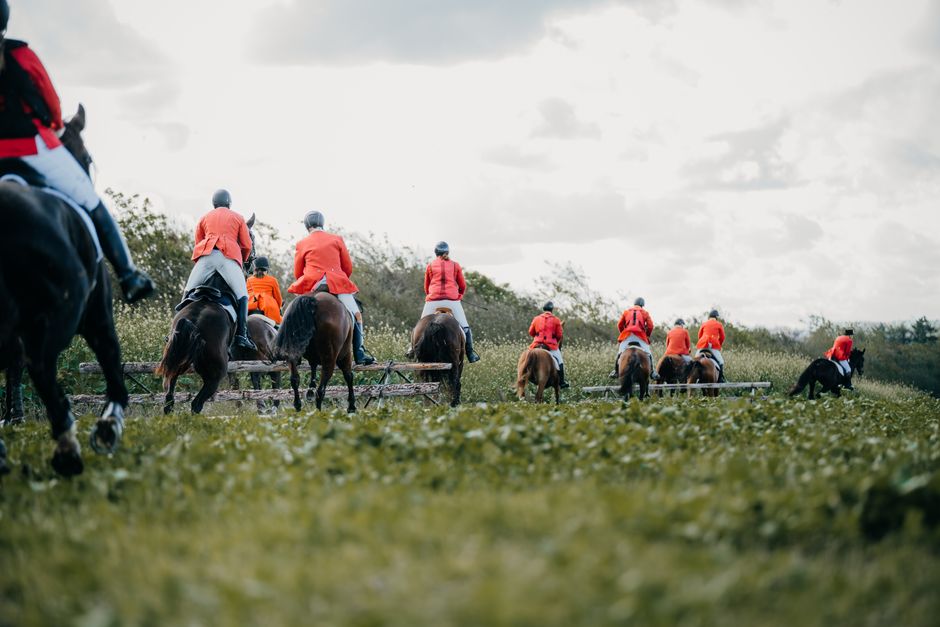
You are sitting on a horse at the in-gate. Your hands are cold, your heart is pounding, and the horse under you, who was perfectly calm in the warm-up ring, has started to dance. Or you are back in a lesson a few weeks after a fall, and the canter that used to feel like fun now feels like a question you do not want to answer. Every rider knows one of these moments. Horseback riding mental training means practicing the skills between your ears (a routine, imagery, a plan for nerves, a way to reset after a mistake) the way you practice your transitions or your lines. This page is for riders, parents and trainers, in lessons and at shows. It is about mental performance, which is different from mental health; a section below explains the difference.
Quick answer: Mental skills for riders are trainable habits: a short routine before you go in, imagery of the test or course, calm breathing and body language (your horse reads them), small goals you control, and a way to reset after a mistake or a fall. Research on these tools is promising but limited, and almost none of it is on riders, so none of it guarantees a better score. See a doctor, licensed psychologist or other qualified professional if worry, low mood or trouble eating or sleeping lasts more than a couple of weeks or gets in the way of daily life, and in a crisis call or text 988 (US).
Fear after a fall
Falls are part of the sport (see horseback riding injuries), and so is the fear that can follow one. We found no published trials on how best to rebuild a rider’s confidence after a fall, so the steps below are common coaching practice, not proven treatment.
- Get checked first. If you hit your head or your back, see a doctor before anything else. Fear that comes with a real injury is not something to ride through.
- Tell your instructor. A trainer can only change the plan if they know. Hiding the fear tends to make it bigger.
- Step back, then build up. Many instructors go back to walk and trot, a quieter horse, a lunge line or a smaller fence, and add one small challenge at a time.
- Name what you are afraid of. The canter? A spook? Jumping alone? A specific fear can be practiced in specific small steps.
- Ask whether the match is right. A horse that is too green or too strong for the rider today is a reason to change the plan, not a character flaw.
Rider fitness helps too. Feeling steadier in your seat is part of feeling safe; see our rider fitness guide.
Confidence, goals and motivation
Confidence is easier to protect than to repair. A survey of 493 female riders in the UK (Forino and colleagues, 2021, Journal of Equine Veterinary Science) found that riders who were unhappy with how their body looked were more likely to feel self-conscious when riding, and many thought judges favor smaller frames. It was a self-reported survey, so it shows how riders feel, not whether judges are biased, but it is a reminder that confidence in the saddle is not only about riding skill. Practical habits trainers often suggest: set goals you control (a steadier halt, a quieter hand, eight good transitions) rather than only ribbons or scores; keep a short note of what went well after each ride; and compare yourself with last month’s self, not with the rider in the next stall.
Show nerves: what the research shows
Nerves are normal, and they are measurable. In a small German study of six horses and their riders (von Lewinski and colleagues, 2013, The Veterinary Journal), riders’ heart rates rose from about 91 to 150 beats per minute at a public performance, compared with about 94 to 118 in an identical rehearsal without spectators, and the change was bigger in the riders than in their horses. A 2025 study of 15 horse and rider pairs at a Western stock horse event (Pennington and colleagues, Journal of Equine Veterinary Science) found that riders with higher cortisol (a stress hormone measured in saliva) before competing tended to place lower overall. That is an association in a small group, not proof that stress alone cost them the placing.
Some pressure can also help. A 2026 position statement from Exercise and Sports Science Australia (Schweickle and colleagues, Sports Medicine) says pressure can have both helpful and harmful effects on performance, and lists pre-performance routines, attentional strategies, psychological skills training and mindfulness-based approaches as evidence-based tools. For the practical side of a show day (food, water, heat, the first aid kit), see horse show day, which also covers breathing for nerves.
Your state and your horse
Riding is the one sport where your teammate is a different species, and one that notices a lot. A 2025 pilot study (Manolachescu and colleagues, Open Veterinary Journal) had anxious and calm people interact with horses on the ground and measured the horses’ heart rate variability and behavior. Horses showed stronger responses when anxious people moved freely than when anxious people used neutral, restricted body language, which led the authors to conclude that horses respond to the body language that goes with anxiety rather than to the stress itself. It was a small ground-handling study with 33 interactions, not a ridden one, so treat it as a pointer.
The practical lesson matches what good trainers teach: slow your breathing, soften your shoulders and hands, and let your body language be calm and steady before you ask the horse for anything. Also learn your horse’s signals. A 2019 survey of equestrians (Bell and colleagues, Animals) found that signs of distress in horses were often missed, and that owning a horse did not by itself make people better at spotting them. Knowing when your horse is tense, tired or in pain is part of riding well, and part of staying safe.
Routines and imagery for dressage and jumping
A pre-ride routine gives your mind a job to do instead of worrying: the same tack check, the same warm-up pattern, the same breath at the in-gate. The ESSA statement above names routines as one of the evidence-based tools. Practice yours at home and in lessons so it is automatic at a show, and keep it the same length whatever the class.
Imagery means rehearsing the test or course in your mind, using as many senses as you can: the rhythm of the canter, the feel of the reins, the sound of the judge’s bell. A 2023 systematic review and meta-analysis across sports (Reinebo and colleagues, Sports Medicine) found moderate effects for imagery, psychological skills training and mindfulness-based approaches, but the effects were no longer significant once weaker studies were removed. A small study of 21 skiers and 16 riders (Louis and colleagues, 2012, Research Quarterly for Exercise and Sport) asked athletes to imagine a course and predict how long it would take: expert skiers were accurate, but novice skiers and both novice and expert riders underestimated the real time. For dressage, that suggests imagery is best used to rehearse the feel and order of the movements; for show jumping, to rehearse the line and your plan for the turns, without trusting your mental clock. See the discipline pages on dressage and show jumping, and eventing, which combines both with cross-country.
After a mistake: resetting
A missed lead change, a rail down or a refusal is part of riding. Common coaching practice (not a tested protocol for riders) is a short reset: one breath, a cue word, and then the next movement or fence, saving the review for after the class. Practice it in lessons by making a deliberate small mistake in a schooling session and carrying on. Afterwards, write down one thing to keep and one thing to fix, and talk it over with your trainer. See also riding recovery for rest between show days.
Young riders and parents
We found no horse-sport-specific trials on mental skills in children, so this is general guidance. Keep the focus on fun, effort and learning, make sure a young rider’s pony or horse is a safe match for their level, and avoid pushing a frightened child over a fence to prove a point. See youth riding for more.
Mental performance is not mental health
Routines, imagery and goal setting are performance skills. Anxiety that will not ease, depression, panic, disordered eating, burnout or trauma after a serious fall are health matters. The 2026 International Olympic Committee consensus statement on mental health in elite athletes (Reardon and colleagues, British Journal of Sports Medicine) says mental health symptoms are common among elite athletes, can affect performance, and that treatment may include psychotherapy, medication and other approaches, with many athletes able to keep competing with support. These belong with a doctor, licensed psychologist or counselor, not with a mental training article. If you are in crisis in the US, call or text the 988 Suicide & Crisis Lifeline.
Mental training: FAQs
How do I get my confidence back after a fall?
First make sure you are physically okay. Then work with your instructor to step back to what feels safe and add small challenges. We found no trials proving one method, so this is common coaching practice. If fear stays strong or you have nightmares or panic, talk to a doctor or psychologist.
Does my horse really feel my nerves?
Possibly through your body language. A 2025 pilot study found horses responded more when anxious handlers moved freely than when they used neutral body language. It was small and done on the ground, so it is a pointer, not a rule.
Are show nerves bad for my score?
Not always. The ESSA position statement says pressure can help or hurt performance. One small Western event study linked higher rider cortisol before competing with lower placings, but that does not prove cause.
Does visualization work for riders?
Across sports, imagery has shown moderate effects, but the evidence is not stable and few studies are on riders. Use it as an add-on to real riding, and do not trust it to tell you how long a course will take.
What is the difference between mental training and mental health care?
Mental training builds performance skills such as routines and focus. Mental health care treats conditions like anxiety disorders or depression and comes from qualified professionals.
Sources
- von Lewinski and colleagues, 2013, The Veterinary Journal, cortisol and heart rate in horse and rider: PubMed 23380228
- Pennington and colleagues, 2025, Journal of Equine Veterinary Science, salivary cortisol in western performance horses and riders: PubMed 41274429
- Manolachescu and colleagues, 2025, Open Veterinary Journal, emotional contagion in human-horse interactions: PubMed 41630745
- Bell and colleagues, 2019, Animals, recognition of equine affective states: PubMed 31835886
- Forino and colleagues, 2021, Journal of Equine Veterinary Science, body image in female equestrians: PubMed 34802624
- Louis and colleagues, 2012, Research Quarterly for Exercise and Sport, motor imagery time in skiers and riders: PubMed 22428415
- Reinebo and colleagues, 2023, Sports Medicine, psychological interventions meta-analysis: PubMed 37812334
- Schweickle and colleagues, 2026, Sports Medicine, ESSA position statement on performance under pressure: PubMed 42271117
- Reardon and colleagues, 2026, British Journal of Sports Medicine, IOC consensus statement on mental health in elite athletes: PubMed 42580854
- 988 Suicide & Crisis Lifeline: 988lifeline.org
General information for education only, not medical advice. It does not replace a doctor, psychologist or other qualified professional. See how we work in our editorial policy. Back to the horseback riding hub.