This article contains affiliate links: if you buy through them we may earn a commission, at no extra cost to you. Read our affiliate disclosure.
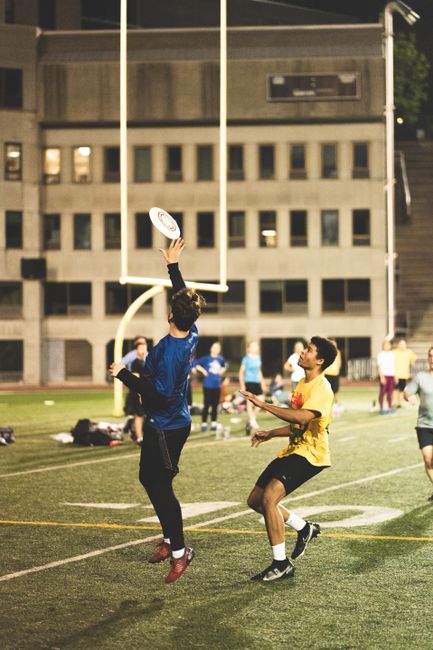
Game five of a tournament weekend, universe point, and a cutter breaks hard for the sideline. She plants her right foot on a patch of worn grass, the defender is a step behind, the disc is already in the air, and everyone is running on legs that played four games yesterday. Nobody is thinking about injury risk in that second, which is exactly why the work happens earlier: in the warm-up, the Tuesday strength session, the cleats you picked and the water you drank at 9 a.m. Injury prevention in ultimate frisbee means the habits and set-ups that lower the chance a player gets hurt, without ever taking it to zero.
Quick answer: Ultimate is officially a non-contact sport, yet players still sprint, cut, jump and dive, and most injuries hit the legs. The best-supported steps are a jump, landing and balance warm-up, Nordic hamstring curls, regular strength training, raising your training load slowly, sensible tournament breaks and heat precautions, and removing anyone with a suspected head injury from play. See a sports medicine doctor, physical therapist or athletic trainer if a knee pops or swells, an ankle keeps giving way, pain stops you playing, or you may have a concussion, and call 911 for concussion danger signs or heat stroke.
General information, not medical advice. This page is about lowering risk. For what each ultimate injury looks like, see our ultimate frisbee injuries guide. Back to the ultimate frisbee hub.
What you are preventing
USA Ultimate’s rules call the game “a non-contact, self-officiated disc sport,” but a 2020 systematic review of 11 studies (Fajardo Pulido and Lystad, Sports) found the lower limb was the most injured region, and that direct contact with another player was the most common injury situation. In the first injury study of professional ultimate (Hess et al., Journal of Athletic Training, 2020), 72% of 299 injuries were to the lower body, and thigh muscle strains and ankle sprains led the list. So the plan below goes after ankles, knees, hamstrings and collisions first. A 2026 review (Chen et al., Frontiers in Sports and Active Living) adds a caution: prevention trials in ultimate itself are scarce, so most advice is borrowed from other cutting sports.
Warm up the way published programs do
Jump, land, cut and balance drills before play are the best-supported tool for cutting sports. A summary of eight meta-analyses (Webster and Hewett, 2018) found that neuromuscular training programs cut ACL injuries by about half overall and non-contact ACL injuries in female athletes by about two-thirds. Those programs, of which FIFA 11+ is the best known, mix running, strength, jumping and landing, and balance. In a small 2025 trial of Iranian national-team ultimate players with unstable ankles, eight weeks of a modified FIFA 11+ improved balance, ankle position sense and jumping (Sharifi et al.).
For a game day, that means a proper warm-up before the first pull, even on a cold early morning, rather than a few throws and a stretch. Our training page shows how to build it into a week.
Technique: cutting, landing, layouts and looking up
- Cut and land with control. AAOS explains that most ACL tears happen without contact, when an athlete pivots, cuts or lands with the knee nearly straight. Motion-sensor research on women’s ultimate players (Slaughter and Adamczyk, 2020, 422 cuts) found that more competitive teams cut with higher speed and less knee bend, which the authors said may be higher-risk cutting. Practice decelerating and “sticking” landings with the knee bent.
- Look before you leave the ground. USA Ultimate’s rules list running without looking, jumping where a significant collision is likely and initiating contact with a player’s head as dangerous play. Calling “up” and tracking the other player, not just the disc, is prevention.
- Learn layouts from a coach. The rules name diving around or through a player, resulting in contact with a back or legs, as dangerous play. USA Ultimate’s youth adaptations recommend no defensive layouts for under-12s and layouts without contact for under-15s.
- Watch the throwing shoulder. In German national-team men, the throwing shoulder had less internal rotation range than the other side (Koeble and Seiberl, 2021); the researchers advised stretching and monitoring.
Build training load slowly
USA Ultimate’s athlete health and safety packet suggests raising workouts by no more than 10% a week and resting at least one day a week. It also warns that muscle strains that are not fully rehabilitated are likely to become chronic problems. A study of competitive players (Doma et al., 2021) found sprint and jump performance still reduced 48 hours after one hard combined plyometric and weights session, so the authors suggested allowing at least 48 hours before the next hard field session. Tournaments add load: in a Hong Kong study (Pang et al., 2021), injury risk was higher at tournaments than in training.
Strength and conditioning that has evidence behind it
- Nordic hamstring curls. A 2019 meta-analysis of 8,459 athletes (van Dyk et al.) found programs that include them cut hamstring injuries by up to 51%. Researchers surveying elite club ultimate players suggested them for the sport. AAOS links hamstring strains to sprinting, fatigue and tight or weak muscles.
- Regular lifting. In a survey of elite club players (Khoo et al., 2021), more days a week of weight training went with less time missed to injury. That is an association, not proof.
- Ankle balance work. The NATA position statement on ankle sprains says a previous sprain is the most consistent risk factor and recommends a balance training program of at least three months.
Recovery matters too: the American Academy of Pediatrics advises youth athletes to take at least one to two days a week off their main sport.
Fields, heat and tournament weekends
Heat. USA Ultimate’s 2025 heat guidelines use the wet bulb globe temperature (WBGT). From 82.0 to 86.9 F there is a hydration break each half; from 87.0 to 89.9 F longer breaks, an extra minute between points and a shorter game cap; at 90 F or higher play is cancelled. NATA says athletes should acclimatize to heat over 7 to 14 days. USA Ultimate lists unusual fatigue, nausea, headache, dizziness, vomiting or chills as heat illness symptoms (rest in shade, take fluids, no return for at least 2 hours); confusion, loss of coordination or collapse can mean exertional heat stroke, an emergency where you call 911. NATA says to cool first and transport second, and names cold-water immersion as the most effective method. Fuel and fluid plans for the weekend are on our game day page.
Sun. The American Academy of Dermatology recommends a broad-spectrum, water-resistant sunscreen of SPF 30 or higher, reapplied every two hours and after sweating.
Lightning. USA Ultimate’s organizer requirements suspend play if thunder is heard or lightning strikes within 10 miles, with shelter in a building or a hard-top enclosed vehicle and a wait of at least 30 minutes after the last thunder or strike.
Fields and games per day. The rules call for flexible, brightly colored cones at field corners. Youth events cap teams at 3 full-length games a day and 6 a weekend, according to USA Ultimate.
Concussion: collisions happen
In a survey of 787 competitive US players (Lazar et al., 2018), about a quarter of men and women reported at least one concussion in ultimate, and many said they had returned to the same game or practice. Prevention here is mostly awareness and the rule that a suspected concussion ends the day. USA Ultimate requires the CDC HEADS UP Concussion Action Plan, and the CDC’s message is “When in doubt, sit them out.” In a self-officiated game, captains and teammates have to make that call. USA Ultimate says no same-day return and see a doctor for every concussion; a licensed health care provider decides when a player returns. Call 911 for danger signs such as a worsening headache, repeated vomiting, slurred speech, seizures or growing confusion. Signs and steps are on our injuries page.
Cleats, braces and gear
Verified standards. Under USA Ultimate’s 2026-2027 rules, braces, casts and guards are allowed if hard or sharp parts are covered and padded, and cleats with dangerous parts, such as metal baseball cleats, are not allowed. Beach ultimate has its own rule that shoes and cleats are not allowed. Players can wear soft clothing that does not endanger others.
Fit and judgment. NATA recommends that athletes who have sprained an ankle before brace or tape for practice and games. There is no ultimate-specific trial showing that a given cleat or brace prevents injury, so treat gear as support, not protection, and ask a physical therapist or athletic trainer what suits your history. Choose cleats that fit snugly at the heel with room for the toes, and replace pairs with worn or sharp studs. Our gear page covers the rest. Items many players keep in the bag are below; specs are the maker’s claims.

ASO EVO Ankle Stabilizer
- Lace-up with figure-8 straps
- Fits left or right foot
- Low profile, fits in cleats

NordStick Nordic Hamstring Curl Strap
- Holds heels for Nordic curls
- 350 lb capacity (listing)
- Packs for travel

Blue Lizard Sport Mineral SPF 50
- Zinc oxide and titanium dioxide
- 80 min water resistant (maker)
- 3.0 fl oz
$8.97 at Amazon, as of Nov 17, 2026 02:07 UTC
Check price on AmazonKids and teens
USA Ultimate’s youth adaptations recommend smaller fields and fewer players for under-12 and under-15 games. Its packet notes that children are more likely to suffer heat illness because they tend to drink less and absorb more heat, and says a youth player who limps or complains of pain should stay out until evaluated by a specialist in youth athletes. The AAP recommends playing several sports before puberty and taking at least three months off a year in one-month blocks. More is on our youth ultimate page.
What prevention cannot do
None of this guarantees you will not get hurt. A warm-up lowers risk in studies, it does not remove it, and a collision on a jump ball can happen to the best-prepared player. A brace is not rehab, and feeling fine after a hit does not rule out a concussion.
When to see a professional
- Call 911 or go to the ER: any concussion danger sign, a possible neck injury, signs of heat stroke, a possible broken bone, a joint that looks out of place.
- Within a day or two: a knee that pops and swells, locks or feels unstable; a suspected concussion; a muscle strain that stopped you playing; an ankle that keeps giving way.
- Within a week: USA Ultimate’s packet says bruising or swelling around a finger, wrist or joint should be checked, because a fracture can look like a sprain.
Ultimate frisbee injury prevention: FAQs
Does a warm-up really help in ultimate?
Published neuromuscular programs lower ACL injury rates in cutting sports, and a modified FIFA 11+ improved balance and jumping in ultimate national-team players with unstable ankles.
Should I wear an ankle brace for ultimate?
NATA recommends a brace or tape for practices and games if you have sprained an ankle before. Balance training is the first-line step for everyone, and USA Ultimate’s rules allow braces whose hard parts are padded. Your athletic trainer or PT can help you choose.
How do I protect my hamstrings?
Nordic hamstring curls are the best-supported exercise: a 2019 meta-analysis found up to 51% fewer hamstring injuries. Build up gradually, and fully rehab any strain, since USA Ultimate warns untreated strains can become chronic.
How much should I increase training each week?
USA Ultimate’s packet suggests no more than 10% a week and at least one rest day a week. It is a rule of thumb.
What do I do about heat at a tournament?
Follow the event’s WBGT rules, acclimatize over 7 to 14 days where you can, drink to thirst, rest in shade, and call 911 for confusion, loss of coordination or collapse.
Can I play on after a hard collision if I feel fine?
If a concussion is suspected, no. USA Ultimate follows the CDC: remove the player, no same-day return, and see a doctor.
Sources
- USA Ultimate, 2026-2027 Official Rules of Ultimate
- USA Ultimate Athlete Health and Safety Packet
- USA Ultimate Athlete Safety page
- USA Ultimate Heat and Air Quality Guidelines (2025)
- USA Ultimate Organizer Health and Safety Requirements
- Fajardo Pulido and Lystad 2020, injuries in ultimate, systematic review
- Hess et al. 2020, professional ultimate injuries
- Chen et al. 2026, ultimate injury review
- Pang et al. 2021, injuries in Hong Kong ultimate
- Palmer et al. 2022, physical demands of elite women’s ultimate
- Slaughter and Adamczyk 2020, cutting in women’s ultimate
- Khoo et al. 2021, elite club ultimate injuries
- Sharifi et al. 2025, modified FIFA 11+ in ultimate players
- Doma et al. 2021, plyometric and resistance session recovery
- Koeble and Seiberl 2021, shoulder adaptations in elite ultimate players
- Lazar et al. 2018, concussion prevalence in ultimate
- Webster and Hewett 2018, ACL prevention meta-analyses
- van Dyk et al. 2019, hamstring prevention meta-analysis
- NATA position statement on ankle sprains (Kaminski 2013)
- NATA position statement on exertional heat illnesses (Casa 2015)
- AAOS OrthoInfo, ACL injuries
- AAOS OrthoInfo, hamstring muscle injuries
- CDC HEADS UP coaches fact sheet
- American Academy of Dermatology, how to apply sunscreen
- AAP clinical report, Brenner 2016, sports specialization
General information for education only, not medical advice. It does not replace a visit with a doctor, physical therapist or athletic trainer. See how we write and check our pages in our editorial policy.