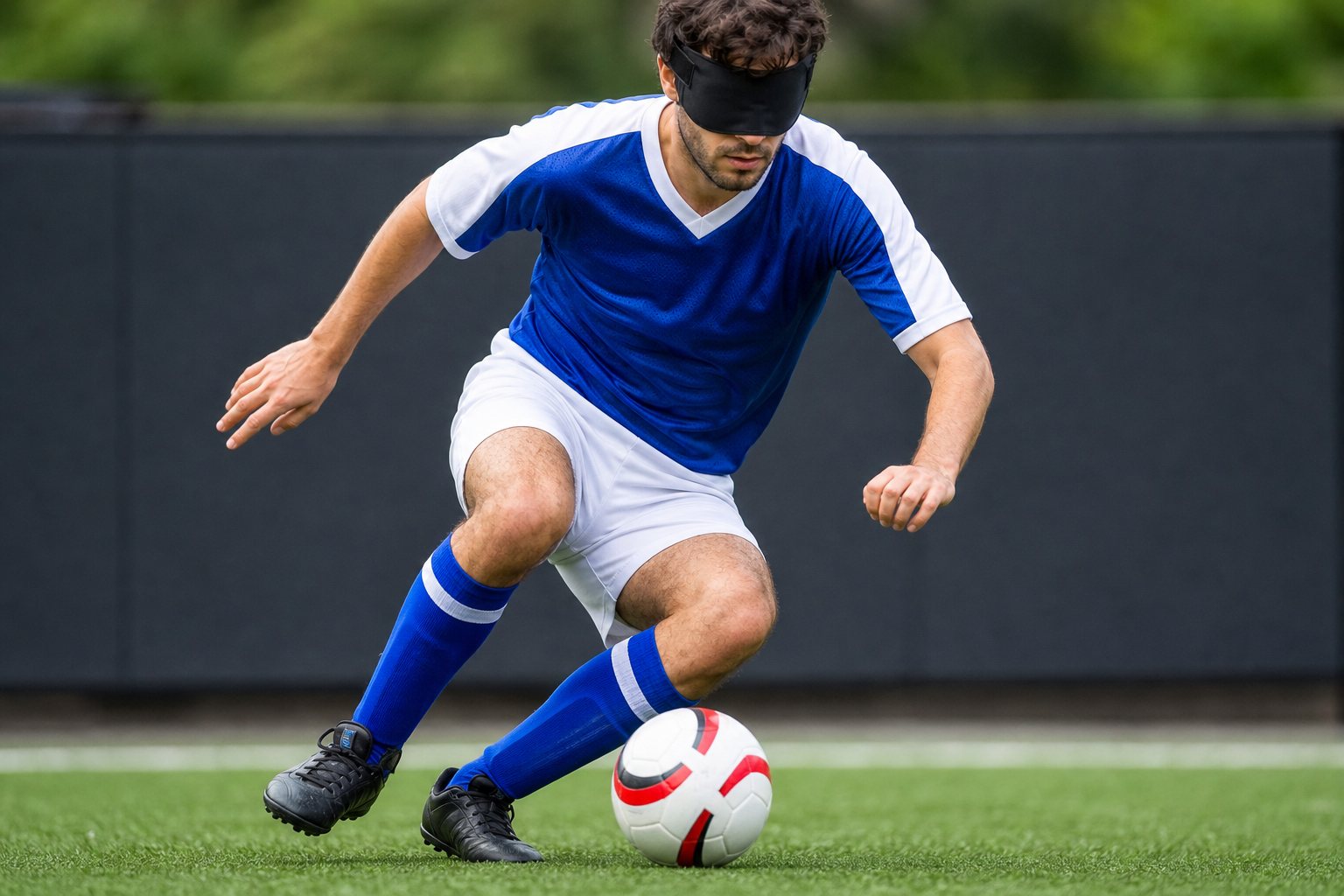
The whistle blows, a player is down, and the room goes very quiet for a different reason. In a sport where nobody sees a collision coming, the first job after a knock is the same as in any sport: stop, check, and get the right person to look. This page explains the injury patterns researchers have counted in blind football, what concussion care looks like, and general rehabilitation principles. It is general information, not a diagnosis; how to lower the risk in the first place is on our injury prevention page, and the sport overview is in the blind football hub.
Quick answer: Research on three Paralympic Games found that lower-limb injuries were the most common in blind football, followed by head, face and neck injuries, and that direct contact was the main cause. Concussion is suspected to be under-recognized. After any head knock, stop play and see a healthcare provider. See a sports medicine doctor, physical therapist or athletic trainer for any injury that does not settle, and call emergency services for danger signs.
What the numbers show
A 2026 analysis in the Journal of Science and Medicine in Sport covered blind football at London 2012, Rio 2016 and Tokyo 2020. It reported 60 injuries in 49 athletes, an incidence of 21.5 per 1,000 athlete days. The lower limb had the highest incidence (11.0 per 1,000 athlete days) and the head, face and neck came next (4.4). Most injuries were sudden, direct contact accounted for 56%, and 61% caused no time loss. At Paris 2024, a 2026 report in the British Journal of Sports Medicine put football 5-a-side at 22.3 injuries per 1,000 athlete days, higher than most sports there. These are elite tournament figures; there are no comparable numbers for school or club play that we could find.
Lower-limb injuries
Because lower-limb injuries lead the figures, the familiar football injuries apply. The papers above do not break the numbers down by diagnosis in the pages we read, so what follows is general information from orthopedic and athletic training sources.
- Ankle sprains. The American Academy of Orthopaedic Surgeons (AAOS) says an ankle sprain happens when the ligaments are stretched past their limits, and names cutting and jumping sports as common settings. The National Athletic Trainers’ Association (NATA) position statement says athletes with a previous sprain should use a brace or tape for practices and games, and recommends a balance and neuromuscular program of at least three months.
- Muscle strains. Sprinting and sudden changes of direction are the usual setting. AAOS describes hamstring injuries as typically a sudden sharp pain at the back of the thigh, with swelling and bruising that can follow.
- Shin pain. AAOS says shin splints are linked to a sudden increase in how often, how long or how hard you train; if it does not improve, a doctor may check for a stress fracture.
- Bruises and contusions. Contact with boards, balls and other players causes many minor injuries; the 61% of injuries with no time loss in the Paralympic data fits this picture.
For ways to avoid these see the soccer injuries page, bearing in mind that blind football has its own collision pattern.
Head injuries and concussion
This is the most important part of the page. Head, face and neck injuries were the second-highest group in the Paralympic analysis. The 2026 authors report no confirmed concussions among the injuries but say concussion is suspected in blind football despite low recognition and reporting. A 2024 narrative review found that athletes with vision impairment may be more likely to sustain concussion than non-disabled athletes and athletes with other impairments, with no good incidence numbers.
The CDC’s HEADS UP steps for any sport are to recognize the signs, remove the player from play and have a healthcare provider decide when it is safe to return. Signs include headache, dizziness, confusion and balance problems. Danger signs, such as repeated vomiting, a seizure or worsening confusion, need a 911 call. The Amsterdam 2022 consensus statement on concussion in sport and the American Medical Society for Sports Medicine (AMSSM) say there is no same-day return to play, and return should be directed by a licensed provider. IBSA also has a temporary concussion substitution rule at its official blind and partially sighted football competitions since 1 January 2021, under which a suspected player leaves the pitch for assessment and can be replaced.
Because concussion is under-recognized in this sport, teammates, coaches and guides should watch for changes in behavior, balance and responsiveness, and the person assessing should know the sport and the player.
General rehabilitation principles
We do not give plans or timelines, because they depend on the injury and the person. The general principles in athletic-training and orthopedic guidance are:
- Get it assessed. A professional decides what the injury is and what is safe.
- Early, pain-guided movement. Rest is often short; guided exercise usually replaces long inactivity, as the professional directs.
- Rebuild strength and balance. NATA’s ankle guidance is an example: structured balance and strength work, not only waiting.
- Return in steps. Most plans go from walking to jogging, sprinting, cutting, team training and games, and only when each step causes no pain or swelling, as directed by a clinician.
- Do not rush. A previous injury is a risk factor for the next one.
There is no universal recovery time, and we do not clear anyone to play. Vision impairment adds practical needs, such as a familiar and clear rehab space and a guide for movement tasks. Ask your clinician to include these, and see recovery for everyday routines.
When to see a professional
Go to a sports medicine doctor, physical therapist or athletic trainer for sudden pain, swelling, an injury that will not bear weight, pain at rest or at night, symptoms after a head knock, or any injury that does not settle. Call 911 for a head injury with danger signs, heavy bleeding or loss of consciousness. A para sport-experienced clinician is ideal; USABA or your national federation may be able to point to one.
Blind football injuries FAQs
What injuries are most common?
In the three-Games Paralympic analysis, lower-limb injuries were the most common, followed by head, face and neck. Direct contact was the main cause.
Is concussion common in blind football?
No confirmed concussions were reported in that analysis, but the authors suspect they are under-recognized. A 2024 review also found athletes with vision impairment may be more likely to sustain concussion.
Can I keep playing after a head knock?
No. The CDC’s HEADS UP guidance says to remove the player from play and have a healthcare provider decide when return is safe.
How long does an ankle sprain take to heal?
It varies; we do not give a time. Ask your clinician, who will base return on function, not the calendar.
Do injuries in blind football differ from sighted football?
Contact is a bigger factor, since players cannot see collisions coming. The sports share many lower-limb injuries.
Sources
- Injury patterns in blind football at three Paralympic Games, J Sci Med Sport 2026
- Injury and illness at the Paris 2024 Paralympic Games, Br J Sports Med 2026
- Concussion in para sport for athletes with vision impairment, 2024
- CDC HEADS UP: responding to a concussion
- CDC HEADS UP: signs and symptoms
- Patricios et al., consensus statement on concussion in sport, Amsterdam 2022, Br J Sports Med 2023
- IBSA: blind football temporary concussion substitution policy (PDF)
- AAOS OrthoInfo: sprained ankle
- AAOS OrthoInfo: hamstring muscle injuries
- AAOS OrthoInfo: shin splints
- NATA position statement: conservative management and prevention of ankle sprains, 2013
General information for education only, not medical advice. It does not replace a visit with a doctor, physical therapist or athletic trainer. See how we write and check our pages in our editorial policy.