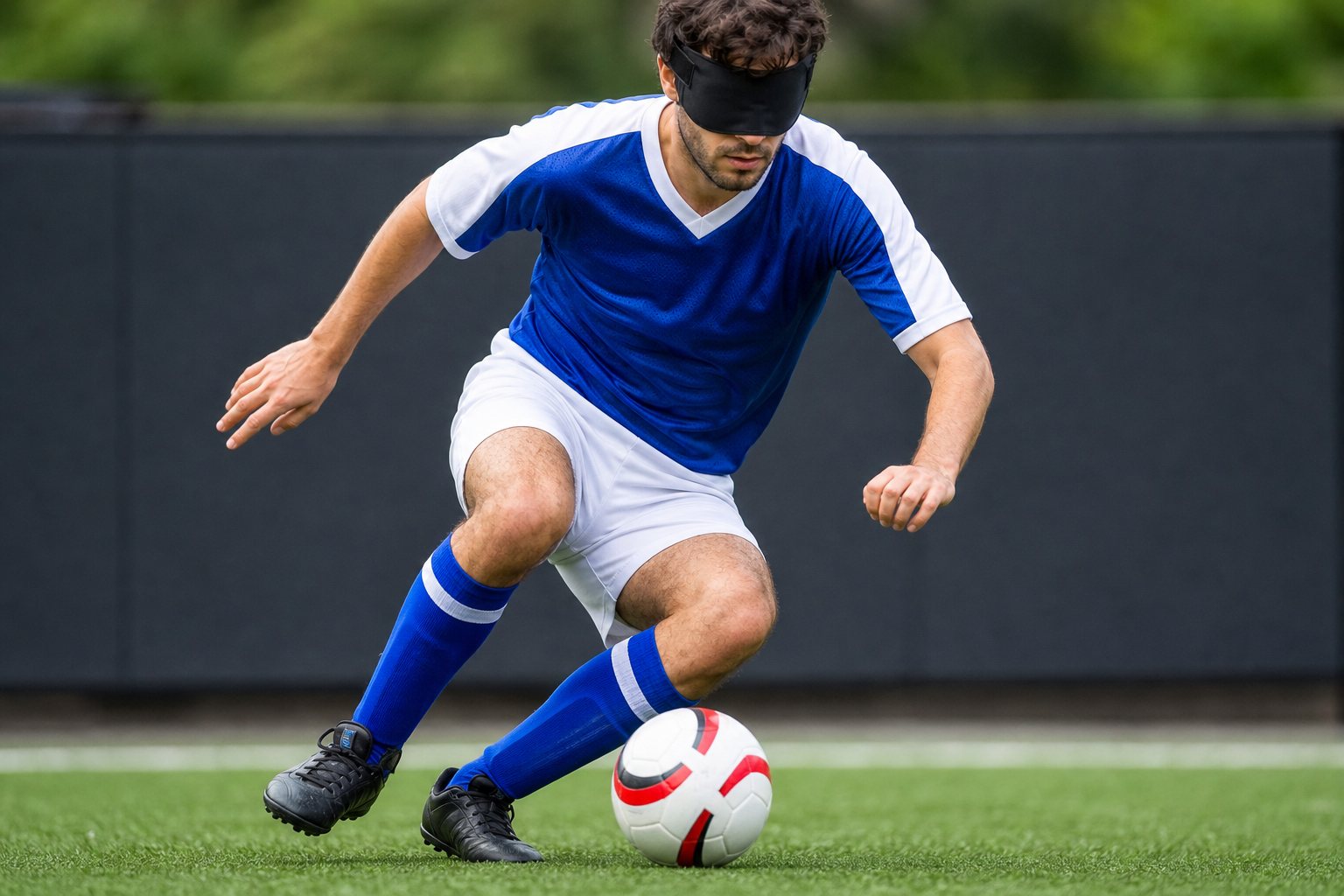
It is the last minute of a tied match, the crowd has gone silent, and the only information a player has is sound: a rattling ball, a teammate’s “voy,” a guide’s voice behind the goal. Concentration here is not a slogan. Mental training in blind football means practising the psychological skills that support performance: attention, confidence, routines, imagery, communication and handling pressure. It is different from mental health care, which has its own section below. The sport overview is in our blind football hub.
Quick answer: Mental skills that are widely taught in sport include a short pre-match routine, calm breathing, simple cue words, imagery and a plan for what to do after a mistake. In blind football, trust and clear communication matter as much as individual focus. Research on blind and visually impaired athletes is small, so these are sensible practices, not promises of better results. Anxiety, low mood, disordered eating or burnout are health matters: talk to a doctor or mental-health professional, and in the US call or text 988 in a crisis.
What is different about the mental side of blind football
Outfield players rely on hearing, memory of the pitch and the words of others. That changes what mental training means:
- Attention is auditory. Players need to pick the ball, the “voy” calls and the guide out of a noisy environment (even though spectators are asked to stay quiet until a goal, according to Paralympic.org).
- Trust is part of tactics. The US head coach quoted by Paralympic.org says players compete “for each other.” Players depend on the goalkeeper’s instructions and the guide’s information, so team cohesion is a performance skill.
- Communication has to be exact. The US coach also says guiding needs detailed descriptions, and that players should not be steered like a joystick, which asks for patience from both sides.
A small amount of published work on visually impaired athletes exists. A 2003 qualitative study by Eddy and Mellalieu in Adapted Physical Activity Quarterly interviewed six elite goalball athletes and concluded that visual impairment does not restrict the ability to use mental imagery and that psychological interventions can be extended to use all of the athlete’s senses. It is a small sample from another sport, so it is encouraging, not conclusive.
Confidence and motivation
Confidence comes mainly from preparation and from evidence in your own training: the passes you completed, the saves you made, the matches you got through. Sport psychologists often suggest keeping a simple log of what went well. Motivation tends to be steadier when goals are about what you control, such as listening, communicating and first touch, than when they are only about results. We did not find blind-football-specific studies on confidence or motivation, so the points here are general guidance.
Goal setting
Set goals in three layers: an outcome (a place in a tournament), a performance goal (pass accuracy or fewer lost balls in drills) and process goals (call “voy” every time, scan with the head toward the sound). Write them down, share them with a coach, and review them every few weeks. Keep a few of them linked to health habits like sleep and fueling; see recovery.
Focus and imagery
Imagery means rehearsing a movement or a situation in the mind. The goalball study above suggests players with severe vision loss can use it, drawing on sound, touch, movement and feeling instead of only pictures. For a blind football player this might be the sound of the ball arriving, the feel of the turn and the guide’s voice before a shot. Keep sessions short (a few minutes) and always use it alongside real practice, not in place of it.
Focus can be trained with the same listening drills used for skills; see training. A cue word such as “listen” or “calm” can bring attention back after a distraction, and slow breathing before kick-off can help settle nerves. These are commonly used practices; we found no blind-football trials of them.
Pre-match routine
A routine is a fixed order of small steps that gets you ready and gives you something to control. A simple version: check kit and eyeshades, a short warm-up, a quiet minute with breathing, a recap of your two process goals, and a team huddle. Practise it at training so that it is familiar on tournament days, when travel, unfamiliar venues and long waits can unsettle a player. Logistics help: arrive early to learn the layout, with a guide or teammate.
Pressure and setbacks
Pressure can come from a close score, a penalty shootout or the knowledge that selection is on the line. Ideas used by many athletes: breathe out slowly, narrow your attention to the next sound or action, and use your cue word. For mistakes, use a short reset routine: acknowledge, breathe, talk to a teammate, back to the next play. A conceded goal is also a chance to speak up for each other; the sport rewards this.
Setbacks such as missing selection or an injury are normal. Talk to your coach about what is in your control, and set a small goal for the next week. Injury and rehab have their own page: blind football injuries.
Decision-making, tactics and teamwork
Decisions in blind football are made from sound and memory: where the ball is, who is calling and where the goal is. Team habits help: one clear voice at a time, short and agreed words, and a goalkeeper who sets the line for defenders. Players can practise these in small-sided games and then review them with a coach after matches.
Mental health is different from mental performance
Mental skills training does not treat anxiety, depression, disordered eating or burnout. These are health matters for a qualified professional, such as a doctor, psychologist or counselor. Warning signs include low mood that lasts, constant worry, sleep problems, withdrawal, big changes in eating or training, or thoughts of self-harm. In the US, call or text 988, the Suicide & Crisis Lifeline, and call 911 in an emergency. The International Olympic Committee’s consensus statement on mental health in elite athletes (Reardon and colleagues, 2019) is a good starting point for coaches and parents who want to know more. Para athletes can also ask their national federation or USABA about support.
Blind football mental training FAQs
Can people who are blind use imagery?
A small study of elite goalball athletes concluded that visual impairment does not restrict the use of imagery and that it can draw on other senses.
How do I stay calm before a penalty or shootout?
Many athletes use slow breathing, a cue word and a fixed routine. These are widely taught but have not been tested in blind football as far as we found.
Does trust really matter that much?
In a sport where communication replaces sight, it is central. The US coach says players compete “for each other.”
What if I get very nervous?
Some nerves are normal. If worry or low mood is constant or stops you from enjoying the sport, talk to a doctor or mental-health professional.
Where do I get help in the US?
Call or text 988 in a crisis. For ongoing support, start with your doctor and ask USABA about resources.
Sources
- Eddy and Mellalieu, mental imagery in athletes with visual impairments, Adapted Physical Activity Quarterly 2003
- Paralympic.org: US blind football team prepares for LA28
- Paralympic.org: blind football
- Reardon et al., IOC consensus statement on mental health in elite athletes, Br J Sports Med 2019
- 988 Suicide & Crisis Lifeline
- USABA: blind soccer
General information for education only, not medical advice. It does not replace a visit with a doctor, physical therapist or athletic trainer. See how we write and check our pages in our editorial policy.