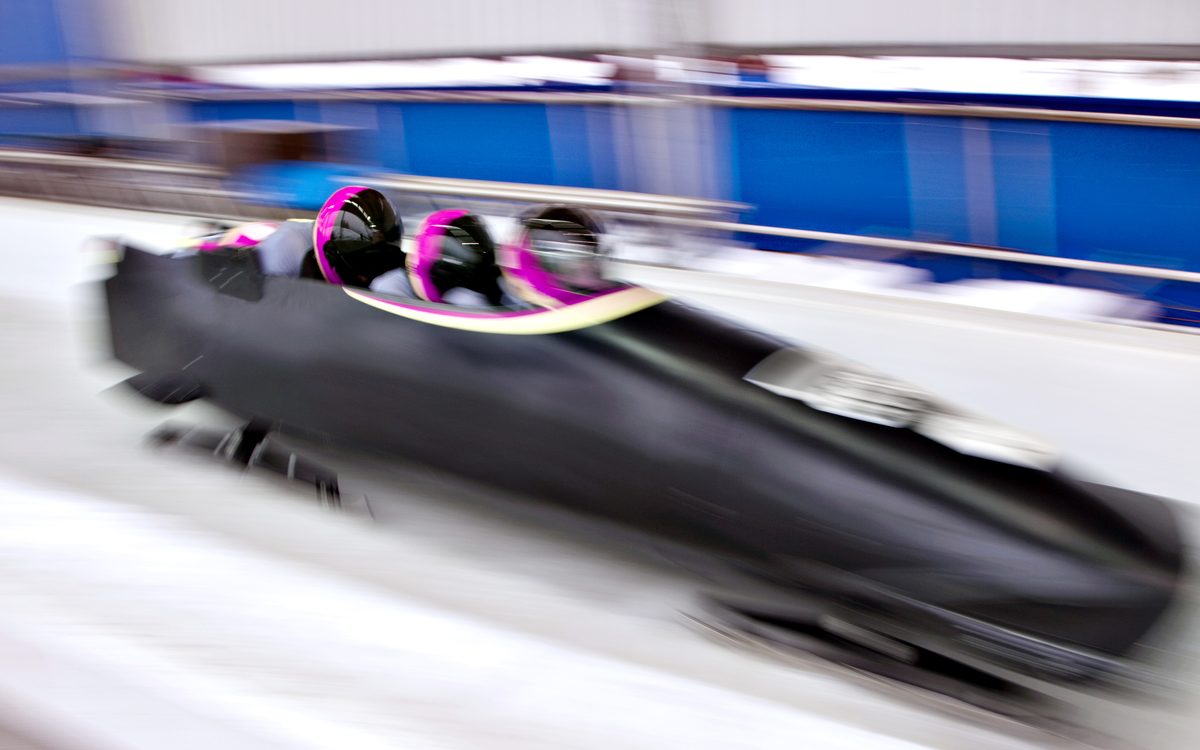
The pilot crouches behind the sled at the top of the track, the crew lined up beside it, and the start official gives the signal. Four, six, ten seconds of all-out pushing later, everyone is in and the sled drops into the first curve. Bobsleigh (called bobsled in North America) looks like a ride, but the first ten seconds are a sprint, and the rest is a steering job where tiny mistakes cost hundredths. This page explains the skills, the competition rules and how a beginner actually gets started.
Quick answer: Bobsleigh is won by the lowest total time over four runs (two a day, over two days at the Olympics). The crew pushes the sled, jumps in, and the pilot steers it down an iced track. Most athletes arrive from another sport: USA Bobsled and Skeleton finds them through combines that test sprinting, jumping and power. It is a high-speed sport with a real head-injury risk, so learn it through a federation program, not on your own. See a sports medicine doctor before starting if you have any health concern.
This is general information, not medical advice. For the sport as a whole see the bobsleigh hub; the related sliding sports are skeleton and luge.
How a bobsleigh competition works
According to NBC Olympics’ explainer, Olympic bobsleigh has four events: two-man, four-man, two-woman and the women’s monobob, where one athlete pushes and pilots the sled alone. Each competitor makes four runs, two on each of two days. Times are recorded electronically to the hundredth of a second, the four times are added up, and the lowest total wins. Tied sleds share the same placing.
The start order matters because ice changes during a race day. NBC reports that before the first run the top 10 pilots in the IBSF rankings choose their start positions, highest ranked first, and everyone else starts in ranking order. The second run mostly goes from slowest to fastest based on run one, the third starts with the fastest combined sleds, and the fourth reverses the order.
The rules that catch beginners out
- The whole crew must finish. A sled that flips or crashes still completes the run if all athletes cross the finish line together, and failing to finish any run means disqualification (NBC Olympics).
- Start on the signal. Teams must start within 60 seconds of the audio and visual signals from officials, and outside help during the start is prohibited (NBC Olympics).
- Sled and crew weight is capped. Reference summaries give different maximum weights for each sled type, and lighter crews may add ballast. We could not read the official numbers, so check the current IBSF rulebook before relying on any figure.
- Equipment is regulated. Reference summaries say sleds are built to IBSF specifications, so they are not an everyday purchase. Ask your club or federation what is supplied and what you bring.
The disciplines in plain words
- Two-man and two-woman: a pilot steers and a brakeman pushes, rides at the back and brakes after the finish.
- Four-man: the pilot, two push athletes and a brakeman. All four must coordinate the push.
- Women’s monobob: a single-seat sled. NBC notes the athlete pushes and pilots with no assistance, so it combines sprint power with driving.
NBC Olympics says sleds reach speeds up to 150 km/h (93 mph). At that speed head protection comes up again and again on our injury prevention page.
Basic skills
The push start
The first seconds decide a surprising amount. A 2026 narrative review of Olympic ice sports concluded that in bobsleigh, skeleton and luge performance is overwhelmingly determined by start velocity, with the first 15 to 65 metres contributing disproportionately to the result. A 2025 biomechanics study of 15 elite men found the push is dominated by the hip extensors early on, with more work at the ankle as speed rises. A 2026 analysis of 28 elite men found whole-body forward lean (angle of attack) was the strongest predictor of acceleration. In plain words: a low, driving, forward-leaning push from strong hips, much like the first steps of a sprint with a heavy load in front of you.
A 2016 video analysis of two-man teams at a world championship described a distinct pattern for each role: pilots started slightly behind the side bar and pushed in a semi-squat marching pattern, and brakemen used the board on the track as a foothold and contributed most to breaking the sled’s inertia. Coaches teach these patterns on the ice and in the gym; do not try to copy them from a video.
Loading, riding and driving
After the push, the crew loads into the sled together and stays compact so the pilot can steer. The pilot learns the line through each curve, and runs are won by smooth driving more than by big corrections. Brakemen and push athletes learn to hold a braced, tucked posture through the curves. We did not find peer-reviewed coaching manuals for the driving skills, so this page leaves the technical detail to certified coaches.
How a beginner starts
Bobsleigh is a talent-transfer sport. USA Bobsled and Skeleton says it is recruiting athletes who can bring their skills from other sports. Its 2026 recruitment series had 12 stops across the country, where athletes completed skills testing: a 40-yard sprint, a 5-10-5 pro agility shuttle, a kneeling power ball toss, a prowler push and a vertical jump. Those who performed well were invited to the training facilities in Lake Placid, New York, to push a sled on ice. The recruitment page also lists a 2026 virtual combine and a sign-up form for future events, and says advancement depends on measurable performance standards, competition results and coaching evaluation. Push athletes are judged on strength, speed and push times; pilots are also judged on driving skill and race results.
We found no age requirement on those pages. Check usabs.com/recruitment for current dates. Outside the United States, contact your national bobsleigh federation through the IBSF site. A sprint, jumping or power background (track and field, football, rugby, throws) is the usual route; see the track and field hub for that kind of training.
Levels, in order
- Talent identification: a combine or recruitment stop.
- Rookie or development stage: first sled pushes and runs, on ice, with federation coaches.
- National team and IBSF competition: World Cup and World Championships.
- Olympic Games: four bobsleigh events at Milano Cortina 2026. The programme for the next Games should be checked on olympics.com.
Official rules and where to read them
The authority for bobsleigh rules is the IBSF, and for US athletes USA Bobsled and Skeleton. Read the current IBSF international rules for sled specifications, weight limits and equipment before you buy or build anything. Para bobsleigh was left out of the Milano Cortina 2026 Paralympic programme according to an IPC statement reproduced on a national Paralympic committee site, while IBSF has run para sport events; check paralympic.org and the IBSF for the current position.
Bobsleigh rules and getting started FAQs
How many runs are there in Olympic bobsleigh?
Four, two on each of two days, according to NBC Olympics. The lowest combined time wins.
What happens if the crew falls out of the sled?
NBC Olympics says a run still counts if all athletes cross the finish line with the sled, and a crew that does not finish a run is disqualified. Crashes are one more reason crews train head protection.
Do I need to be a sprinter to start?
Sprinting speed and power are what USA Bobsled and Skeleton tests for push athletes: a 40-yard sprint, a vertical jump, a power ball toss and a prowler push at its 2026 events. Pilots are also judged on driving skill, which is learned on the ice.
Can kids do bobsleigh?
We did not find a youth or school pathway on the USA Bobsled and Skeleton recruitment pages and found no age requirement. Ask your national federation.
Where can I read the official rules?
Through the IBSF website and your national federation. This page gives plain-language summaries only.
Sources
- NBC Olympics: How does Olympic bobsled work?
- NBC Olympics: bobsled results, Milano Cortina 2026
- USA Bobsled and Skeleton: recruitment
- USA Bobsled and Skeleton: 2026 recruitment series
- International Bobsleigh and Skeleton Federation (IBSF)
- Olympic ice sports: a narrative review toward Milano-Cortina 2026, Scand J Med Sci Sports
- Biomechanics of the bobsleigh push phase, J Sports Sci 2025
- Biomechanical performance predictors of the bobsleigh push phase, J Sports Sci 2026
- Two-man bobsled push start analysis, J Hum Kinet 2016
General information for education only, not medical advice. It does not replace a sports medicine doctor, physical therapist, athletic trainer, licensed mental health professional or qualified coach. See our editorial policy for how we research and write.