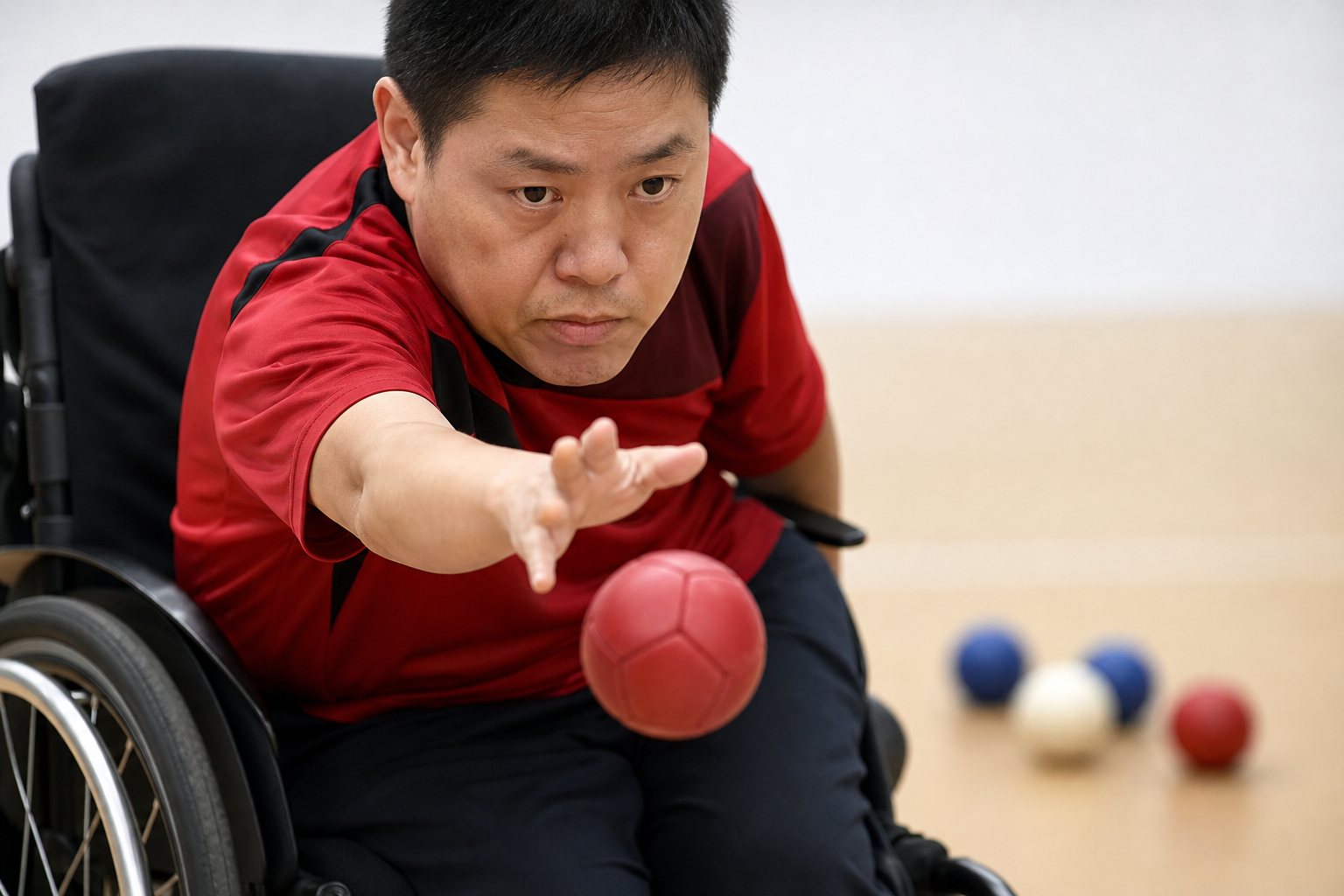
Picture a boccia player in the last end of a close match: the shoulders have been working for an hour, the timer is running, and the next ball has to leave the hand, foot or ramp in exactly the way it did a thousand times in practice. Boccia training is mostly about repeating that delivery with control, and about keeping the body and mind fresh enough to do it under pressure. This page explains what the sport asks of the body and gives a sensible way to organise a week, using only what the sources support.
Quick answer: Boccia is a low-impact, high-precision sport, so most training time goes to practising accurate delivery at different distances with a coach. Off-court work (strength, mobility, positioning and fitness) should be planned with a physical therapist, occupational therapist or coach who understands your impairment and class. Published research on boccia is small, so treat any specific number as a starting point to discuss, not a target. See a doctor or therapist if training causes pain that lingers, new numbness or weakness, or any sign your usual symptoms are changing.
Back to the boccia hub. New to the sport? Start with skills, rules and getting started. Safety ideas are on the injury prevention page.
What the sport asks of the body and mind
The USOPC says boccia tests coordination, accuracy, concentration and the ability to strategise. It is not a high-impact sport. The physical demands depend heavily on your class and impairment:
- BC1 and BC2 athletes throw or kick, so shoulder, arm, trunk and (for kickers) leg control matter.
- BC3 athletes use a ramp, so the demands shift toward head, arm or mouth control of the device, and toward clear communication with an assistant who may not look at the court.
- BC4 athletes throw with severe limits in all four limbs and poor trunk control, according to World Boccia, so seated stability is a large part of the task.
Sessions are also mentally long. A 2026 study of 11 Paralympic boccia players (six with cerebral palsy) tested whether mental fatigue reduced accuracy at 3, 6 and 9 metres and found no significant effect. That is a small group, so it does not mean fatigue never matters, but it is a useful reminder that practising at several distances is how researchers and coaches look at accuracy.
A sensible weekly shape
There is no published weekly programme for boccia that we could confirm, so the plan below is a general structure to adapt with a coach and therapist, not a prescription. The pattern is simple: skill work most days in short blocks, supporting strength and mobility on two or three days, and real rest in between.
- Skill sessions (most days): short, focused blocks with a goal for each (for example distance control to a marked spot, or jack placement). Many coaches track results so progress is visible.
- Match-style sessions (once or twice a week): play with the timer on, with the right assistant for your class, so game pace becomes normal.
- Strength and mobility (two to three short sessions): shoulders, arms, trunk and any muscles you use to deliver the ball, chosen by a clinician. See below.
- Fitness and general activity: light cardiovascular work that suits your body, if your medical team approves.
- Rest days: at least one or two days with no delivery practice. Our recovery page covers sleep and soreness.
Starting small
If you are new, begin with short delivery sessions and add time slowly, not all at once. Stop a session early if pain, spasms or tiredness change how you move. A shorter, good session beats a long, sloppy one.
Strength, trunk control and bones
Strength work is common advice in para sport, but the right exercises depend on the athlete. Two pieces of research are worth knowing:
- A 2026 cross-sectional study of 30 wheelchair para-athletes across six sports, including boccia, found boccia had the largest upper-limb asymmetry: about 30%, compared with 10% to 12% in wheelchair basketball, handball and powerlifting. The authors used 15% as the cut-off for asymmetry and said unilateral technical demands and impairment level shape muscle adaptation. It is a small exploratory study, but it suggests that working both sides, where your body allows, is worth discussing with a clinician.
- A small 2025 study of five world-class BC2 players with cerebral palsy found some had bone mineral density below the range expected for their age. Its authors say the findings are preliminary and suggested that monitoring and strength training may be worth discussing with a clinician.
A resistance band is a simple, low-cost way to do light arm and shoulder work at home, if a clinician has approved the exercises; see our gear page. Never start a new strength programme on your own if you have spasticity, a spinal cord injury or a condition that affects blood pressure.
Periodisation basics
Periodisation just means planning the year in phases so you are fresh for the events that matter. A simple version many sports use is:
1. Base phase: more volume, working on technique and general conditioning.
2. Pre-competition phase: more match-style practice, with timing and tactics.
3. Competition phase: fewer, sharper sessions and more rest between events.
4. Off-season: a lighter period to recover, review and repair equipment.
We found no boccia-specific research on how to split these phases, so ask your coach to build one around your calendar and health.
Technology, feedback and video
Researchers are testing new ways to give feedback. A 2026 longitudinal case series followed three national-level players with severe cerebral palsy over eight weeks and 694 throws, using an AI system to track movement. It reported that the system could pick up a 4.69% reduction in movement variability in the most severely impaired athlete even when scores did not change. This is a feasibility study with three athletes, not proof that the approach improves results. Everyday tools such as video of your delivery and a simple score sheet can show progress without any special system.
Training with an assistant or coach
For BC1 and BC3 athletes, the assistant is part of the team, and the two of you should practise together under the same rules you will use in competition. Agree on signals and on who adjusts what, and practise swaps in the chair position so nothing is a surprise on match day. Whoever helps should know the athlete’s health plan, including what to do for the warning signs described on our injury prevention page.
Boccia training FAQs
How many hours a week should I train?
We found no published guideline for boccia. A coach and therapist can set the amount based on your class, health and goals. Beginners often start with short, regular sessions and add time slowly.
Do I need to be strong to play boccia?
The USOPC describes boccia as a sport of coordination, accuracy, concentration and strategy, not power. Strength still helps with seated stability and endurance, and a clinician can suggest what is safe for you.
Should I train both sides of my body?
A 2026 study of 30 wheelchair para-athletes found boccia players had about 30% upper-limb asymmetry. That does not mean it is a problem for every athlete, but it is a good question to ask your physical therapist.
Can I train at home?
Yes, for some work. Light band exercises and delivery practice with a clinician-approved setup can be done at home, but court practice with the real equipment and timer is still important.
When should I stop and get checked?
Stop and see a doctor, physical therapist or athletic trainer if you have pain that lingers, new numbness or weakness, a sudden change in spasticity, or a pounding headache with sweating or flushing (see the autonomic dysreflexia note on our injury prevention page).
Sources
- USOPC: Sport overview, boccia
- World Boccia: about boccia
- Mental fatigue and accuracy in Paralympic boccia players (PubMed)
- Upper-limb asymmetry in wheelchair para-athletes (PubMed)
- Health-related parameters in world-class boccia players using DXA (PubMed)
- AI-based kinematic modeling in elite boccia athletes: case series (PubMed)
General information for education only, not medical advice. It does not replace a doctor, physical therapist, athletic trainer or classifier who knows you. See our editorial policy for how we write and source our pages.